
在麻醉患者中,使用触发式肌电图推进无框架立体定向导航,以在三叉神经痛的射频热消融(RFTA)过程中精确靶向卵圆孔。
Advancing frameless stereotactic navigation for precise targeting of the foramen ovale during radio-frequency thermal ablation (RFTA) for trigeminal neuralgia in anesthetized patients using triggered electromyography.
作者信息
Silverstein Justin W, Kashanian Alon, Huang Grace, Ellis Jason A
机构信息
Department of Neurology, Lenox Hill Hospital/Donald and Barbara Zucker School of Medicine at Hofstra/Northwell, New York, NY, USA.
Department of Clinical Neurophysiology, Neuro Protective Solutions, New York, NY, USA.
出版信息
Acta Neurochir (Wien). 2025 Jun 5;167(1):162. doi: 10.1007/s00701-025-06575-8.
PURPOSE
Radio-frequency thermal ablation (RFTA) is an effective method for treating trigeminal neuralgia (TN). However, challenges persist in locating the foramen ovale (FO) and awake surgery has its limitations. Here we evaluate a novel neurophysiologic technique using dynamic mapping with triggered electromyography (T-EMG) to guide surgeons in identifying the FO under general anesthesia.
METHODS
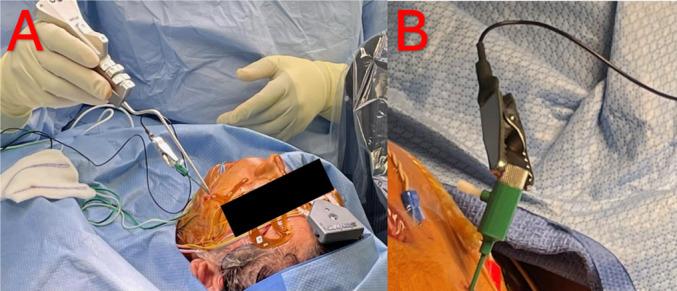
We prospectively collected clinical data from all patients undergoing RFTA for TN with dynamic T-EMG between September 2022 and December 2024. We subsequently reviewed the data within this database. We placed needle electrodes in the masseter muscle and converted a Tew trigeminal needle to a monopolar stimulator. With the assistance of stereotactic navigation and fluoroscopy, we guided the needle to the predicted border of the FO and delivered a current until a response was elicited by the masseter muscle. Based on this motor response, we made real-time trajectory adjustments to identify the FO and ablate the appropriate trigeminal branch.
RESULTS
Twenty-six consecutive patients underwent 27 RFTA procedures under general anesthesia. In 26 out of 27 procedures (96%), the FO was successfully identified. All patients awoke with intact mastication functionality. Sixteen patients (61.5%) had improvement in their facial pain, two (7.7%) had worse pain, and eight (30.8%) had no change in their pain at last follow-up. There were no major complications.
CONCLUSION
Dynamic mapping using T-EMG for identifying the V3 motor branch of the trigeminal nerve during RFTA procedures under general anesthesia is a reliable and practical method for identifying the FO. This technique demonstrates the potential to enhance the precision of RFTA and improve patient outcomes.
目的
射频热凝术(RFTA)是治疗三叉神经痛(TN)的有效方法。然而,在定位卵圆孔(FO)方面仍存在挑战,并且清醒手术也有其局限性。在此,我们评估一种使用触发式肌电图(T-EMG)动态映射的新型神经生理学技术,以指导外科医生在全身麻醉下识别FO。
方法
我们前瞻性收集了2022年9月至2024年12月期间所有接受动态T-EMG引导下RFTA治疗TN的患者的临床数据。随后我们回顾了该数据库中的数据。我们将针电极置于咬肌中,并将Tew三叉神经针转换为单极刺激器。在立体定向导航和荧光透视的辅助下,我们将针引导至FO的预测边界,并施加电流,直到咬肌引发反应。基于这种运动反应,我们进行实时轨迹调整以识别FO并消融适当的三叉神经分支。
结果
26例连续患者在全身麻醉下接受了27次RFTA手术。在27次手术中的26次(96%)中,成功识别出FO。所有患者醒来时咀嚼功能完好。在最后一次随访时,16例患者(61.5%)面部疼痛有所改善,2例(7.7%)疼痛加重,8例(30.8%)疼痛无变化。无重大并发症。
结论
在全身麻醉下的RFTA手术中,使用T-EMG动态映射识别三叉神经的V3运动分支是一种可靠且实用的识别FO的方法。该技术显示出提高RFTA精度并改善患者预后的潜力。


 Zotero 插件