Winter Jordan, Hynes Annette, Berthiaume Chris, Cain Kelsy, Armbrust E Virginia, Ribalet François
School of Oceanography, University of Washington, Seattle, Washington, United States of America.
PLoS One. 2025 Jun 5;20(6):e0324466. doi: 10.1371/journal.pone.0324466. eCollection 2025.
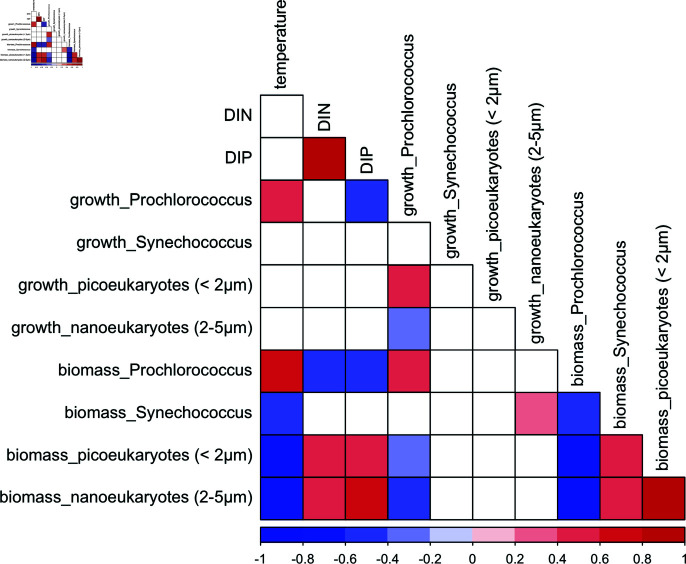
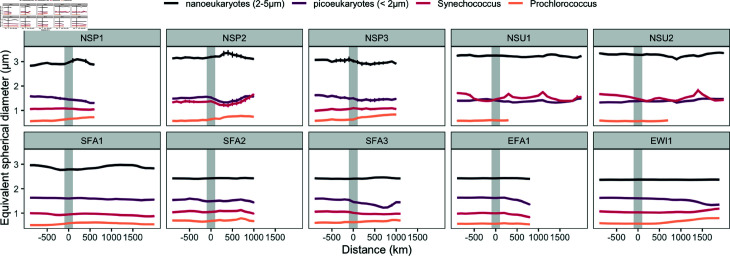
Phytoplankton communities play an important role in marine food webs and biogeochemical cycles. The transition zones between ocean gyres and surrounding waters represent critical ecological boundaries where environmental gradients drive significant shifts in phytoplankton community structure. This study investigates how nutrient availability and temperature shape the size distribution and composition of small phytoplankton (< 5 [Formula: see text]m) communities across the North Pacific Subtropical Gyre (NPSG) boundaries, testing several ecological hypotheses that explain phytoplankton size distribution patterns in relation to environmental variability. We used high-resolution, underway flow cytometry data collected during eight oceanographic cruises from 2016 to 2021 to assess changes in phytoplankton biomass and growth rate across the gyre boundaries. The cyanobacterium Prochlorococcus dominated within the gyre, with biomass ranging from 3.2 to 13.1 [Formula: see text]gC L-1, and its relative contribution to total phytoplankton biomass varied among cruises (31% to 81%, average 60 [Formula: see text] 16%). Prochlorococcus growth rates were significantly higher within the gyre (0.43 [Formula: see text] 0.18 per day) than outside the gyre (0.28 [Formula: see text] 0.16 per day) (one-sided t-test, p < 0.001). Northward in the gyre, Prochlorococcus biomass and growth rates declined. Some variations in biomass and growth rates were observed southward and eastward, with biomass ranging from 3 to 10 [Formula: see text]gC L-1 and growth rate ranging from 0.2 to 0.6 per day. Outside the NPSG, total phytoplankton biomass increased, with nanoeukaryotes becoming the predominant contributors (up to 71%, 9.1 [Formula: see text] 7.3 [Formula: see text]gC L-1). Picoeukaryote biomass also increased outside the gyre (up to 28 [Formula: see text] 12% of total biomass). Nutrient concentrations increased by nearly two orders of magnitude outside the NPSG, coinciding with the shift towards larger phytoplankton. The dominance of Prochlorococcus within the gyre emphasizes its adaptation to oligotrophic conditions, while the shift towards larger size classes outside the gyre likely reflects the relatively higher nutrient availability. The relatively low abundance of Synechococcus even in nutrient-rich regions suggest that that factors beyond nutrient availability, such as grazing, may influence its distribution. These findings have implications for understanding how phytoplankton communities will respond to future changes in oceanographic conditions, such as warming and altered nutrient regimes.
浮游植物群落在海洋食物网和生物地球化学循环中发挥着重要作用。大洋环流与周围水域之间的过渡带代表着关键的生态边界,环境梯度在这些边界处驱动浮游植物群落结构发生显著变化。本研究调查了营养物质可利用性和温度如何塑造北太平洋亚热带环流(NPSG)边界周围小型浮游植物(<5 [公式:见正文]m)群落的大小分布和组成,检验了几个解释浮游植物大小分布模式与环境变异性关系的生态学假设。我们使用了2016年至2021年八次海洋学航次期间收集的高分辨率、 underway流式细胞术数据,以评估整个环流边界浮游植物生物量和生长速率的变化。蓝细菌原绿球藻在环流内部占主导地位,生物量范围为3.2至13.1 [公式:见正文]gC L-1,其对浮游植物总生物量的相对贡献在各航次中有所不同(31%至81%,平均60 [公式:见正文] 16%)。原绿球藻在环流内部的生长速率(每天0.43 [公式:见正文] 0.18)显著高于环流外部(每天0.28 [公式:见正文] 0.16)(单侧t检验,p < 0.001)。在环流中向北,原绿球藻的生物量和生长速率下降。在向南和向东方向观察到生物量和生长速率有一些变化,生物量范围为3至10 [公式:见正文]gC L-1,生长速率范围为每天0.2至0.6。在NPSG外部,浮游植物总生物量增加,微型真核生物成为主要贡献者(高达71%,9.1 [公式:见正文] 7.3 [公式:见正文]gC L-1)。微微型真核生物的生物量在环流外部也有所增加(高达总生物量的28 [公式:见正文] 12%)。NPSG外部的营养物质浓度增加了近两个数量级,这与向更大浮游植物的转变相吻合。原绿球藻在环流内部的主导地位强调了其对贫营养条件的适应性,而环流外部向更大尺寸类别的转变可能反映了相对较高的营养物质可利用性。即使在营养丰富的区域,聚球藻的丰度相对较低,这表明除了营养物质可利用性之外的因素,如捕食,可能会影响其分布。这些发现对于理解浮游植物群落将如何应对未来海洋学条件的变化,如变暖和营养状况改变,具有重要意义。