Follett Christopher L, Dutkiewicz Stephanie, Forget Gael, Cael B B, Follows Michael J
Department of Earth, Atmospheric and Planetary Sciences Massachusetts Institute of Technology Cambridge Massachusetts USA.
National Oceanography Centre Southampton UK.
Limnol Oceanogr. 2021 Jun;66(6):2442-2454. doi: 10.1002/lno.11763. Epub 2021 May 5.
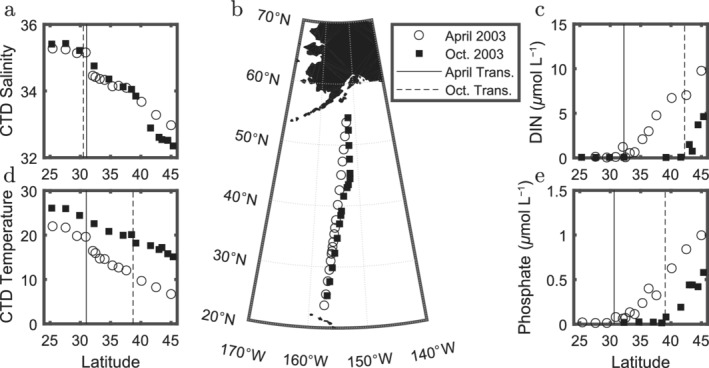
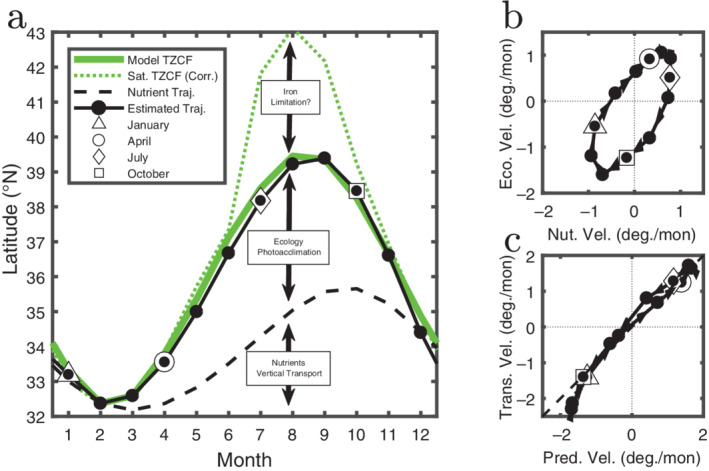
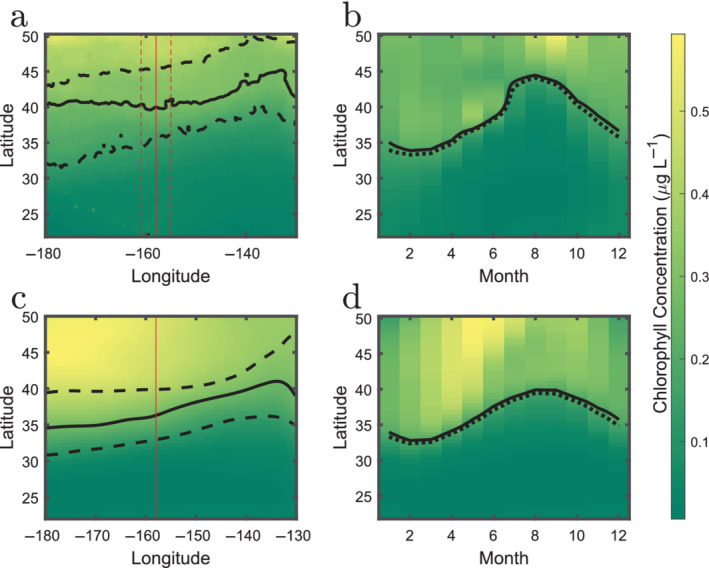
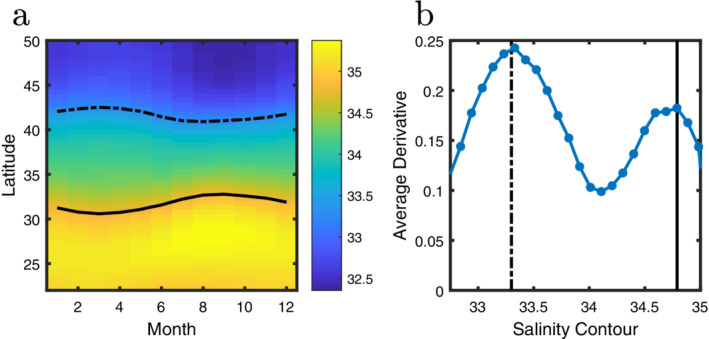
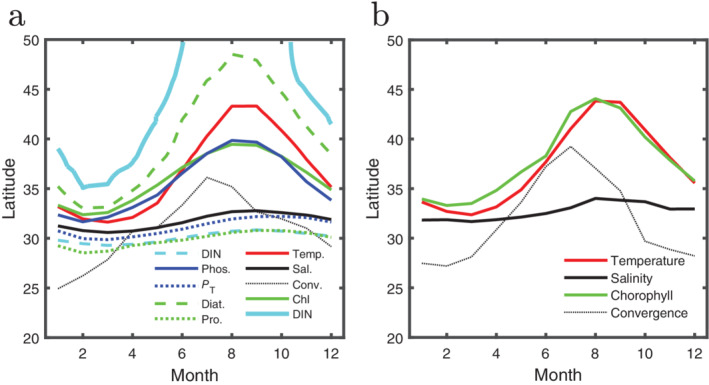
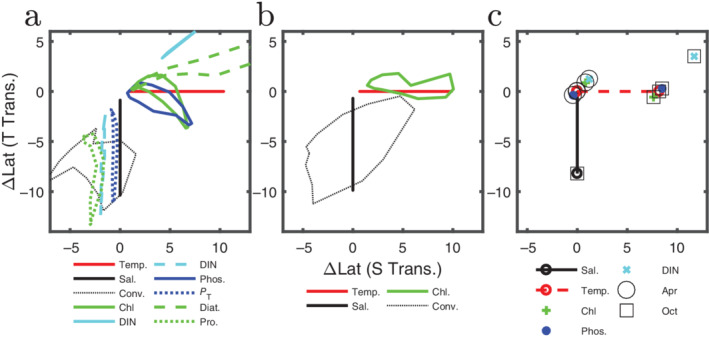
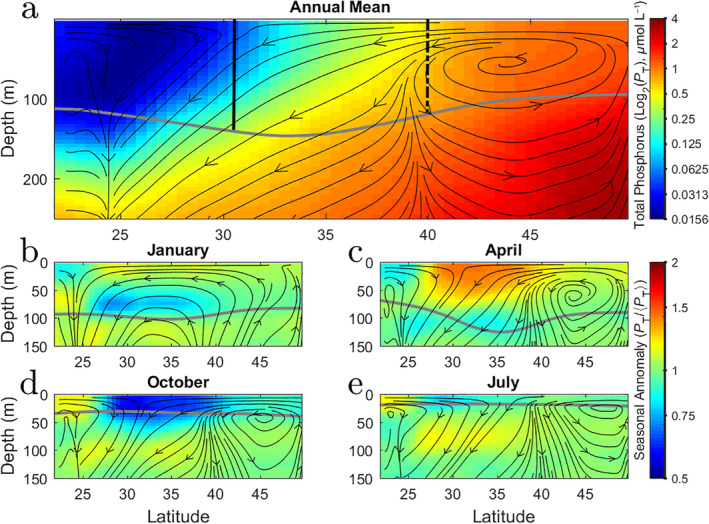
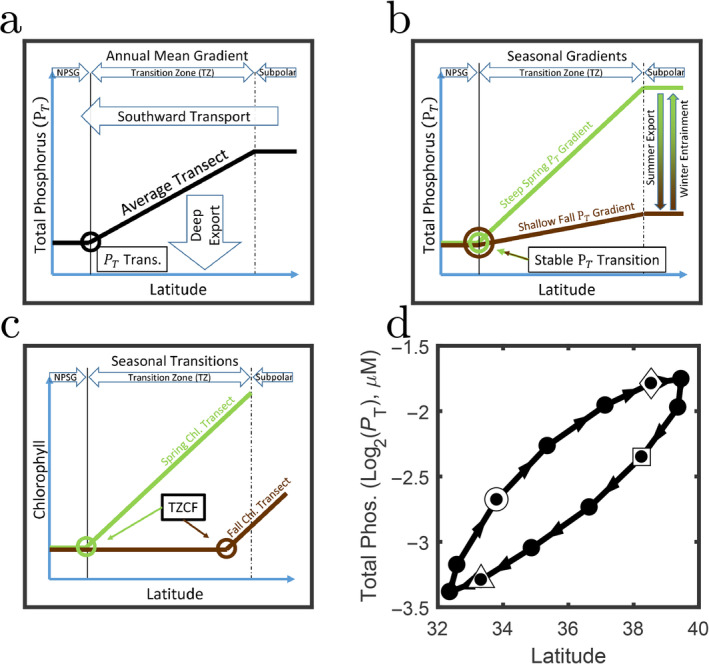
In the North Pacific Ocean, nutrient rich surface waters flow south from the subpolar gyre through a transitional region and into the subtropics. Along the way, nutrients are used, recycled, and exported, leading to lower biomass and a commensurate change in ecosystem structure moving southward. We focus on the region between the two gyres (the Transition Zone) using a coupled biophysical ocean model, remote sensing, floats, and cruise data to explore the nature of the physical, biogeochemical, and ecological fields in this region. Nonlinear interactions between biological processes and the meridional gradient in nutrient supply lead to sharp shifts across this zone. These transitions between a southern region with more uniform biological and biogeochemical properties and steep meridional gradients to the north are diagnosed from extrema in the first derivative of the properties with latitude. Some transitions like that for chlorophyll (the transition zone chlorophyll front [TZCF]) experience large seasonal excursions while the location of the transitions in other properties moves very little. The seasonal shifts are not caused by changes in the horizontal flow field, but rather by the interaction of seasonal, depth related, forcing with the mean latitudinal gradients. Focusing on the TZCF as a case study, we express its phase velocity in terms of vertical nutrient flux and internal ecosystem processes, demonstrating their nearly equal influence on its motion. This framework of propagating biogeochemical transitions can be systematically expanded to better understand the processes that structure ecosystems and biogeochemistry in the North Pacific and beyond.
在北太平洋,营养丰富的表层海水从副极地环流向南流经一个过渡区域,进入亚热带。在此过程中,营养物质被利用、循环和输出,导致生物量降低,生态系统结构也随之向南发生相应变化。我们利用一个生物物理耦合海洋模型、遥感、浮标和航次数据,聚焦于两个环流之间的区域(过渡区),以探究该区域物理、生物地球化学和生态场的性质。生物过程与营养物质供应的经向梯度之间的非线性相互作用导致该区域出现急剧变化。从这些性质随纬度的一阶导数极值中,可以诊断出具有更均匀生物和生物地球化学性质的南部区域与北部陡峭经向梯度之间的这些转变。一些转变,如叶绿素的转变(过渡区叶绿素锋 [TZCF])经历较大的季节性偏移,而其他性质转变的位置变化很小。季节性变化不是由水平流场的变化引起的,而是由季节性、与深度相关的强迫作用与平均纬度梯度的相互作用导致的。以 TZCF 为例进行研究,我们根据垂直营养通量和内部生态系统过程来表示其相速度,证明它们对其运动的影响几乎相等。这种生物地球化学转变传播的框架可以系统地扩展,以更好地理解构建北太平洋及其他地区生态系统和生物地球化学的过程。