Lin Bingqin, Zheng Nana, Li Biao, Wang Wei, Luo Tong, Fan Yimei, Chan Ngan Yin, Rao Shitao, Yang Ying, Feng Hongliang, Zhang Jihui
Department of Neurology, The First Affiliated Hospital of Jinan University, Guangzhou, China.
Center for Sleep and Circadian Medicine, The Affiliated Brain Hospital, Guangzhou Medical University, Guangzhou, China.
Transl Psychiatry. 2025 Jun 5;15(1):191. doi: 10.1038/s41398-025-03405-4.
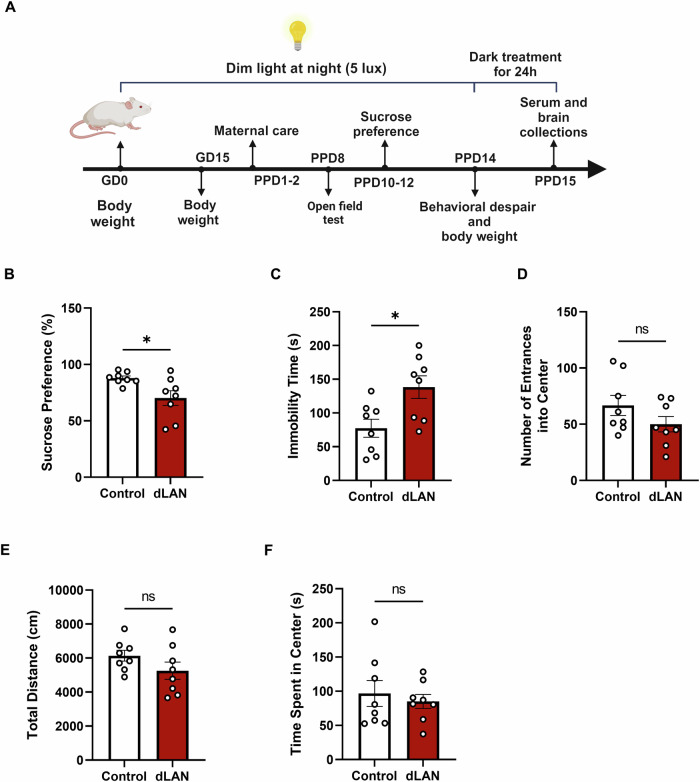
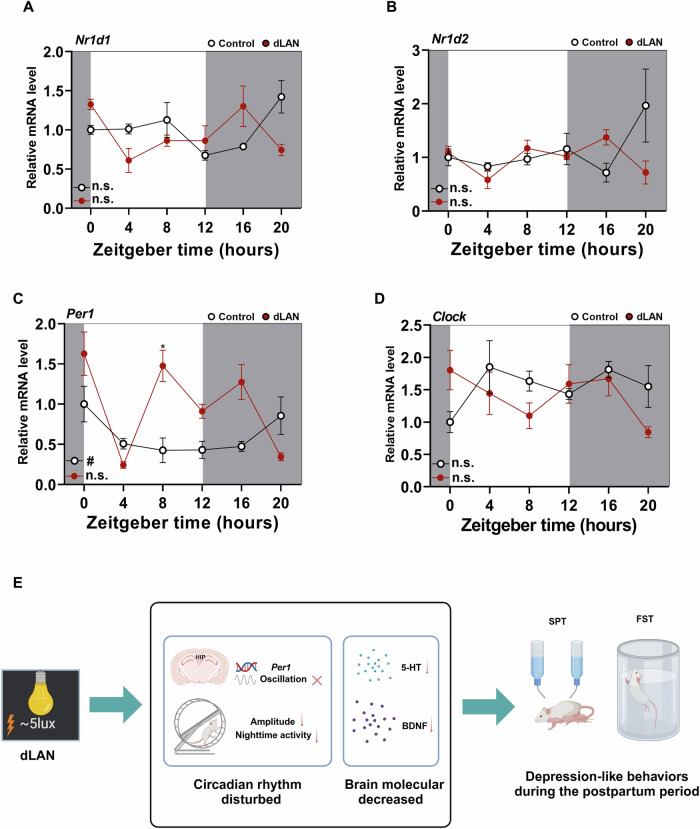
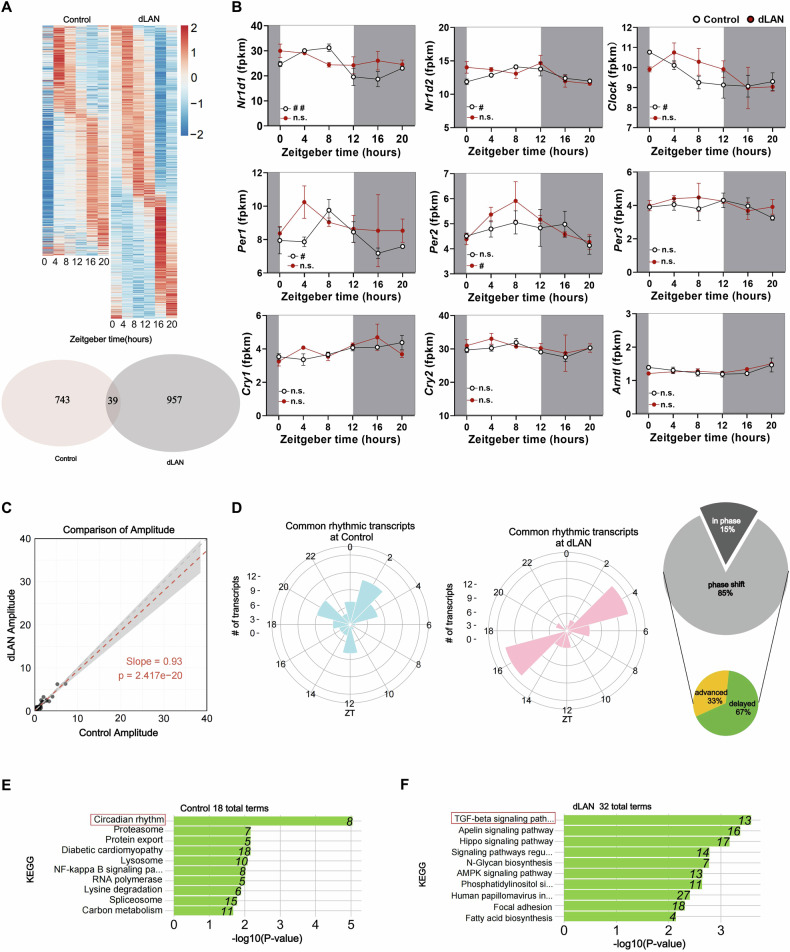
Growing evidence suggests that dim light at night (dLAN) may disrupt circadian rhythms and provoke symptoms of anxiety and depression. Due to the inconvenience of pregnancy and caring for infants, there is a high prevalence of dLAN exposure among pregnant and postpartum women. However, the role and circadian mechanism of dLAN on depression, and anxiety during the postpartum period remain unclear. Pregnant mice were housed in either a light-dark cycle (LD; 12 h of 200 lux:12 h of 0 lux) or a light-dLAN cycle (dLAN; 12 h of 200 lux:12 h of 5 lux) during the gestational and postpartum periods. Depression- and anxiety-related symptoms were assessed by the open field test, sucrose preference test, and forced swim test. Hippocampal transcript profiles were examined using multi-timepoint transcriptome analysis to assess the effects of dLAN exposure. Our findings showed that dLAN significantly increased depression-like behaviors, such as decreased sugar preference and increased immobility time, and decreased levels of brain serotonin (5-HT) and brain-derived neurotrophic factor (BDNF) during the postpartum period. In addition, dLAN reduced the amplitude of circadian rest-activity behaviors and nighttime activity levels, and these disruptions were significantly related to depression-like behaviors and low levels of 5-HT. Moreover, dLAN disrupted the expressions of hippocampal circadian genes particularly Per1 in postpartum mice. These findings reveal that dLAN induces depression-like behaviors in postpartum mice, with disruptions in circadian rest-activity rhythms and rhythmic gene expression likely mediating the adverse effects of dLAN on these behaviors.
越来越多的证据表明,夜间昏暗灯光(dLAN)可能会扰乱昼夜节律,并引发焦虑和抑郁症状。由于怀孕和照顾婴儿带来的不便,孕妇和产后女性中dLAN暴露的患病率很高。然而,dLAN在产后抑郁和焦虑中的作用及昼夜节律机制仍不清楚。在妊娠期和产后期间,将怀孕小鼠置于明暗循环(LD;200勒克斯光照12小时:0勒克斯黑暗12小时)或dLAN循环(dLAN;200勒克斯光照12小时:5勒克斯黑暗12小时)环境中。通过旷场试验、蔗糖偏好试验和强迫游泳试验评估与抑郁和焦虑相关的症状。使用多时间点转录组分析检查海马转录谱,以评估dLAN暴露的影响。我们的研究结果表明,dLAN显著增加了产后抑郁样行为,如蔗糖偏好降低和不动时间增加,同时降低了大脑血清素(5-HT)和脑源性神经营养因子(BDNF)的水平。此外,dLAN降低了昼夜休息-活动行为的幅度和夜间活动水平,这些干扰与抑郁样行为和低水平的5-HT显著相关。此外,dLAN扰乱了产后小鼠海马昼夜节律基因的表达,尤其是Per1。这些发现揭示了dLAN在产后小鼠中诱发抑郁样行为,昼夜休息-活动节律和节律性基因表达的破坏可能介导了dLAN对这些行为的不利影响。