Centre for Integrative Medicine, Department of Physical Medicine and Rehabilitation, Ghent University Hospital, Corneel Heymanslaan 10, Ghent, B-9000, Belgium.
Faculty of Medicine and Health Sciences, Ghent University, Corneel Heymanslaan 10, Ghent, B-9000, Belgium.
BMC Pregnancy Childbirth. 2024 Aug 12;24(1):529. doi: 10.1186/s12884-024-06671-0.
Poor subjective sleep quality, depressive symptoms and fatigue occur frequently in postpartum. However, the dynamics of their respective associations from prepartum throughout the maternity period in function of baby feeding method have not been fully elucidated.
Prospective, longitudinal study using validated questionnaires probing for sleep quality, insomnia, fatigue and depressive symptoms at 35-37 weeks of gestation and at 2, 8 and 12 weeks postpartum in the obstetric departments of two Flemish hospitals. Somers'd ordinal correlation was used for correlations between the results of questionnaires (ratio variables) and the feeding method variable (an ordinal variable); T tests (normal data) or Mann Whitney (non normal data) tests for equality of means; ordinal regression ('Proportional odds model') to investigate the predictive value of parameters at one moment on the feeding method choice at a later moment; logistic regression to investigate the predictive value of parameters on later change of feeding method.
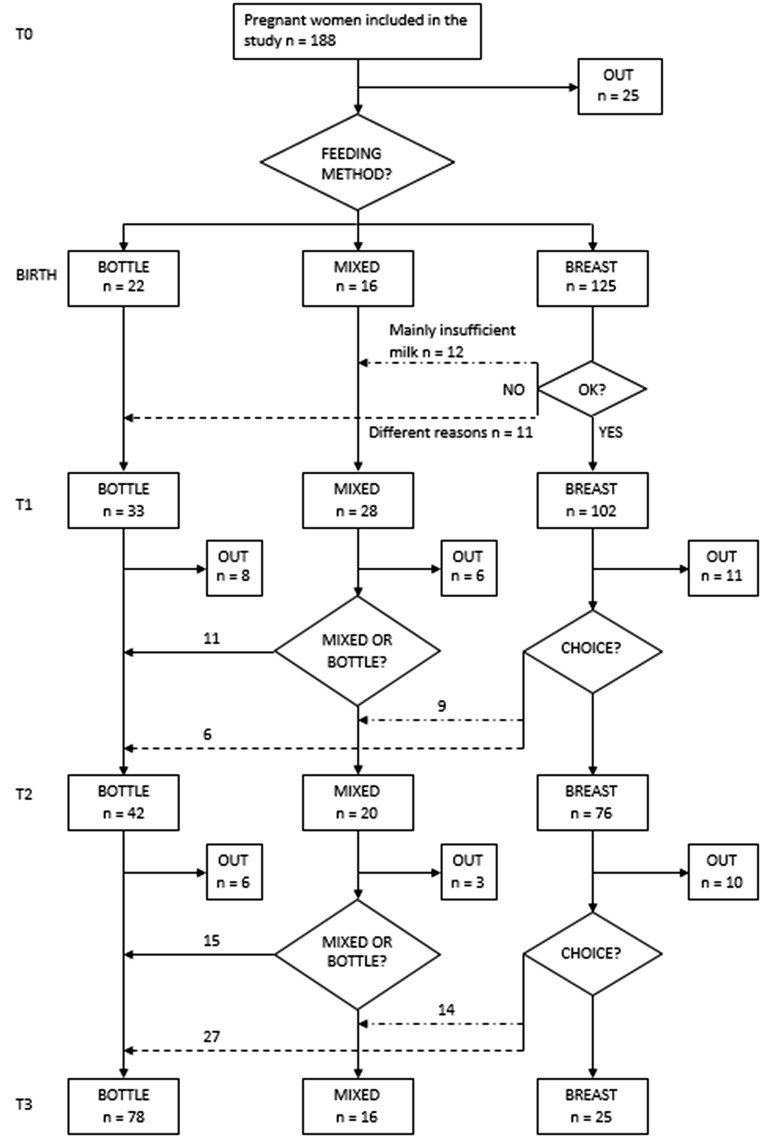
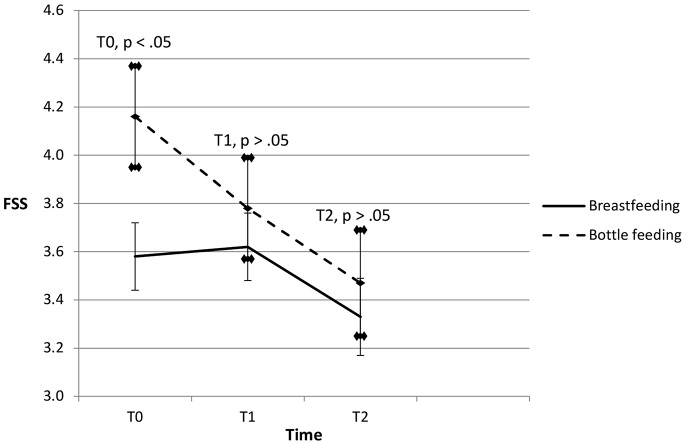
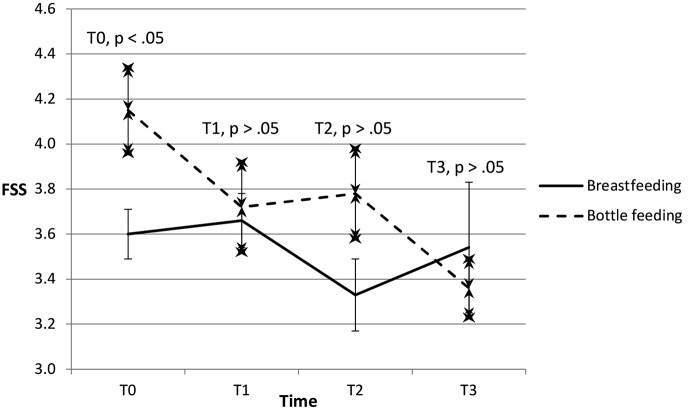
188 women indicating a choice for either bottle or breastfeeding in prepartum (27-35 weeks' gestation) were included. Higher fatigue assessed through the Fatigue Severity Scale within late pregnancy was moderately associated with primary bottle feeding choice. Fatigue decreased at early and late postpartum in bottle feeding (-0.38 ± 1.04; p = .110 and - 0.31 ± 1.01; p = .642 respectively), but remained unchanged from late pregnancy through early and late postpartum in breastfeeding (0.04 ± 1.21; p = .110 and - 0.27 ± 0.96; p = .642 respectively), resulting in similar fatigue in both feeding methods in early through late postpartum. There were no differences in sleep quality or insomnia symptoms at all time points. Presence of postpartum depressive symptoms were associated with early switching to bottle feeding (Somers' d correlation 0.11 (p = .021).
Fatigue and depressive symptoms are inversely associated with breastfeeding initiation or maintenance and influence feeding method dynamics.
产后常出现主观睡眠质量差、抑郁症状和疲劳。然而,从产前到整个产褥期,不同喂养方式下这些症状的关联动态尚未完全阐明。
前瞻性纵向研究,在两家佛兰芒医院的妇产科,使用经过验证的问卷,在妊娠 35-37 周、产后 2、8 和 12 周时,分别调查睡眠质量、失眠、疲劳和抑郁症状。Somers 的有序相关用于问卷结果(比值变量)和喂养方式变量(有序变量)之间的相关性;T 检验(正态数据)或 Mann Whitney 检验(非正态数据)用于均值相等性检验;有序回归(“比例优势模型”)用于研究某一时刻的参数对随后喂养方式选择的预测价值;逻辑回归用于研究参数对随后喂养方式变化的预测价值。
188 名在产前(妊娠 27-35 周)选择奶瓶或母乳喂养的女性被纳入研究。妊娠晚期疲劳严重程度评估通过疲劳严重程度量表(Fatigue Severity Scale)进行,与首选奶瓶喂养选择中度相关。奶瓶喂养的产妇在产后早期和晚期疲劳程度下降(-0.38±1.04;p=0.110 和-0.31±1.01;p=0.642),但在母乳喂养中,从妊娠晚期到产后早期和晚期疲劳程度保持不变(0.04±1.21;p=0.110 和-0.27±0.96;p=0.642),导致产后早期和晚期两种喂养方式的疲劳程度相似。在所有时间点,睡眠质量或失眠症状均无差异。产后抑郁症状的存在与早期改用奶瓶喂养相关(Somers' d 相关 0.11(p=0.021)。
疲劳和抑郁症状与母乳喂养的开始或维持呈负相关,并影响喂养方式的动态变化。