Hasegawa Daisuke, Hori Amane, Okamura Yukiko, Suijo Kenichi, Mizuno Masaki, Hotta Norio
College of Life and Health Sciences, Chubu University, Kasugai, Aichi, Japan.
Japan Society for the Promotion of Science, Chiyoda-ku, Tokyo, Japan.
Physiol Rep. 2025 Jun;13(11):e70365. doi: 10.14814/phy2.70365.
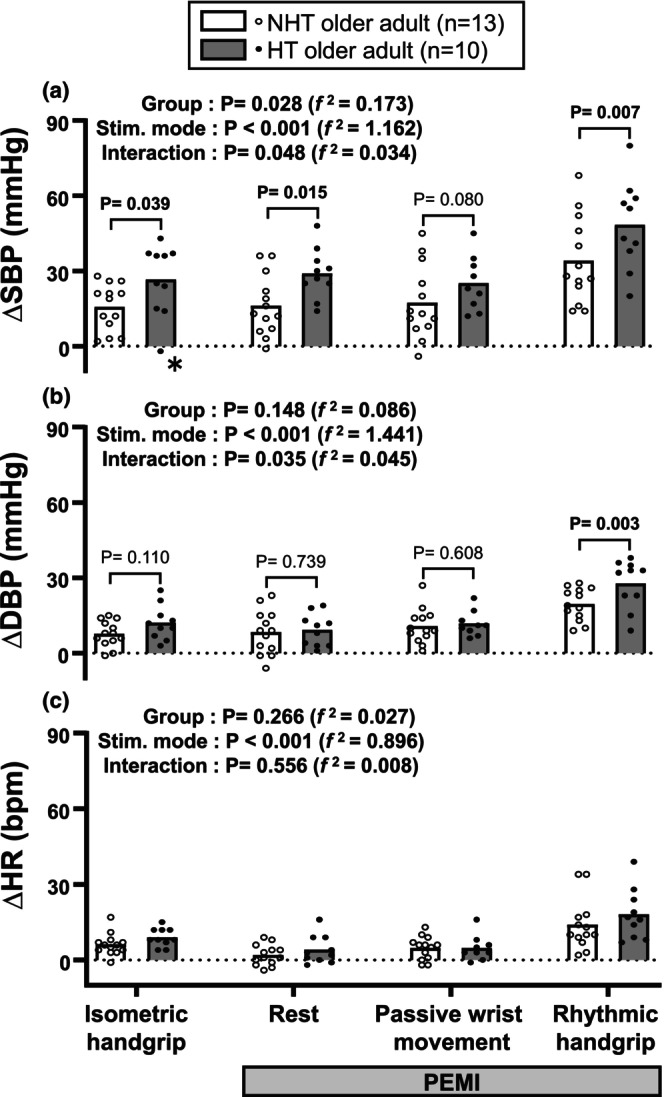
Hypertension is known to augment exercise blood pressure (BP). Aging also potentiates BP response to ischemic dynamic exercise. However, whether hypertension further enhances aging-induced augmented BP response to ischemic dynamic exercise has not yet been investigated. Therefore, we aimed to test the hypothesis that hypertension exacerbates the pressor response to ischemic dynamic exercise in older adults. The participants were classified into the following two groups: nonhypertensive (NHT, n = 13, 60-80 years) and hypertensive (HT, n = 10, 61-78 years). We compared the BP responses to very light-intensity rhythmic handgrip exercise during post-isometric handgrip exercise muscle ischemia (PEMI) simulated as ischemic dynamic exercise between the HT and NHT groups. Both systolic BP (SBP) and diastolic BP (DBP) responses to the rhythmic handgrip exercise during PEMI in the HT group (∆SBP: 48 ± 18 mmHg and ∆DBP: 28 ± 10 mmHg, p = 0.007) were significantly higher than those in the NHT group (∆SBP: 34 ± 17 mmHg and ∆DBP: 20 ± 6 mmHg, p = 0.003). Importantly, resting SBP was a significant independent determinant of DBP response to the rhythmic handgrip exercise during PEMI (β = 0.412, p = 0.047). These results suggest that hypertension further elevates the heightened BP response to ischemic dynamic exercise in older adults.
已知高血压会增加运动血压(BP)。衰老也会增强血压对缺血性动态运动的反应。然而,高血压是否会进一步增强衰老引起的对缺血性动态运动的血压反应尚未得到研究。因此,我们旨在检验高血压会加剧老年人对缺血性动态运动的升压反应这一假设。参与者被分为以下两组:非高血压组(NHT,n = 13,60 - 80岁)和高血压组(HT,n = 10,61 - 78岁)。我们比较了HT组和NHT组在模拟缺血性动态运动的等长握力运动后肌肉缺血(PEMI)期间对极轻度有节奏握力运动的血压反应。HT组在PEMI期间对有节奏握力运动的收缩压(SBP)和舒张压(DBP)反应(∆SBP:48±18 mmHg和∆DBP:28±10 mmHg,p = 0.007)均显著高于NHT组(∆SBP:34±17 mmHg和∆DBP:20±6 mmHg,p = 0.003)。重要的是,静息SBP是PEMI期间对有节奏握力运动的DBP反应的显著独立决定因素(β = 0.412,p = 0.047)。这些结果表明,高血压会进一步升高老年人对缺血性动态运动增强的血压反应。