Gagnon Marc-André, Dong Miaoran
School of Public Policy and Administration Carleton University Ottawa Ontario Canada.
School of Journalism and Communication Carleton University Ottawa Ontario Canada.
Cochrane Evid Synth Methods. 2023 Apr 27;1(3):e12011. doi: 10.1002/cesm.12011. eCollection 2023 May.
To identify all scientific papers that used internal industry documents in the pharmaceutical sector and analyze what and how the scientific literature learned about corporate influence in the pharmaceutical sector through these internal documents.
Scoping review.
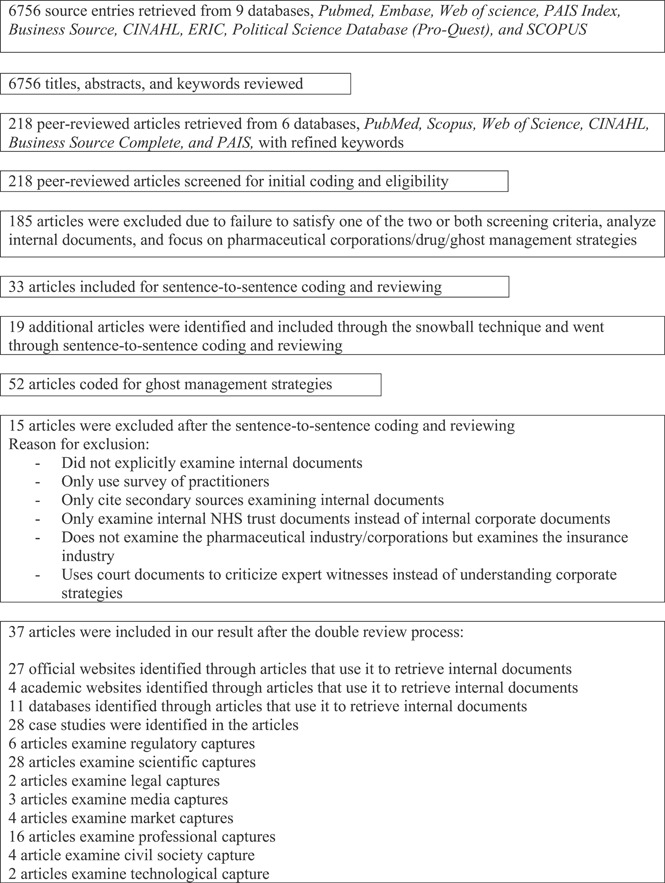
Using different series of keywords, we searched six databases, PubMed, Scopus, Web of Science, CINAHL, Business Source Complete, and PAIS, for peer-reviewed journal articles analyzing pharmaceutical corporations' internal documents. We completed the scoping review using a purposive snowball sampling method to extract relevant case studies and peer-reviewed journal articles from relevant articles' reference lists when our search keywords failed to capture them. To analyze the content of the literature and better categorize the types of corporate strategies at play in the pharmaceutical sector, we used categories of ghost-management previously developed in the literature.
We identified 37 peer-reviewed papers in the final results. All the articles included in the final results are published in English. Almost all articles obtained most of their internal document data through legal proceedings. All 37 articles unveil dynamic ghost-management strategies that pharmaceutical corporations employ to safeguard their corporate interest. The strategies identified relate to scientific capture ( = 28), professional capture ( = 16), regulatory capture ( = 6), media capture ( = 3), market capture ( = 4), technological capture ( = 2), civil society capture ( = 4), and others ( = 2).
The scientific literature using internal documents confirmed widespread corporate influence in the pharmaceutical sector. While the academic literature used internal documents related to only a handful of products, our research results, based on ghost-management categories, demonstrate the extent of corporate influence in every interstice of pharmaceutical markets, particularly in clinical research and clinical practice. It also allows us to better refine the conceptual categories of ghost-management to better map corporate influence and conflict of interest.
识别所有使用制药行业内部行业文件的科学论文,并分析科学文献通过这些内部文件了解到制药行业企业影响的内容及方式。
范围综述。
我们使用不同系列的关键词,在六个数据库(PubMed、Scopus、Web of Science、CINAHL、Business Source Complete和PAIS)中搜索分析制药公司内部文件的同行评议期刊文章。当我们的搜索关键词未能涵盖相关案例研究和同行评议期刊文章时,我们采用目的滚雪球抽样方法,从相关文章的参考文献列表中提取这些内容,以完成范围综述。为了分析文献内容并更好地对制药行业中发挥作用的企业策略类型进行分类,我们使用了文献中先前开发的幽灵管理类别。
我们在最终结果中识别出37篇同行评议论文。最终结果中纳入的所有文章均以英文发表。几乎所有文章都是通过法律程序获取其大部分内部文件数据的。所有37篇文章都揭示了制药公司为维护其企业利益而采用的动态幽灵管理策略。所确定的策略涉及科学俘获(=28)、专业俘获(=16)、监管俘获(=6)、媒体俘获(=3)、市场俘获(=4)、技术俘获(=2)、民间社会俘获(=4)以及其他(=2)。
使用内部文件的科学文献证实了制药行业中广泛存在的企业影响。虽然学术文献使用的内部文件仅涉及少数产品,但我们基于幽灵管理类别的研究结果表明,企业影响在制药市场的各个角落都存在,尤其是在临床研究和临床实践中。这也使我们能够更好地完善幽灵管理的概念类别,以更好地描绘企业影响和利益冲突。