de Souza Luís Ronan Marquez Ferreira, Barbisan Cinthia Callegari, Torres Cecília Vidal de Souza, Canedo Isadora Balderama
Universidade Federal do Triângulo Mineiro (UFTM), Uberaba, MG, Brazil.
Beneficência Portuguesa de São Paulo (BP), São Paulo, SP, Brazil.
Radiol Bras. 2025 May 21;58:e20240096. doi: 10.1590/0100-3984.2024.0096-en. eCollection 2025 Jan-Dec.
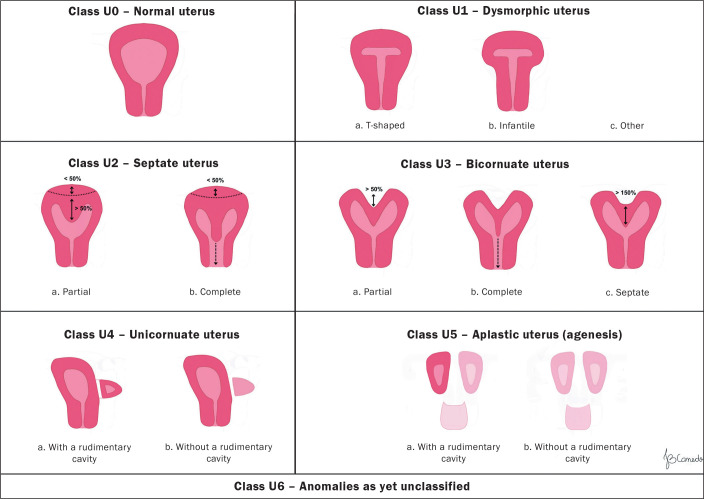
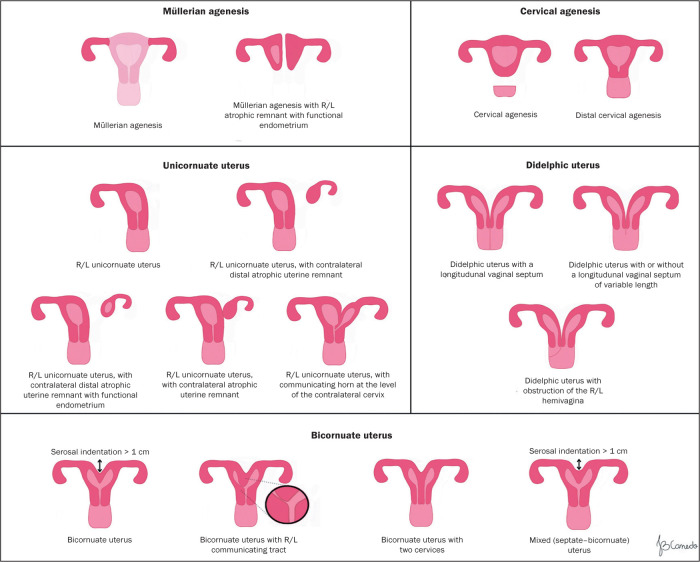
Müllerian anomalies represent a spectrum of congenital malformations of the female reproductive tract. Over the decades, various classifications have been developed to categorize these anomalies. Based on a classification proposed by Kaufmann and Jarcho in 1946, the classification devised by the American Fertility Society in 1988 was considered simple and practical; although it faced criticism for its subjectivity and limitations in classifying complex anomalies, it was widely adopted. In 2013, the European Society of Human Reproduction and Embryology and the European Society for Gynaecological Endoscopy introduced a more detailed classification, which, albeit more complex and with a risk of overdiagnosis, also included cervical and vaginal anomalies. In 2021, the American Society for Reproductive Medicine updated the classification with the aim of simplifying and improving diagnostic accuracy, expanding the categories, and defining more objective criteria. This new classification seeks to facilitate communication among professionals and enhance clinical management, emphasizing the importance of continuous updates to improve reproductive outcomes and the quality of life for patients affected by these anomalies. This article aims to discuss the strengths and limitations of each of these classifications, offering a critical analysis of their impact on the diagnosis and treatment of müllerian anomalies. It also seeks to highlight aspects that may be refined in future revisions to achieve greater diagnostic precision and clinical applicability.
苗勒管异常代表了女性生殖道的一系列先天性畸形。几十年来,人们开发了各种分类方法来对这些异常进行分类。基于考夫曼和贾尔乔在1946年提出的一种分类方法,美国生育协会在1988年设计的分类方法被认为简单实用;尽管它因主观性以及在对复杂异常进行分类时存在局限性而受到批评,但仍被广泛采用。2013年,欧洲人类生殖与胚胎学会和欧洲妇科内镜学会引入了一种更详细的分类方法,该方法虽然更复杂且存在过度诊断的风险,但也包括了宫颈和阴道异常。2021年,美国生殖医学学会更新了分类方法,旨在简化并提高诊断准确性、扩大分类范畴以及定义更客观的标准。这种新的分类方法旨在促进专业人员之间的沟通并加强临床管理,强调持续更新对于改善受这些异常影响患者的生殖结局和生活质量的重要性。本文旨在讨论这些分类方法各自的优点和局限性,对它们在苗勒管异常诊断和治疗方面的影响进行批判性分析。它还旨在突出未来修订中可能需要完善的方面,以实现更高的诊断精度和临床适用性。