Tsoi Shu Ki, Choo Sharon, Lee Lai-Yang, Monagle Paul, Hearps Stephen, Karlaftis Vasiliki, Attard Chantal, Burgess Janet, Tran Chuong, Bazeley Sheree, Challen Natalie, Steer Andrew C, Osowicki Joshua
Department of Infectious Diseases, The Royal Children's Hospital Melbourne, Parkville, Victoria, Australia.
Tropical Diseases Research Group, Murdoch Children's Research Institute, Melbourne, Victoria, Australia.
J Pediatric Infect Dis Soc. 2025 Aug 7;14(7). doi: 10.1093/jpids/piaf054.
Diagnostic criteria for acute rheumatic fever and post-streptococcal glomerulonephritis, the 2 major autoimmune complications of Streptococcus pyogenes infection, include serological evidence of preceding infection. The S. pyogenes proteins, namely streptolysin O and deoxyribonuclease B, are the most widely used targets for clinical streptococcal serology. We aimed to establish age-based reference intervals (RIs) for healthy children in Victoria, Australia, to guide interpretation of anti-streptolysin O (ASO) levels measured by turbidimetry and nephelometry, and anti-deoxyribonuclease B (ADB) levels by nephelometry.
Serum samples were collected from healthy pediatric cohorts aged 32-week gestation to <18 years at 4 hospitals in Melbourne, Australia, between February 2015 and October 2018. Anti-streptolysin O levels were measured in 2 cohorts: by turbidimetry in cohort 1 and by nephelometry in cohort 2. Anti-deoxyribonuclease B levels were measured by nephelometry in cohort 2. Reference intervals (RIs) for each age group were generated, including 80% upper limit of normal (ULN) cut-offs.
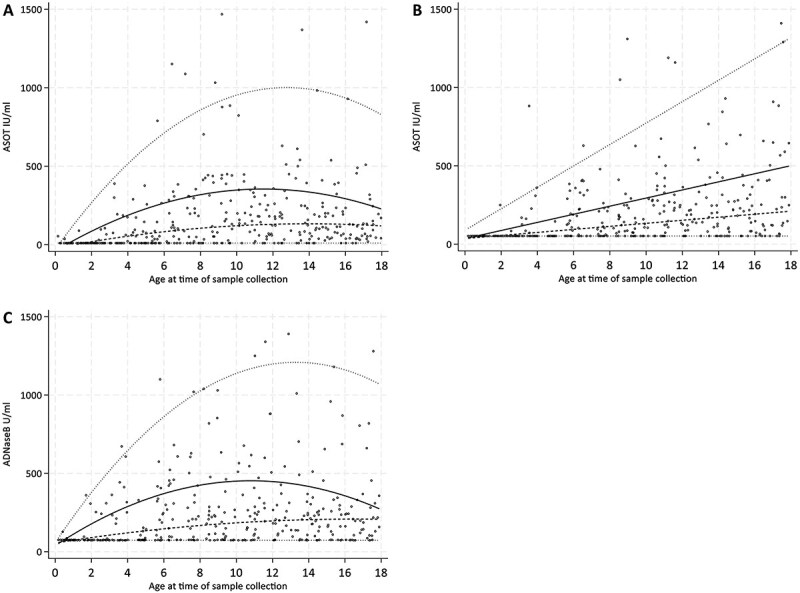
Anti-streptolysin O levels were measured by turbidimetry for 359 samples from cohort 1, and ASO and ADB levels were measured by nephelometry for 360 samples from cohort 2. Anti-streptolysin O levels, measured by turbidimetry, were highest in children 5-9 years of age (80% ULN 346 IU/mL) in cohort 1. For cohort 2, there was a linear age-related increase in ASO levels measured by nephelometry (80% ULN 426 IU/mL in those 15 to <18 years old) and ADB levels were highest in children aged 10-14 years (80% ULN 454 IU/mL).
We established age-specific RI for ASO and ADB levels measured by turbidimetry and nephelometry for healthy Australian children. This study highlights the importance of local method-specific age-based RI to interpret ASO and ADB levels when clinicians suspect acute rheumatic fever or post-streptococcal glomerulonephritis in children.
急性风湿热和链球菌感染后肾小球肾炎是化脓性链球菌感染的两大主要自身免疫性并发症,其诊断标准包括先前感染的血清学证据。化脓性链球菌蛋白,即链球菌溶血素O和脱氧核糖核酸酶B,是临床链球菌血清学中最常用的检测靶点。我们旨在为澳大利亚维多利亚州的健康儿童建立基于年龄的参考区间(RI),以指导通过比浊法和散射比浊法测定的抗链球菌溶血素O(ASO)水平以及通过散射比浊法测定的抗脱氧核糖核酸酶B(ADB)水平的解读。
2015年2月至2018年10月期间,在澳大利亚墨尔本的4家医院从妊娠32周龄至未满18岁的健康儿科队列中采集血清样本。在两个队列中测定抗链球菌溶血素O水平:队列1采用比浊法,队列2采用散射比浊法。队列2采用散射比浊法测定抗脱氧核糖核酸酶B水平。生成每个年龄组的参考区间(RI),包括80%正常上限(ULN)临界值。
队列1的359份样本采用比浊法测定抗链球菌溶血素O水平,队列2的360份样本采用散射比浊法测定ASO和ADB水平。队列1中,采用比浊法测定的抗链球菌溶血素O水平在5至9岁儿童中最高(80% ULN为346 IU/mL)。对于队列2,采用散射比浊法测定的ASO水平随年龄呈线性增加(15至未满18岁者80% ULN为426 IU/mL),ADB水平在10至14岁儿童中最高(80% ULN为454 IU/mL)。
我们为澳大利亚健康儿童通过比浊法和散射比浊法测定的ASO和ADB水平建立了特定年龄的RI。本研究强调了当地特定方法的基于年龄的RI在临床医生怀疑儿童患有急性风湿热或链球菌感染后肾小球肾炎时解读ASO和ADB水平的重要性。