Nicoletti Letizia, Paoletti Camilla, Coletto Martina, Marcello Elena, Stola Giovanni Paolo, Cossetta Francesca, Schiavone Francesco, Andreana Ilaria, Stella Barbara, Arpicco Silvia, Mattu Clara, Chiono Valeria
Department of Mechanical and Aerospace Engineering, Politecnico di Torino, Corso Duca degli Abruzzi 24, Turin, 10129, Italy.
PoliRNA Srl, Via Vincenzo Vela 42, Turin, 10128, Italy.
Adv Healthc Mater. 2025 Jul;14(18):e2500971. doi: 10.1002/adhm.202500971. Epub 2025 Jun 6.
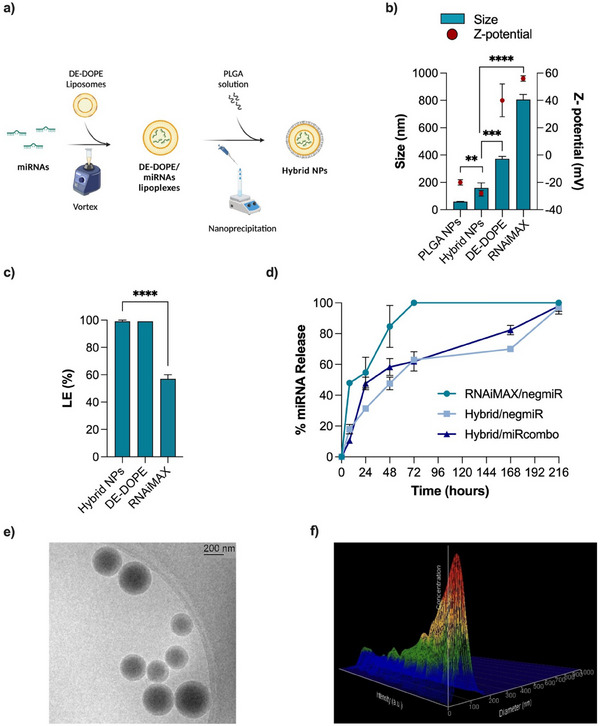
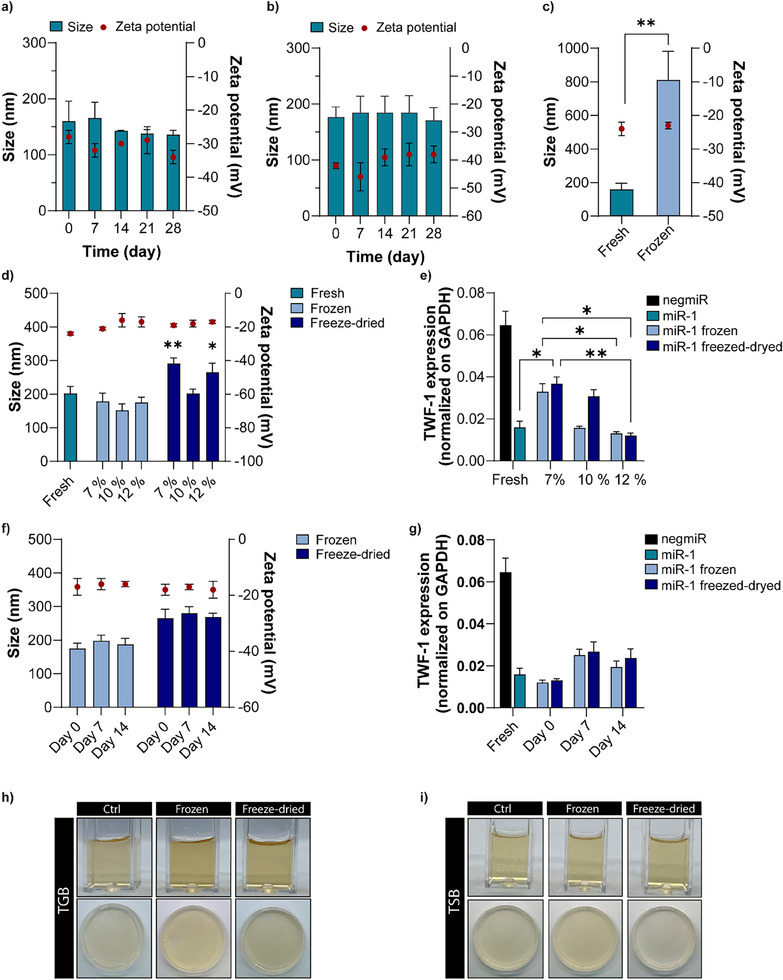
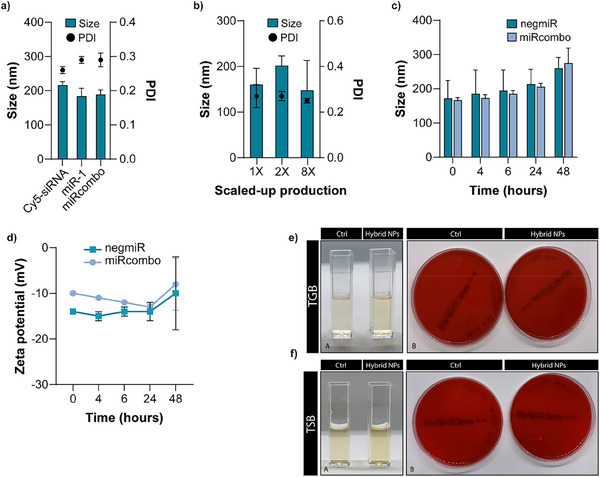
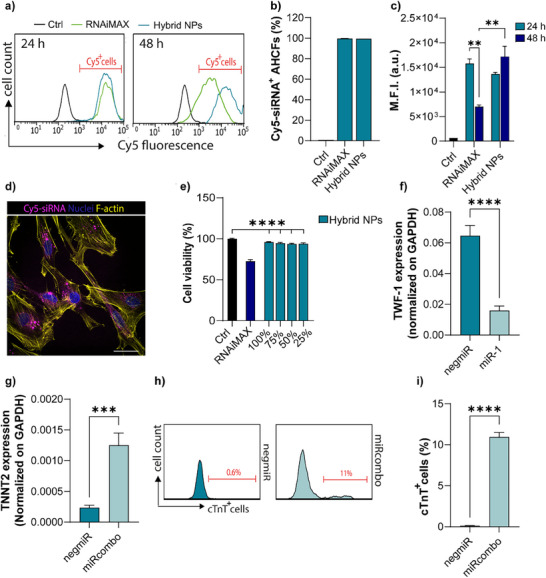
Hybrid polymer-lipid nanoparticles (hybrid NPs) are developed as novel in vitro transfection vectors for microRNAs (miRNAs) delivery to overcome the poor stability, incomplete loading efficiency and fast release kinetics of commercial transfection agents. Hybrid NPs with nanometric size are prepared by a scalable high-yield nanoprecipitation method. They consisted of a lipoplex core, composed of the cationic lipid [2-(2,3-didodecyloxypropyl)-hydroxyethyl] ammonium bromide (DE) and helper lipid dioleoyl phosphatidylethanolamine (DOPE), providing 99% miRNA loading, and a poly(lactic acid-co-glycolic acid) (PLGA) shell, ensuring NPs colloidal stability and controlled miRNA release kinetics. Adult human cardiac fibroblasts (AHCFs), transiently transfected with miR-1 loaded hybrid NPs versus RNAiMAX showed superior viability and higher miRNA content over 48 h. Hybrid NPs could be stored up to 14 days at -20 °C, upon freeze-drying with trehalose cryoprotectant (12% w/v), regaining their physicochemical and biological properties when redispersed. Hybrid NPs are assessed in a miRcombo model of fibroblast-to-cardiomyocyte reprogramming. At 15 days post-transfection with reprogramming miRNAs (miRcombo: miRs-1, 133, 208 and 499), cardiac troponin T marker expression is significantly increased at gene and protein level. These results pave the way to hybrid NP use as transfection vectors for the in vitro testing of miRNAs targeting AHCFs.
混合聚合物-脂质纳米颗粒(混合纳米颗粒)被开发为用于递送微小RNA(miRNA)的新型体外转染载体,以克服商业转染剂稳定性差、装载效率不完全和释放动力学快的问题。通过可扩展的高产纳米沉淀法制备了具有纳米尺寸的混合纳米颗粒。它们由一个脂质复合物核心组成,该核心由阳离子脂质[2-(2,3-二十二烷氧基丙基)-羟乙基]溴化铵(DE)和辅助脂质二油酰磷脂酰乙醇胺(DOPE)组成,可实现99%的miRNA装载,以及一个聚(乳酸-共-乙醇酸)(PLGA)外壳,确保纳米颗粒的胶体稳定性和可控的miRNA释放动力学。与RNAiMAX相比,用装载了miR-1的混合纳米颗粒瞬时转染的成人心脏成纤维细胞(AHCFs)在48小时内显示出更高的活力和更高的miRNA含量。在用海藻糖冷冻保护剂(12% w/v)冻干后,混合纳米颗粒可在-20°C下储存长达14天,重新分散时恢复其物理化学和生物学特性。在成纤维细胞向心肌细胞重编程的miRcombo模型中评估了混合纳米颗粒。在用重编程miRNA(miRcombo:miRs-1、133、208和499)转染后15天,心肌肌钙蛋白T标志物在基因和蛋白质水平上的表达显著增加。这些结果为混合纳米颗粒用作转染载体以体外测试靶向AHCFs的miRNA铺平了道路。