Bustard John R T, Hsu Daniel Hsiang, Fergie Rachael
Department of Management, Leadership and Marketing, Ulster University, Belfast, Northern Ireland.
J Knowl Econ. 2022 Mar 2:1-16. doi: 10.1007/s13132-022-00984-1.
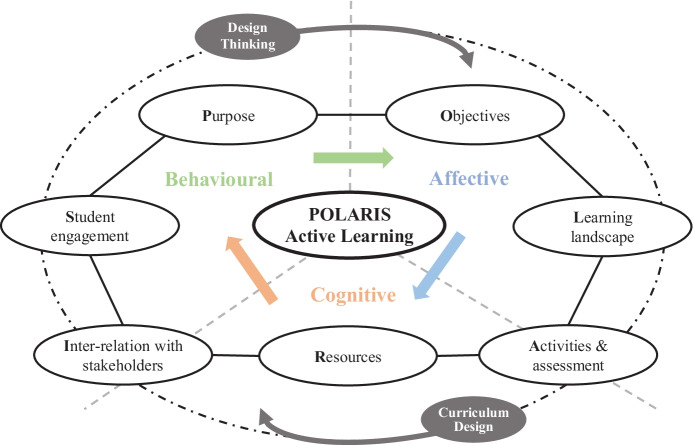
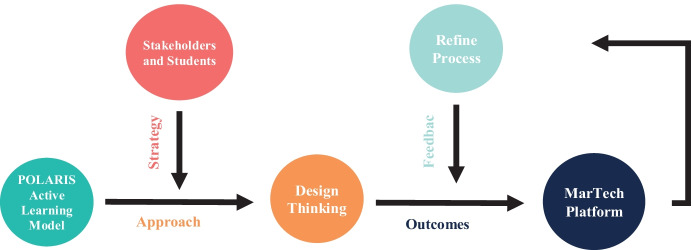
The purpose of this paper is to develop a framework for enhancing student engagement through active learning and design thinking workshops online. The COVID-19 pandemic has increased the need for digital engagement exponentially, yet the important experiences of collaborative and active learning (AL) have become more challenging to facilitate and support in circumstances of remote access during classes. As such, design thinking (DT) online presented a unique opportunity to explore this collaborative approach to engaging in user-centred design and design innovation. To explore a specific curriculum design dilemma and validate the methodology adopted, online DT workshops were conducted with two different cohorts of students toward co-creating more student-centred forms of learning in two digital marketing (DM) courses. The approach was guided by the POLARIS active learning framework to embed the framework's seven perspectives (Purpose, Objectives, Learning landscape, Activities and assessment, Resources, Inter-relation with stakeholders, and Student engagement) which were considered to better enhance student engagement in an online learning environment. Using the framework proposed, which additionally integrates Quadruple Helix Model (QHM) actors, would facilitate further DT innovation towards co-creating new value in digital marketing pedagogy, curriculum design, and beyond.
本文的目的是开发一个框架,通过在线主动学习和设计思维工作坊来提高学生的参与度。新冠疫情极大地增加了数字参与的需求,但在课堂远程访问的情况下,协作式和主动学习(AL)的重要体验变得更具挑战性,难以促进和支持。因此,在线设计思维(DT)提供了一个独特的机会来探索这种以用户为中心的设计和设计创新的协作方法。为了探索一个具体的课程设计困境并验证所采用的方法,针对两门数字营销(DM)课程,与两组不同的学生开展了在线DT工作坊,以共同创造更多以学生为中心的学习形式。该方法以北极星主动学习框架为指导,融入该框架的七个视角(目的、目标、学习环境、活动与评估、资源、与利益相关者的相互关系以及学生参与度),这些视角被认为能更好地提高学生在在线学习环境中的参与度。使用所提出的框架,该框架还整合了四螺旋模型(QHM)参与者,将有助于进一步推动DT创新,以便在数字营销教学法、课程设计及其他领域共同创造新价值。