Park Wooyoung, Son Se-Young, Yi Joonyeop, Cha Seungwoo, Moon Hankyeol, Kim Minyoung, Ji Sangho, Yu Wookyung, Sung Changmin, Cha Sun-Shin, Hahn Ji-Sook
Department of Chemical and Biological Engineering, Institute of Chemical Processes, Seoul National University, Seoul 08826, Republic of Korea.
Department of Chemistry & Nanoscience, Ewha Womans University, Seoul 03760, Republic of Korea.
Nucleic Acids Res. 2025 Jun 6;53(11). doi: 10.1093/nar/gkaf462.
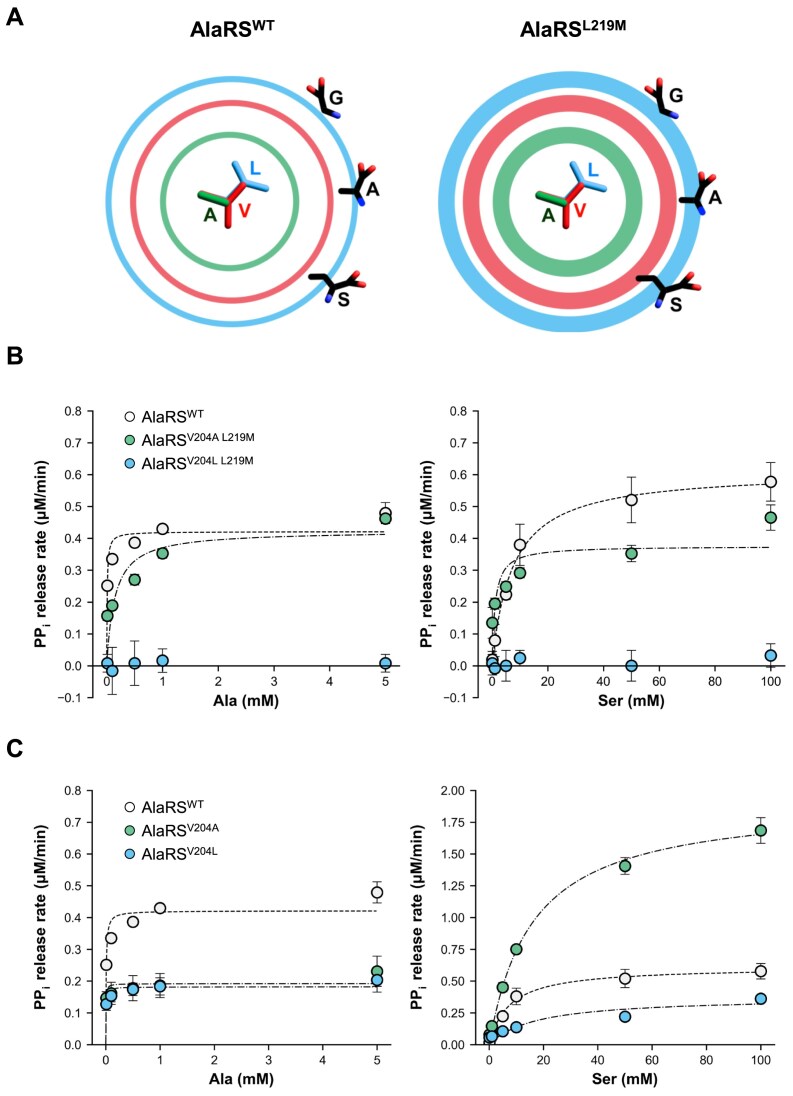
Aminoacyl-tRNA synthetases are critical for accurate genetic translation, attaching amino acids to their corresponding transfer RNA molecules. Alanyl-tRNA synthetase (AlaRS) often misactivates Ser or Gly instead of Ala, which is detrimental unless corrected by its editing functions. The paradox of misactivating larger Ser by AlaRS was considered inevitable due to its inherent design, sharing an essential acidic residue to accommodate the activated adenylated intermediates from both cognate and non-cognate amino acids. Here we show a groundbreaking discovery where a single-point mutation, L219M, in AlaRS from Methylomonas sp. DH-1, effectively eliminates Ser misactivation. Structural analysis of the pre-activation state unveiled that the flexibility of Val204 is the key to preventing Ser binding in AlaRSL219M. This research elucidates the amino acid discrimination mechanism in AlaRS, independent of editing domain. Remarkably, the AlaRSL219M mutation was initially identified as a causal mutation enhancing lactate tolerance in a strain developed through adaptive laboratory evolution. We showed that AlaRSL219M also eliminates the enzyme's inherent lactyltransferase activity, suggesting that the lactate tolerance observed might result from preventing excessive protein lactylation under lactate stress. This opens possibilities for developing high-fidelity and lactylation-deficient AlaRS mutants across various organisms, facilitating studies on their potential benefits in different physiological scenarios.
氨酰-tRNA合成酶对于准确的基因翻译至关重要,它将氨基酸连接到相应的转运RNA分子上。丙氨酰-tRNA合成酶(AlaRS)常常错误地将丝氨酸(Ser)或甘氨酸(Gly)而不是丙氨酸(Ala)激活,除非通过其编辑功能进行校正,否则这是有害的。由于其固有的设计,AlaRS错误激活较大的Ser被认为是不可避免的,它共享一个必需的酸性残基来容纳来自同源和非同源氨基酸的活化腺苷酸中间体。在这里,我们展示了一个开创性的发现,即甲基单胞菌属DH-1的AlaRS中的单点突变L219M有效地消除了Ser的错误激活。对预激活状态的结构分析表明,Val204的灵活性是防止Ser在AlaRSL219M中结合的关键。这项研究阐明了AlaRS中与编辑结构域无关的氨基酸识别机制。值得注意的是,AlaRSL219M突变最初被鉴定为通过适应性实验室进化开发的菌株中增强乳酸耐受性的因果突变。我们表明,AlaRSL219M也消除了该酶固有的乳酰转移酶活性,这表明观察到的乳酸耐受性可能是由于在乳酸胁迫下防止蛋白质过度乳酰化所致。这为开发跨各种生物体的高保真和乳酰化缺陷型AlaRS突变体开辟了可能性,有助于研究它们在不同生理场景中的潜在益处。