Atoyebi A O, Olaoye S O, Okunlola M A, Palamuleni M E, Adebowale A S
Department of Epidemiology and Medical Statistics, Faculty of Public Health, University of Ibadan, Ibadan, Nigeria.
Department of Obstetrics and Gynaecology, College of Medicine, University of Ibadan, Ibadan, Nigeria.
BMC Public Health. 2025 Jun 7;25(1):2134. doi: 10.1186/s12889-025-23284-0.
Despite consistent reporting of high fertility levels in Nigeria, contraceptive prevalence rates remain low. Information on the type of contraceptive uptake among women who visit family planning (FP) clinics is still sketchy in Ibadan. Therefore, we assessed the trend and pattern of contraceptive use among women attending a FP clinic at a tertiary health facility in Ibadan.
A mixed-method design was adopted for the study. Records of women (n = 1,619) who accessed FP services at the University College Hospital [UCH] from 2018 to 2022 were reviewed. The qualitative data included a key informant interview (KII) involving a senior officer of the FP Clinic and a focus group discussion (FGD) among high-fertility (≥ 4 living children) women. Data were analysed using a logistic regression model (α), and thematic analysis was used for the qualitative part of the study.
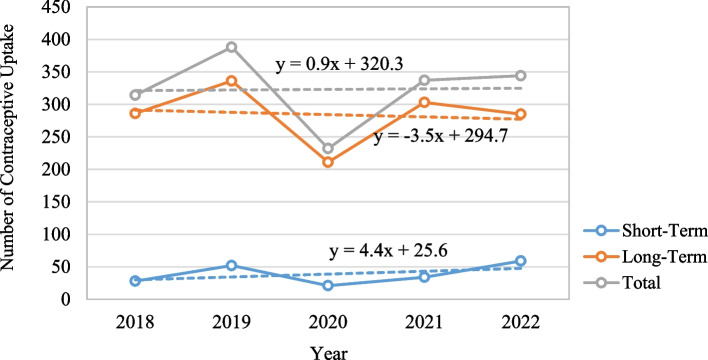
The mean age of women was 33.8 ± 6.34 years, 87.7% were in monogamous marriages, 82.3% were Yoruba, and 47.2% did not intend to bear more children. The uptake of long-term and short-term contraceptive methods showed a declining (slope = -3.5) and increasing (slope = + 4.4) trend, respectively. The likelihood of non-use of a long-term contraceptive method was lower among women with ≥ 3 surviving children who had tertiary education (uOR = 0.539, 95% C.I = 0.338-0.859, p = 0.009) and were Christians (uOR = 0.410, 95% C.I = 0.258-0.652, p < 0.001) compared to their counterparts with at most secondary education and were Muslims, respectively. High fertility women who are not using Long-acting reversible contraceptive methods (LACMs) identified fear, partner's influence, misconceptions, cost, parity, privacy, and inconvenience as reasons for the non-use of the methods.
Conceptive uptake at the UCH followed an increasing trend from 2018 to 2022. Sensitisation on the adoption of LACMs among high-fertility women might improve the use of such methods in the study area.
尽管尼日利亚一直报告高生育率,但避孕普及率仍然很低。在伊巴丹,关于前往计划生育(FP)诊所的女性使用避孕方法类型的信息仍然很粗略。因此,我们评估了在伊巴丹一家三级医疗机构的计划生育诊所就诊的女性中避孕使用的趋势和模式。
本研究采用混合方法设计。回顾了2018年至2022年期间在大学学院医院[UCH]获得计划生育服务的女性(n = 1619)的记录。定性数据包括对计划生育诊所一名高级官员的关键信息访谈(KII)以及高生育率(≥4个存活子女)女性中的焦点小组讨论(FGD)。使用逻辑回归模型(α)分析数据,并对研究的定性部分进行主题分析。
女性的平均年龄为33.8±6.34岁,87.7%为一夫一妻制婚姻,82.3%为约鲁巴族,47.2%不打算再生育。长期和短期避孕方法的使用分别呈下降趋势(斜率=-3.5)和上升趋势(斜率=+4.4)。与至多接受过中等教育且为穆斯林的女性相比,有≥3个存活子女且接受过高等教育的女性(uOR = 0.539,95%置信区间= 0.338 - 0.859,p = 0.009)以及基督教女性(uOR = 0.410,95%置信区间= 0.258 - 0.652,p < 0.001)不使用长期避孕方法的可能性较低。未使用长效可逆避孕方法(LACMs)的高生育率女性将恐惧、伴侣的影响、误解、成本、生育次数、隐私和不便视为不使用这些方法的原因。
2018年至2022年期间,UCH的避孕使用率呈上升趋势。对高生育率女性进行长效可逆避孕方法使用的宣传可能会提高该研究地区此类方法的使用率。