Daroudi Rajabali, AkbariSari Ali, Zamandi Mahmoud, Shahali Zahra
Department of Health Management, Policy and Economics, School of Public Health, Tehran University of Medical Sciences, Tehran, Iran (the Islamic Republic of).
Department of Health Management, Policy and Economics, School of Public Health, Tehran University of Medical Sciences, Tehran, Iran (the Islamic Republic of)
BMJ Open. 2025 Jun 8;15(6):e099322. doi: 10.1136/bmjopen-2025-099322.
Hypertension is one of the silent diseases and is the major cause of many chronic conditions. The treatment services for hypertension and its cardiovascular complications impose high costs on society and the health system. However, in LMCs, there is not enough evidence-based information about the costs of high blood pressure. This study aims to assess the economic burden of hypertension in Iran in 2020.
A prevalence-based cost of illness study.
Data on hypertension and selected diseases, including their prevalence, incidence, mortality risk and death counts, were sourced from literature reviews, the Global Burden of Disease (GDP) and the Non-Communicable Diseases Research Centre. Cost estimates were derived from health insurance data, surveys, research studies and treatment protocols. Additional data, such as population, employment rates, household activity rates, wage rates and GDP per capita, were obtained from the Statistical Centre of Iran and the World Bank.
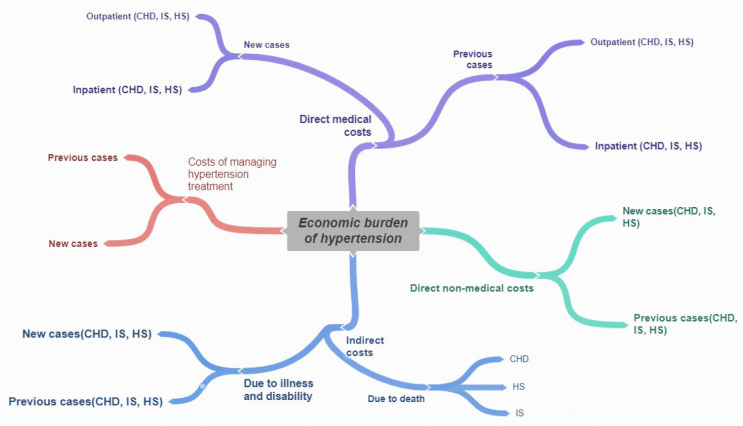
A prevalence-based cost of illness study was used to estimate the economic burden of hypertension. The focus was on the most significant diseases associated with high blood pressure, including coronary heart disease, ischaemic stroke, haemorrhagic stroke and the direct costs of hypertension. Subsequently, the total number of patients was multiplied by the average cost per patient for each disease. To calculate the average cost, inpatient and outpatient, direct non-medical and indirect costs of diseases were estimated and multiplied by a population-attributed fraction of high blood pressure. Direct costs (hospitalisation and outpatient costs and direct non-medical costs) of hypertension were calculated using the bottom-up approach, and the human capital approach was used to calculate indirect costs.
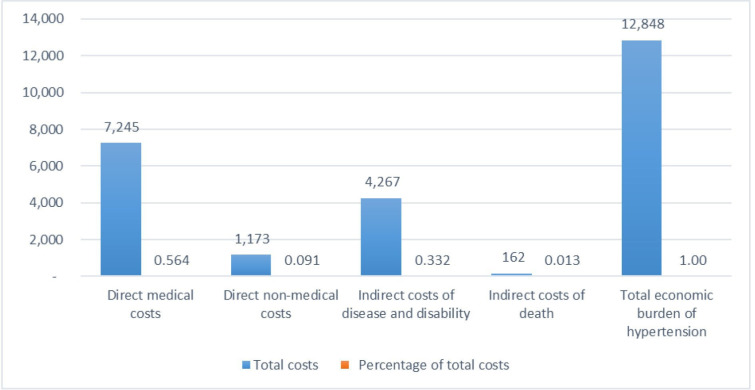
According to the results of the study, the total economic burden of hypertension was $ purchasing power parity (PPP) 12 848.22 million, of which the share of direct medical, non-medical and indirect costs of hypertension were $ PPP 7245.13 million (56.4%), $ PPP 1173.42 million (9.1%) and $ PPP 4429.68 million (34.5%), respectively. The total economic burden of high blood pressure was equal to 23% of the total economic burden of four chronic diseases.
The economic burden of high blood pressure in the country is very high and significant, and it was equivalent to about 1% of the country's gross domestic product in 2020, which shows the necessity of preventive interventions.
高血压是一种隐匿性疾病,是许多慢性病的主要病因。高血压及其心血管并发症的治疗服务给社会和卫生系统带来了高昂成本。然而,在低收入和中等收入国家,关于高血压成本的循证信息不足。本研究旨在评估2020年伊朗高血压的经济负担。
一项基于患病率的疾病成本研究。
关于高血压及选定疾病的数据,包括其患病率、发病率、死亡风险和死亡人数,来自文献综述、全球疾病负担(GBD)和非传染性疾病研究中心。成本估计来自医疗保险数据、调查、研究和治疗方案。其他数据,如人口、就业率、家庭活动率、工资率和人均国内生产总值,来自伊朗统计中心和世界银行。
采用基于患病率的疾病成本研究来估计高血压的经济负担。重点关注与高血压相关的最主要疾病,包括冠心病、缺血性中风、出血性中风以及高血压的直接成本。随后,将每种疾病的患者总数乘以每位患者的平均成本。为计算平均成本,估算了疾病的住院和门诊、直接非医疗和间接成本,并乘以高血压的人群归因分数。高血压的直接成本(住院和门诊成本以及直接非医疗成本)采用自下而上的方法计算,人力资本法用于计算间接成本。
根据研究结果,高血压的总经济负担为128.4822亿美元(购买力平价),其中高血压的直接医疗、非医疗和间接成本分别占72.4513亿美元(56.4%)、11.7342亿美元(9.1%)和44.2968亿美元(34.5%)。高血压的总经济负担占四种慢性病总经济负担的23%。
该国高血压的经济负担非常高且显著,相当于2020年该国国内生产总值的约1%,这表明有必要进行预防性干预。