Kopf R Keller, McPhan Luke, McInerney Paul J, Zampatti Brenton, Thiem Jason, Koster Wayne, Butler Gavin L, Bond Nick, Thompson Ross M
Research Institute for the Environment and Livelihoods, Charles Darwin University, Darwin, Northern Territory, Australia.
Gulbali Institute, Charles Sturt University, Albury, New South Wales, Australia.
J Anim Ecol. 2025 Jul;94(7):1435-1448. doi: 10.1111/1365-2656.70069. Epub 2025 Jun 9.
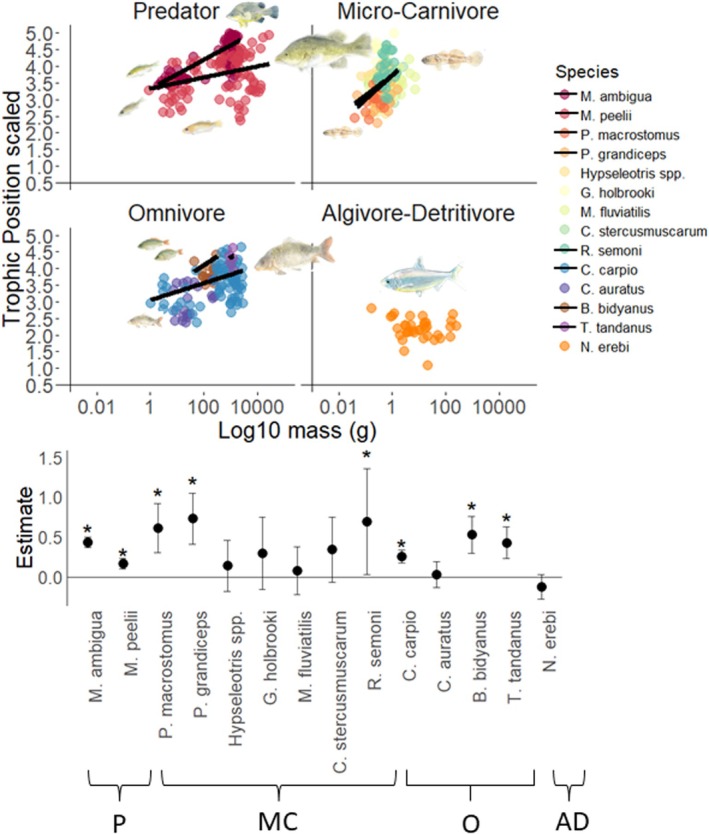
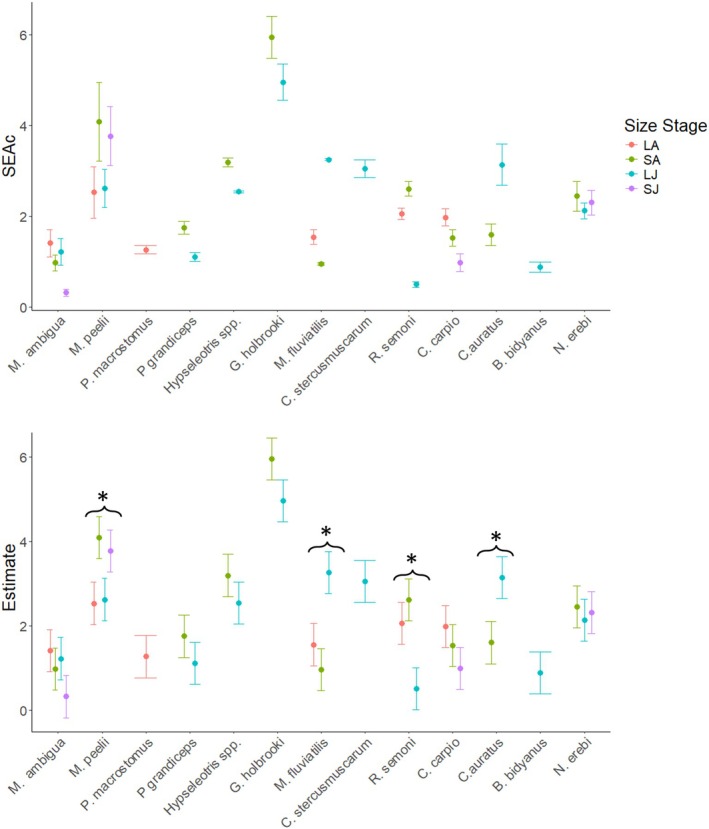
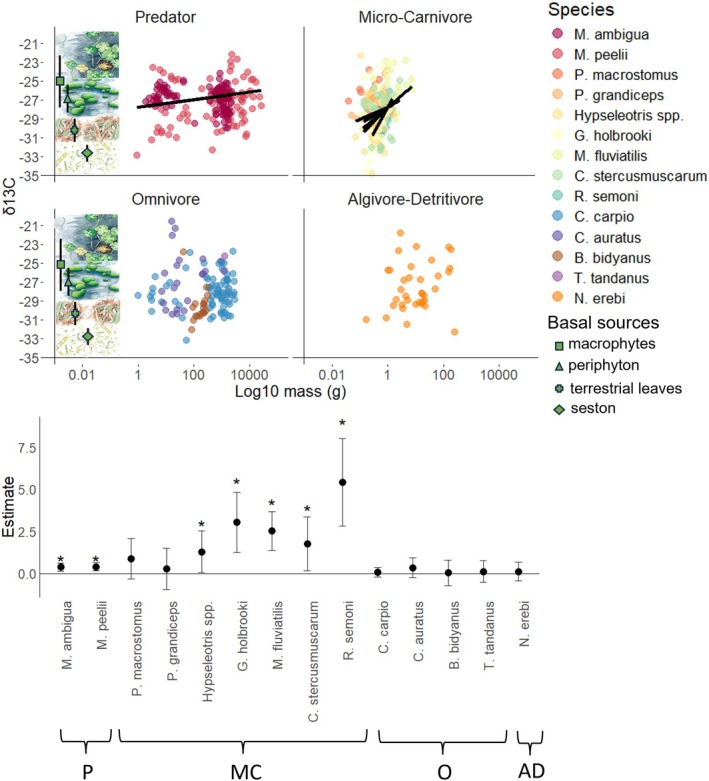
Food web interactions are generally considered to be size-structured and occur at the individual or group level within species, yet many ecological models and tests of theory assign species-level values to define trophic position or niches. Such studies ignore potential ontogenetic or within-species size-based changes in consumer behaviour and trophic dynamics that can occur as individuals grow. We use stable isotope analysis of δN and δC to explore the effects of body size on fish community trophic structure and niches in one of Australia's largest river basins-the Murray-Darling. First, we test whether Trophic Position (TP) and δC scale with body mass within and among species and functional guilds (predator; micro-carnivore; omnivore; algivore-detritivore). Secondly, we test whether isotopic niche breadth scales with body size within and among species or community mass-classes ranging from <1 to >8192 g. There were positive relationships between individual body mass and TP or δC in 12/14 species, including two predators, seven micro-carnivores and three omnivores, but not in an algivore-detritivore. In contrast to the positive size-based scaling of TP and δC within species, no scaling relationship was found between TP or δC and body mass among species. Bayesian ellipses fitted to TP and δC showed that isotopic trophic niche breadth varied within and among species, but did not scale positively or negatively with body mass at any level of biological organisation. The importance of within-species, size-based, trophic structure in our study contrasts with previous evidence suggesting that river food webs are not size-structured. Food web models and tests of theory which have assumed a single, species-level, TP or δC do not capture the complex intraspecific size-based trophic dynamics of river fish communities. In contrast, our niche breadth results suggest that the isotopic diversity of food resources supporting the fish community did not scale with body size. These contrasting results may be explained by optimal foraging whereby larger predators, micro-carnivores and omnivores of some species selectively feed on higher energy, higher TP and δC-enriched resources whilst avoiding lower energy, lower TP and δC-depleted food items.
食物网相互作用通常被认为是按大小构建的,且发生在物种内的个体或群体层面,但许多生态模型和理论检验给物种层面赋值来定义营养级位置或生态位。这类研究忽略了随着个体生长,消费者行为和营养动态中可能出现的潜在个体发育或物种内基于大小的变化。我们利用δN和δC的稳定同位素分析,来探究体型对澳大利亚最大的流域之一——墨累-达令河流域鱼类群落营养结构和生态位的影响。首先,我们测试营养级位置(TP)和δC是否在物种内、物种间以及功能类群(捕食者;小型肉食动物;杂食动物;藻食性碎屑食性动物)内随体重变化。其次,我们测试同位素生态位宽度是否在物种内、物种间或群落质量等级(从<1克到>8192克)内随体型变化。在14个物种中的12个物种中,个体体重与TP或δC之间存在正相关关系,包括两种捕食者、七种小型肉食动物和三种杂食动物,但在一种藻食性碎屑食性动物中不存在这种关系。与物种内基于大小的TP和δC的正相关关系相反,在物种间未发现TP或δC与体重之间的比例关系。拟合到TP和δC的贝叶斯椭圆表明,同位素营养生态位宽度在物种内和物种间有所不同,但在任何生物组织水平上都与体重不存在正相关或负相关关系。我们研究中物种内基于大小的营养结构的重要性,与之前表明河流食物网不是按大小构建的证据形成对比。假设单一物种层面的TP或δC的食物网模型和理论检验,无法捕捉河流鱼类群落复杂的种内基于大小的营养动态。相比之下,我们的生态位宽度结果表明,支持鱼类群落的食物资源的同位素多样性并未随体型变化。这些对比结果可能由最优觅食来解释,即一些物种中较大的捕食者、小型肉食动物和杂食动物选择性地以能量更高、TP和δC含量更高的资源为食,同时避开能量较低、TP和δC含量较低的食物。