Chen Yueyue, Zhang Wenhua, Ma Junyi, Liu Wenxing, Song Xingrong, Chen Xi
Department of Anesthesiology, Guangzhou Women and Children's Medical Center, Guangzhou Medical University, Guangdong Provincial Clinical Research Center for Child Health, Guangzhou, People's Republic of China.
Department of Anesthesiology, The Third Affiliated Hospital of Guangzhou Medical University, Guangzhou, People's Republic of China.
Drug Des Devel Ther. 2025 Jun 1;19:4605-4615. doi: 10.2147/DDDT.S515924. eCollection 2025.
Preoperative anxiety is an urgent problem in pediatric patients. This trial evaluated intravenous remimazolam for preoperative sedation in pediatric patients, assessing efficacy, safety, and age-dependent dose effects.
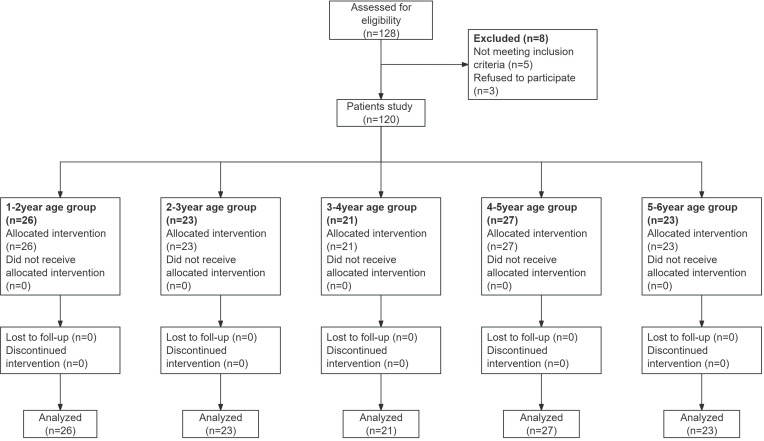
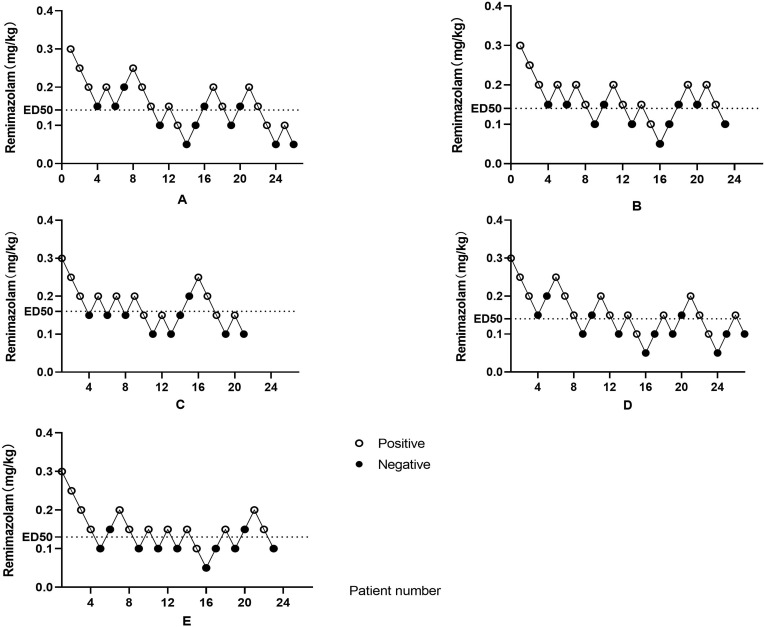
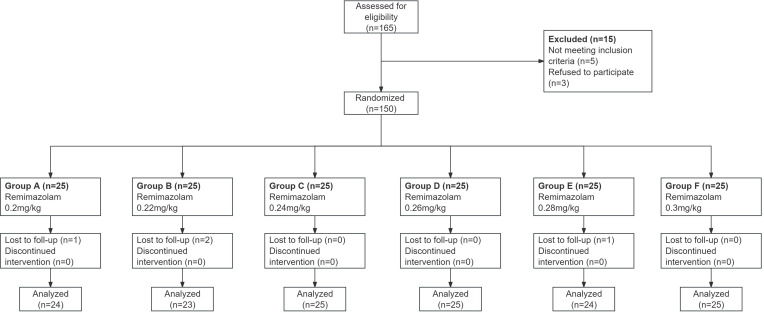
In this two-part study, Aged 1~6 years old, 293 ASA I-II children [Parental Separation Anxiety Score (PSAS) ≥3 after nonpharmacological interventions] were enrolled. Part I: children were divided into 5 groups according to their age, and the trial was conducted by the Dixon-Massey sequential method. The first child in each group received a dose of 0.3 mg/kg of remimazolam, with a drug dose gradient of 0.05 mg/kg. Part II: 150 children were randomly selected and assigned to receive remimazolam 0.2-0.3 mg/kg. The main observations of this study were sedation effect and safety.
The ED and 95% confidence interval (CI) for children aged 1-2 years was 0.14 (0.11-0.16) mg/kg, for children aged 2-3 years was 0.14 (0.11-0.17) mg/kg, for children aged 3-4 years was 0.16 (0.12-0.19) mg/kg, and for children aged 4-5 years was 0.14 (0.11-0.16) mg/kg, 5-6 years 0.13 (0.10-0.16) mg/kg, with no significant difference between age groups (P=0.525). The ED for preoperative sedation in children aged 1-6 years was 0.29 mg/kg (95% CI: 0.27-0.40). The difference in MOAA/S scores between the different dose groups in Part II was statistically significant (p<0.001) at 2 minutes after dosing. None of the adverse events that occurred after the use of remimazolam in this trial required the use of medication for intervention.
Remimazolam can be effectively used for preoperative sedation in children aged 1-6 years with low circulatory and respiratory effects, and there was no difference in the effective dose of the drug by age.
术前焦虑是儿科患者的一个紧迫问题。本试验评估了静脉注射瑞马唑仑用于儿科患者术前镇静的效果,评估其有效性、安全性及年龄依赖性剂量效应。
在这项分为两部分的研究中,纳入了293名年龄在1至6岁的美国麻醉医师协会(ASA)I-II级儿童[非药物干预后父母分离焦虑评分(PSAS)≥3分]。第一部分:根据年龄将儿童分为5组,采用迪克森-梅西序贯法进行试验。每组的第一个儿童接受0.3mg/kg的瑞马唑仑剂量,药物剂量梯度为0.05mg/kg。第二部分:随机选取150名儿童,给予0.2 - 0.3mg/kg的瑞马唑仑。本研究的主要观察指标为镇静效果和安全性。
1至2岁儿童的半数有效剂量(ED)及95%置信区间(CI)为0.14((0.11 - 0.16))mg/kg,2至3岁儿童为0.14((0.11 - 0.17))mg/kg,3至4岁儿童为0.16((0.12 - 0.19))mg/kg,4至5岁儿童为0.14((0.11 - 0.16))mg/kg,5至6岁儿童为0.13((0.10 - 0.16))mg/kg,各年龄组之间无显著差异(P = 0.525)。1至6岁儿童术前镇静的ED为0.29mg/kg(95% CI:(0.