Kim Chang Seong, Suh Sang Heon, Choi Hong Sang, Bae Eun Hui, Ma Seong Kwon, Kim Bongseong, Han Kyung-Do, Kim Soo Wan
Department of Internal Medicine, Chonnam National University Medical School, Gwangju 61469, South Korea.
Department of Internal Medicine, Chonnam National University Hospital, Gwangju 61469, South Korea.
World J Diabetes. 2025 May 15;16(5):102094. doi: 10.4239/wjd.v16.i5.102094.
Diabetes is a significant risk factor for chronic kidney disease, and diabetic kidney disease (DKD) is prevalent among patients with diabetes. Previous studies have indicated that the duration of diabetes and poor glycemic control are associated with an increased risk of DKD, but data on how the duration and severity of hyperglycemia specifically relate to DKD progression are limited.
To investigate the relationship between diabetes duration and glycemic control, and DKD progression in South Korea.
We included 2303 patients with diabetes using the 2019-2021 Korea National Health and Nutrition Examination Surveys data. DKD was defined as an estimated glomerular filtration rate (eGFR) < 60 mL/min per 1.73 m, urinary albumin-to-creatinine ratio ≥ 30 mg/g, or both. Diabetes duration and severity were classified into six categories each.
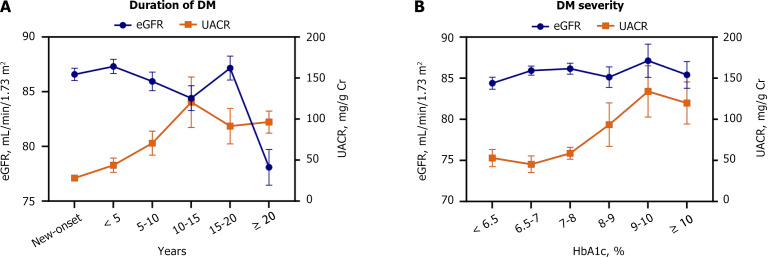
DKD prevalence was 25.5%. The DKD risk significantly increased in diabetes lasting 10-15 years or hemoglobin A1C (HbA1c) ≥ 8% compared to patients with newly diagnosed diabetes or HbA1c < 6.5%. Albuminuria developed with shorter diabetes duration and lower HbA1c than eGFR decline. The adjusted odds ratios for DKD were 3.77 [95% confidence interval (95%CI): 2.60-5.45] and 4.91 (95%CI: 2.80-8.63) in patients with diabetes lasting ≥ 20 years and HbA1c ≥ 10%, respectively, compared to those with new-onset diabetes and HgA1c < 6.5%.
Patients with diabetes lasting > 10 years or HbA1c > 8% had a higher risk of DKD, emphasizing the importance of early monitoring and management is crucial to prevent DKD progression.
糖尿病是慢性肾脏病的重要危险因素,糖尿病肾病(DKD)在糖尿病患者中普遍存在。既往研究表明,糖尿病病程和血糖控制不佳与DKD风险增加有关,但关于高血糖的病程和严重程度如何具体与DKD进展相关的数据有限。
研究韩国糖尿病病程、血糖控制与DKD进展之间的关系。
我们使用2019 - 2021年韩国国家健康与营养检查调查数据纳入了2303例糖尿病患者。DKD定义为估计肾小球滤过率(eGFR)<60 ml/(min·1.73 m²)、尿白蛋白与肌酐比值≥30 mg/g,或两者兼有。糖尿病病程和严重程度各分为六类。
DKD患病率为25.5%。与新诊断糖尿病或糖化血红蛋白(HbA1c)<6.5%的患者相比,病程持续10 - 15年或HbA1c≥8%的糖尿病患者DKD风险显著增加。与eGFR下降相比,蛋白尿在糖尿病病程较短和HbA1c较低时就会出现。与新发糖尿病且HbA1c<6.5%的患者相比,病程≥20年且HbA1c≥10%的糖尿病患者DKD的校正比值比分别为3.77 [95%置信区间(95%CI):2.60 - 5.45]和4.91(95%CI:2.80 - 8.63)。
病程>10年或HbA1c>8%的糖尿病患者发生DKD的风险更高,强调早期监测和管理对于预防DKD进展至关重要。