
芬兰大脑出生队列中准父母的白细胞端粒长度与特质恢复力、童年不良经历及心理困扰的关联
Associations of Leukocyte Telomere Length With Trait Resilience, Adverse Childhood Experiences, and Psychological Distress Among Expecting Parents in the FinnBrain Birth Cohort.
作者信息
Mondolin Viivi, Karlsson Hasse, Perasto Laura, Paunio Tiina, Vitikainen Emma, Martens Dries S, Karlsson Linnea, Tuulari Jetro J, Kataja Eeva-Leena
机构信息
FinnBrain Birth Cohort Study, Turku Brain and Mind Center, Department of Clinical Medicine, University of Turku, Turku, Finland.
Centre for Population Health Research, Turku University Hospital and University of Turku, Turku, Finland.
出版信息
Biol Psychiatry Glob Open Sci. 2025 Apr 1;5(4):100498. doi: 10.1016/j.bpsgos.2025.100498. eCollection 2025 Jul.
BACKGROUND
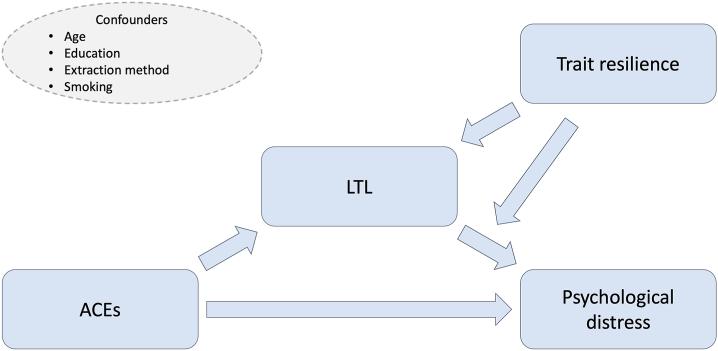
Telomere attrition has previously been associated with mental health problems and adverse childhood experiences (ACEs). Resilience has been shown to protect against mental health problems even in the context of ACEs. In this study, we examined the associations between leukocyte telomere length (LTL), symptoms of psychological distress, ACEs, and trait resilience. We examined whether LTL mediates the negative effects of ACEs and whether trait resilience moderates the association between LTL and distress.
METHODS
The study population was drawn from the ongoing FinnBrain Birth Cohort Study and included 342 mothers and 339 fathers who had provided blood samples and questionnaire data during pregnancy. Questionnaire data included the Connor-Davidson Resilience Scale 10, Edinburgh Postnatal Depression Scale, Symptom Checklist-90, and Trauma and Distress Scale. Data analysis included regression analysis, mixed-methods models, and statistical evaluation.
RESULTS
ACEs were associated with depressive and anxiety symptoms. However, contrary to the initial hypothesis, LTL was not associated with ACEs or distress symptoms and thus did not mediate their association. Furthermore, resilience was not associated with LTL and did not moderate the possible association between LTL and distress symptoms.
CONCLUSIONS
We found no association between TL and ACEs, psychological distress, or trait resilience. The mild distress symptoms, limited exposure to high ACEs, and the predominantly moderate to high socioeconomic status in the sample may be relevant to interpreting these findings. Encouragingly, not all ACEs necessarily lead to telomere attrition.
背景
端粒损耗先前已被证明与心理健康问题及不良童年经历(ACEs)有关。研究表明,即使在存在ACEs的情况下,心理韧性也能预防心理健康问题。在本研究中,我们考察了白细胞端粒长度(LTL)、心理困扰症状、ACEs和特质心理韧性之间的关联。我们研究了LTL是否介导了ACEs的负面影响,以及特质心理韧性是否调节了LTL与困扰之间的关联。
方法
研究人群来自正在进行的芬兰大脑出生队列研究,包括342名母亲和339名父亲,他们在孕期提供了血液样本和问卷数据。问卷数据包括康纳-戴维森韧性量表10、爱丁堡产后抑郁量表、症状自评量表90以及创伤与困扰量表。数据分析包括回归分析、混合方法模型和统计评估。
结果
ACEs与抑郁和焦虑症状相关。然而,与最初的假设相反,LTL与ACEs或困扰症状无关,因此并未介导它们之间的关联。此外,心理韧性与LTL无关,也未调节LTL与困扰症状之间可能存在的关联。
结论
我们发现端粒长度与ACEs、心理困扰或特质心理韧性之间无关联。样本中轻微的困扰症状以及接触严重ACEs的情况有限,且社会经济地位大多处于中高水平,这些因素可能与解释这些发现有关。令人鼓舞的是,并非所有的ACEs都会导致端粒损耗。


 Zotero 插件