Lotfi Nastaran, Bagheri Moghaddam Ahmad, Froutan Razieh, Nezami Hossein
Department of Medical Surgical Nursing, School of Nursing and Midwifery, Mashhad University of Medical Sciences, Mashhad, Iran.
Department of Anesthesiology and Critical Care, Faculty of Medicine, Mashhad University of Medical Sciences, Mashhad, Iran.
Arch Acad Emerg Med. 2025 May 22;13(1):e48. doi: 10.22037/aaemj.v13i1.2652. eCollection 2025.
Ventilation and oxygen delivery during cardiopulmonary resuscitation (CPR) is of paramount importance. This study aimed to compare the effects of manual and mechanical ventilation on respiratory parameters of intubated patients during CPR.
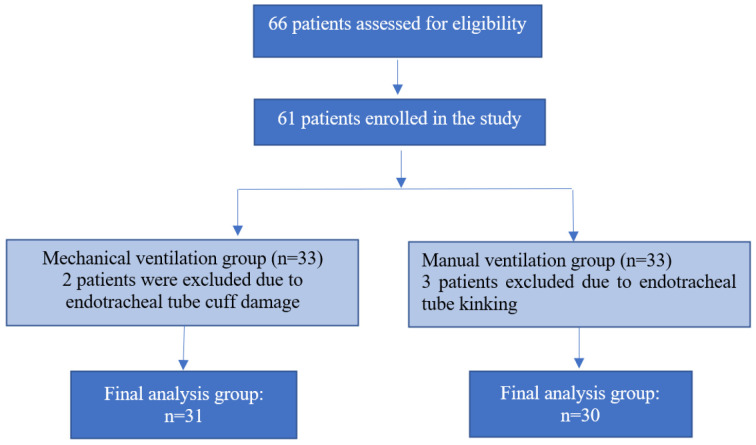
This randomized controlled clinical trial was conducted in 2024 on 61 intubated patients with neurological disorders admitted to the ICU of educational hospitals. Participants were allocated to either the intervention or the control group using block randomization with a block size of six. The intervention group received mechanical ventilation, while the control group received manual ventilation using bag valve mask (BVM). The effects of manual versus mechanical ventilation during CPR on key physiological and respiratory parameters, including venous blood gases (VBG), end tidal Co2 (ETCO₂), and peripheral oxygen saturation (SpO₂) were compared between groups. Statistical analyses were performed using SPSS version 21.
The study findings indicated no statistically significant differences between the manual and mechanical ventilation groups in terms of venous blood pH levels (P = 0.38), PCO (P = 0.65), and HCO levels (P = 0.47) changes. However, PO₂ (P < 0.001), ETCO₂ (P < 0.05). and SpO₂ (P < 0.001) were more stable and consistently higher in patients receiving mechanical ventilation.
These findings suggest that while pH, PCO₂, and HCO levels did not significantly differ between the two ventilation methods, mechanical ventilation demonstrated superior efficacy in optimizing oxygenation (PO₂ and SpO₂) and regulating ETCO₂ levels.
心肺复苏(CPR)期间的通气和氧气输送至关重要。本研究旨在比较心肺复苏期间手动通气和机械通气对插管患者呼吸参数的影响。
本随机对照临床试验于2024年对61名入住教学医院重症监护病房的患有神经系统疾病的插管患者进行。采用区组大小为6的区组随机化将参与者分配到干预组或对照组。干预组接受机械通气,而对照组使用袋阀面罩(BVM)进行手动通气。比较两组在心肺复苏期间手动通气与机械通气对关键生理和呼吸参数的影响,包括静脉血气(VBG)、呼气末二氧化碳(ETCO₂)和外周血氧饱和度(SpO₂)。使用SPSS 21版进行统计分析。
研究结果表明,手动通气组和机械通气组在静脉血pH值水平变化(P = 0.38)、PCO(P = 0.65)和HCO水平变化(P = 0.47)方面无统计学显著差异。然而,接受机械通气的患者的PO₂(P < 0.001)、ETCO₂(P < 0.05)和SpO₂(P < 0.001)更稳定且持续更高。
这些发现表明,虽然两种通气方法在pH、PCO₂和HCO水平上没有显著差异,但机械通气在优化氧合(PO₂和SpO₂)和调节ETCO₂水平方面显示出更好的效果。