• 文献检索
  • 文档翻译
  • 深度研究
  • 学术资讯
  • Suppr Zotero 插件Zotero 插件
  • 邀请有礼
  • 套餐&价格
  • 历史记录
应用&插件
Suppr Zotero 插件Zotero 插件浏览器插件Mac 客户端Windows 客户端微信小程序
定价
高级版会员购买积分包购买API积分包
服务
文献检索文档翻译深度研究API 文档MCP 服务
关于我们
关于 Suppr公司介绍联系我们用户协议隐私条款
关注我们

Suppr 超能文献

核心技术专利:CN118964589B侵权必究
粤ICP备2023148730 号-1Suppr @ 2026

文献检索

告别复杂PubMed语法,用中文像聊天一样搜索,搜遍4000万医学文献。AI智能推荐,让科研检索更轻松。

立即免费搜索

文件翻译

保留排版,准确专业,支持PDF/Word/PPT等文件格式,支持 12+语言互译。

免费翻译文档

深度研究

AI帮你快速写综述,25分钟生成高质量综述,智能提取关键信息,辅助科研写作。

立即免费体验

临床医生和政策制定者对尼泊尔孕产妇保健中实施和扩大产后宫内避孕综合服务的障碍与促进因素的看法:一项定性研究

Clinician and policymaker perspectives on the barriers and enablers to implementing and scaling up integrated postpartum intrauterine contraceptive services within maternity care in Nepal: a qualitative study.

作者信息

Rai Pramila, O'Connor Denise A, Ackerman Ilana N, Dangal Ganesh, Rimal Surya Prasad, Rai Pabitra, Buchbinder Rachelle

机构信息

School of Public Health and Preventive Medicine, Monash University, Melbourne, Australia.

Kathmandu Model Hospital, Kathmandu, Nepal.

出版信息

Lancet Reg Health Southeast Asia. 2025 May 14;37:100599. doi: 10.1016/j.lansea.2025.100599. eCollection 2025 Jun.

DOI:10.1016/j.lansea.2025.100599
PMID:40487913
原文链接:https://pmc.ncbi.nlm.nih.gov/articles/PMC12141544/
Abstract

BACKGROUND

Integrating postpartum family planning services within maternity care, specifically counselling about family planning and postpartum intrauterine contraceptive device (PPIUCD) insertion, may help reduce unintended pregnancies and related complications. This study explored factors affecting the implementation and scale-up of integration of these services within maternity care in Nepal from the perspectives of healthcare providers and policymakers.

METHODS

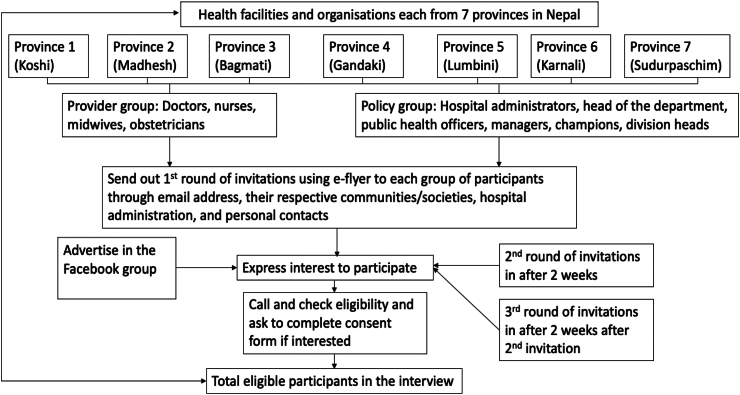
For this qualitative study, we conducted in-depth, semi-structured interviews remotely with healthcare providers and policymakers across all seven provinces of the Nepali maternal healthcare sector until theme saturation was achieved. Potentially eligible participants were invited through publicly available e-mail addresses, personal contacts, snowball sampling, and social media advertisements. Respondents were assessed for eligibility and subsequently recruited. The Consolidated Framework for Implementation Research and Theoretical Domains Framework guided our inquiry and analysis. We transcribed the interviews verbatim, translated the transcripts into English and analysed them using thematic analysis.

FINDINGS

Based on 26 interviews, we identified five major barrier themes relating to care recipients, healthcare providers, health facilities and the health system. The themes included: (i) the perceived inadequate awareness and low desire for PPIUCDs among care recipients, (ii) PPIUCD-specific issues, (iii) inadequate capacity and capability to deliver the services, (iv) inadequate investment and priority, and (v) contextual factors such as pelvic inflammatory diseases and hygiene considerations. Some contrasting views were reported between healthcare providers and policy participants. Policy participants emphasised insufficient efforts by healthcare providers to provide counselling and PPIUCD, while healthcare providers identified PPIUCD-related issues (e.g., complexity of the insertion procedure) as a significant barrier hindering their efforts. Both healthcare providers and policy participants identified inadequate investment in and priority on integrating postpartum contraceptive services, including PPIUCD, as another important factor. Participants indicated that there is an urgent need to implement effective integrated counselling and contraception services.

INTERPRETATION

Greater investment is needed to address multilevel barriers to implementing and scaling up integrated postpartum family planning services, particularly PPIUCD insertion within maternity services in Nepal. Priority should be given to health education for care recipients and the community, capacity building (ensuring care providers are capable), and upgrading of health facilities.

FUNDING

Monash International Postgraduate Research Scholarship and Monash Graduate Scholarship.

https://cdn.ncbi.nlm.nih.gov/pmc/blobs/3162/12141544/cee8f07d8e9d/gr3.jpg
https://cdn.ncbi.nlm.nih.gov/pmc/blobs/3162/12141544/9d4310c2316c/gr1.jpg
https://cdn.ncbi.nlm.nih.gov/pmc/blobs/3162/12141544/1e395bd0bc29/gr2.jpg
https://cdn.ncbi.nlm.nih.gov/pmc/blobs/3162/12141544/cee8f07d8e9d/gr3.jpg
https://cdn.ncbi.nlm.nih.gov/pmc/blobs/3162/12141544/9d4310c2316c/gr1.jpg
https://cdn.ncbi.nlm.nih.gov/pmc/blobs/3162/12141544/1e395bd0bc29/gr2.jpg
https://cdn.ncbi.nlm.nih.gov/pmc/blobs/3162/12141544/cee8f07d8e9d/gr3.jpg
摘要

背景

将产后计划生育服务纳入孕产妇保健服务,特别是提供计划生育咨询和插入产后宫内节育器(PPIUCD),可能有助于减少意外怀孕及相关并发症。本研究从医疗服务提供者和政策制定者的角度,探讨了影响尼泊尔孕产妇保健服务中这些服务整合实施和扩大规模的因素。

方法

在这项定性研究中,我们通过电子邮件公开地址、个人联系、滚雪球抽样和社交媒体广告,远程对尼泊尔孕产妇保健部门所有七个省的医疗服务提供者和政策制定者进行了深入的半结构化访谈,直至达到主题饱和。邀请潜在符合条件的参与者,评估其资格并随后招募。实施研究综合框架和理论领域框架指导了我们的调查和分析。我们逐字转录访谈内容,将转录本翻译成英文,并使用主题分析进行分析。

结果

基于26次访谈,我们确定了与受护理者、医疗服务提供者、卫生设施和卫生系统相关的五个主要障碍主题。这些主题包括:(i)受护理者对PPIUCD的认识不足和需求较低,(ii)PPIUCD特有的问题,(iii)提供服务的能力和资质不足,(iv)投资和优先级不足,以及(v)诸如盆腔炎和卫生考虑等背景因素。医疗服务提供者和政策参与者之间报告了一些不同观点。政策参与者强调医疗服务提供者在提供咨询和PPIUCD方面的努力不足,而医疗服务提供者则将PPIUCD相关问题(如插入程序的复杂性)视为阻碍其工作的重大障碍。医疗服务提供者和政策参与者都认为,对包括PPIUCD在内的产后避孕服务整合的投资和优先级不足是另一个重要因素。参与者表示迫切需要实施有效的综合咨询和避孕服务。

解读

需要加大投资以消除实施和扩大综合产后计划生育服务,特别是在尼泊尔孕产妇服务中插入PPIUCD的多层次障碍。应优先考虑对受护理者和社区进行健康教育、能力建设(确保护理提供者有能力)以及升级卫生设施。

资金来源

莫纳什国际研究生研究奖学金和莫纳什研究生奖学金。

相似文献

1
Clinician and policymaker perspectives on the barriers and enablers to implementing and scaling up integrated postpartum intrauterine contraceptive services within maternity care in Nepal: a qualitative study.临床医生和政策制定者对尼泊尔孕产妇保健中实施和扩大产后宫内避孕综合服务的障碍与促进因素的看法:一项定性研究
Lancet Reg Health Southeast Asia. 2025 May 14;37:100599. doi: 10.1016/j.lansea.2025.100599. eCollection 2025 Jun.
2
Provider perspectives in implementing the Postpartum Intrauterine Device Initiative in Sri Lanka: a qualitative study.斯里兰卡实施产后宫内节育器倡议的提供者观点:一项定性研究。
BMJ Sex Reprod Health. 2021 Jul;47(3):193-199. doi: 10.1136/bmjsrh-2020-200876. Epub 2020 Nov 19.
3
Delivering postpartum family planning services in Nepal: are providers supportive?在尼泊尔提供产后计划生育服务:提供者是否支持?
BMC Health Serv Res. 2018 Dec 6;18(1):948. doi: 10.1186/s12913-018-3777-3.
4
Factors associated with the uptake of immediate postpartum intrauterine contraceptive devices (PPIUCD) in Rwanda: a mixed methods study.卢旺达产后即时宫内节育器(PPIUCD)使用的相关因素:一项混合方法研究
BMC Pregnancy Childbirth. 2020 Oct 27;20(1):650. doi: 10.1186/s12884-020-03337-5.
5
Investigating the quality of family planning counselling as part of routine antenatal care and its effect on intended postpartum contraceptive method choice among women in Nepal.调查尼泊尔女性在常规产前护理中计划生育咨询的质量及其对产后避孕方法选择意向的影响。
BMC Womens Health. 2020 Feb 18;20(1):29. doi: 10.1186/s12905-020-00904-y.
6
Canadian Contraception Consensus (Part 1 of 4).加拿大避孕共识(共4部分,第1部分)
J Obstet Gynaecol Can. 2015 Oct;37(10):936-42. doi: 10.1016/s1701-2163(16)30033-0.
7
Canadian Contraception Consensus (Part 2 of 4).加拿大避孕共识(共四部分,第二部分)
J Obstet Gynaecol Can. 2015 Nov;37(11):1033-9. doi: 10.1016/s1701-2163(16)30054-8.
8
Postpartum Insertion Of Intrauterine Contraceptive Device: A Safe And Effective Contraception.产后宫内节育器放置术:一种安全有效的避孕方法。
J Ayub Med Coll Abbottabad. 2022 Jul-Sep;34(Suppl 1)(3):S671-S677. doi: 10.55519/JAMC-03-S1-10029.
9
Community and health systems barriers and enablers to family planning and contraceptive services provision and use in Kabwe District, Zambia.赞比亚卡布韦区计划生育及避孕服务提供与使用中的社区和卫生系统障碍及促进因素
BMC Health Serv Res. 2018 May 31;18(1):390. doi: 10.1186/s12913-018-3136-4.
10
Integrating postpartum contraceptive counseling and IUD insertion services into maternity care in Nepal: results from stepped-wedge randomized controlled trial.将产后避孕咨询和宫内节育器放置服务整合到尼泊尔的产妇保健中:来自阶梯式随机对照试验的结果。
Reprod Health. 2019 May 29;16(1):69. doi: 10.1186/s12978-019-0738-1.

本文引用的文献

1
The Acceptance of Postpartum Intrauterine Contraceptive Devices Among Women Who Receive Focused Family Planning Counseling in the Antenatal Period Compared to Those Who Receive Routine Counseling: A Randomized Controlled Trial.与接受常规咨询的女性相比,接受产前计划生育重点咨询的女性对产后宫内节育器的接受情况:一项随机对照试验。
Cureus. 2023 Jun 12;15(6):e40344. doi: 10.7759/cureus.40344. eCollection 2023 Jun.
2
Acceptance, safety and efficacy of postpartum intrauterine contraceptive device.产后宫内节育器的可接受性、安全性和有效性。
J Family Med Prim Care. 2023 May;12(5):868-873. doi: 10.4103/jfmpc.jfmpc_1392_22. Epub 2023 May 31.
3
The prevalence of exclusive breastfeeding practice in the first six months of life and its associated factors in Nepal: A systematic review and meta-analysis.
尼泊尔六个月内纯母乳喂养做法的流行率及其相关因素:系统评价和荟萃分析。
Sex Reprod Healthc. 2023 Sep;37:100863. doi: 10.1016/j.srhc.2023.100863. Epub 2023 May 29.
4
Community and Health Care Provider Perspectives on Barriers to and Enablers of Family Planning Use in Rural Sindh, Pakistan: Qualitative Exploratory Study.巴基斯坦信德省农村地区社区及医疗保健提供者对计划生育使用障碍与促进因素的看法:定性探索性研究
JMIR Form Res. 2023 Mar 10;7:e43494. doi: 10.2196/43494.
5
Utilisation, effectiveness, and safety of immediate postpartum intrauterine device insertion: a systematic literature review.产后即时宫内节育器放置的使用、效果和安全性:系统文献回顾。
BMJ Sex Reprod Health. 2023 Apr;49(2):e1. doi: 10.1136/bmjsrh-2022-201579. Epub 2022 Dec 9.
6
The updated Consolidated Framework for Implementation Research based on user feedback.基于用户反馈的更新的实施研究综合框架。
Implement Sci. 2022 Oct 29;17(1):75. doi: 10.1186/s13012-022-01245-0.
7
Women's involvement in decision-making and receiving husbands' support for their reproductive healthcare: a cross-sectional study in Lalitpur, Nepal.女性在决策中的参与以及获得丈夫对其生殖健康护理的支持:尼泊尔勒利德布尔的一项横断面研究。
Int Health. 2023 Jan 3;15(1):67-76. doi: 10.1093/inthealth/ihac034.
8
Economic Evaluation of Provision of Postpartum Intrauterine Device Services in Bangladesh and Tanzania.孟加拉国和坦桑尼亚提供产后宫内节育器服务的经济评价。
Glob Health Sci Pract. 2021 Mar 31;9(1):107-122. doi: 10.9745/GHSP-D-20-00447.
9
Assessing knowledge, attitudes, and practice of health providers towards the provision of postpartum intrauterine devices in Nepal: a two-year follow-up.评估尼泊尔卫生提供者在提供产后宫内节育器方面的知识、态度和实践:为期两年的随访。
Reprod Health. 2021 Feb 17;18(1):43. doi: 10.1186/s12978-021-01099-7.
10
The impact of family planning on maternal mortality in Indonesia: what future contribution can be expected?计划生育对印度尼西亚产妇死亡率的影响:未来可以预期有什么贡献?
Popul Health Metr. 2021 Jan 11;19(1):2. doi: 10.1186/s12963-020-00245-w.