Chemaitelly Hiam, Ayoub Houssein H, Coyle Peter, Tang Patrick, Hasan Mohammad R, Yassine Hadi M, Al Thani Asmaa A, Al-Kanaani Zaina, Al-Kuwari Einas, Jeremijenko Andrew, Kaleeckal Anvar Hassan, Latif Ali Nizar, Shaik Riyazuddin Mohammad, Abdul-Rahim Hanan F, Nasrallah Gheyath K, Al-Kuwari Mohamed Ghaith, Al-Romaihi Hamad Eid, Al-Thani Mohamed H, Al-Khal Abdullatif, Bertollini Roberto, Butt Adeel A, Abu-Raddad Laith J
Infectious Disease Epidemiology Group, Weill Cornell Medicine-Qatar, Cornell University, Doha, Qatar.
World Health Organization Collaborating Centre for Disease Epidemiology Analytics on HIV/AIDS, Sexually Transmitted Infections, and Viral Hepatitis, Weill Cornell Medicine-Qatar, Cornell University, Qatar Foundation - Education City, Doha, Qatar.
Elife. 2025 Jun 9;14:e103690. doi: 10.7554/eLife.103690.
This study investigated the presence of the healthy vaccinee effect-the imbalance in health status between vaccinated and unvaccinated individuals-in two rigorously conducted COVID-19 vaccine effectiveness studies involving primary series and booster vaccinations. It also examined the temporal patterns and variability of this effect across different subpopulations by analyzing the association between COVID-19 vaccination and non-COVID-19 mortality in Qatar.
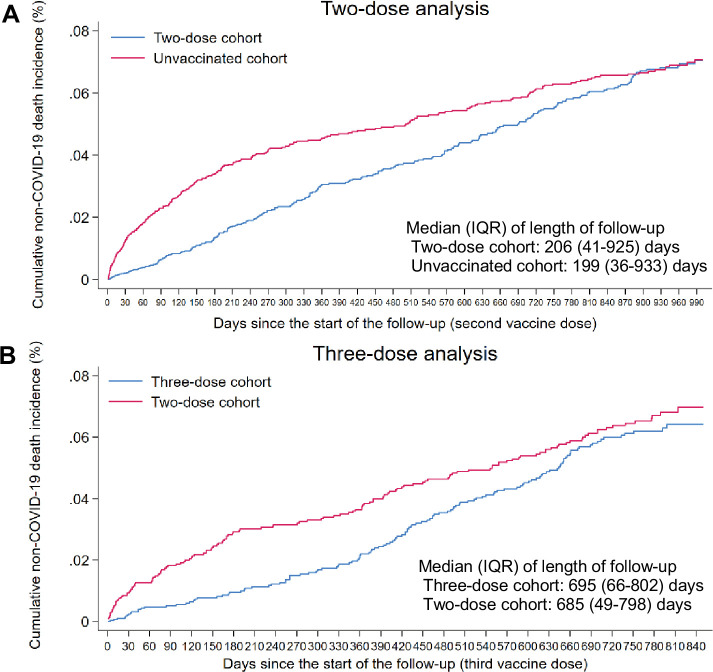
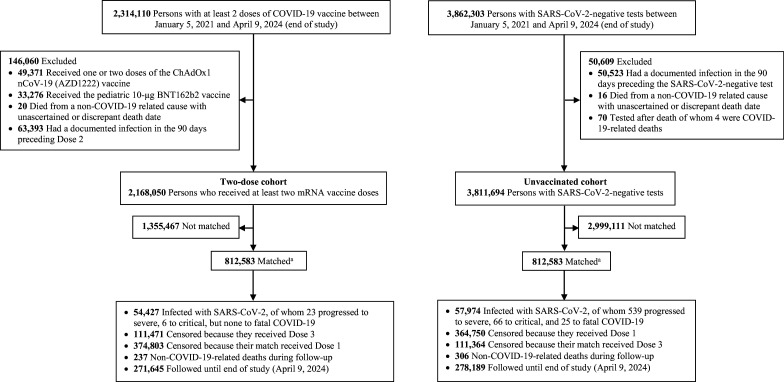
Two matched, retrospective cohort studies assessed the incidence of non-COVID-19 death in national cohorts of individuals with a primary series vaccination versus no vaccination (two-dose analysis), and individuals with three-dose (booster) vaccination versus primary series vaccination (three-dose analysis), from January 5, 2021, to April 9, 2024.
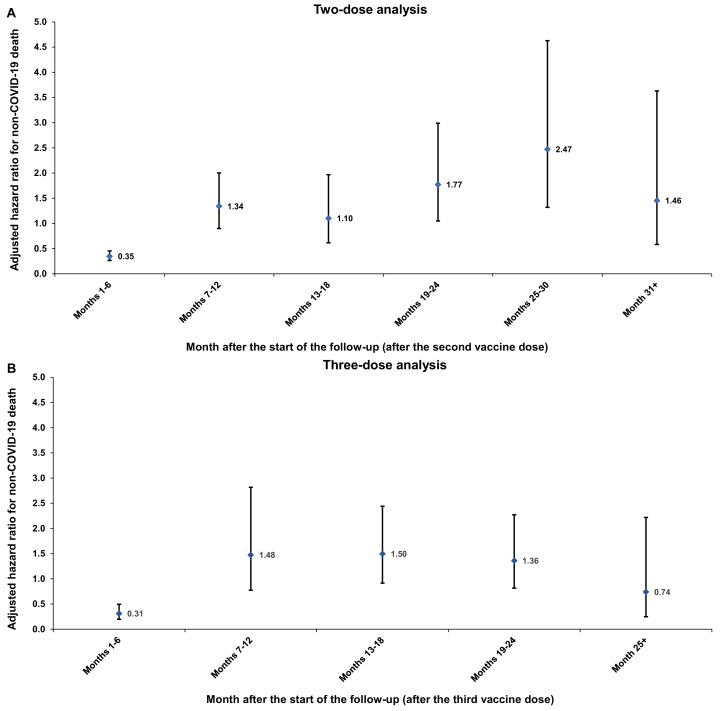
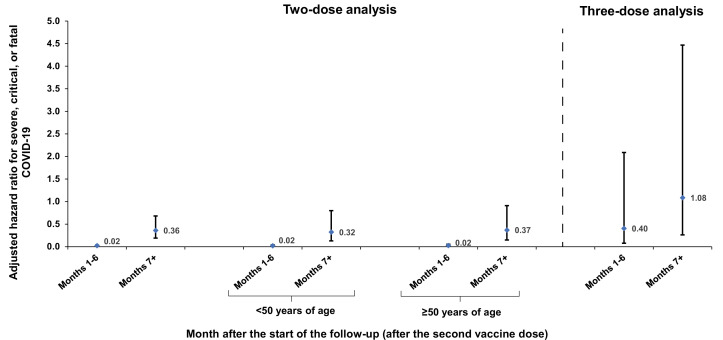
The adjusted hazard ratio (aHR) for non-COVID-19 death was 0.76 (95% CI: 0.64-0.90) in the two-dose analysis and 0.85 (95% CI: 0.67-1.07) in the three-dose analysis. In the first 6 months of follow-up in the two-dose analysis, the aHR was 0.35 (95% CI: 0.27-0.46); however, the combined analysis of all subsequent periods showed an aHR of 1.52 (95% CI: 1.19-1.94). In the first 6 months of follow-up in the three-dose analysis, the aHR was 0.31 (95% CI: 0.20-0.50); however, the combined analysis of all subsequent periods showed an aHR of 1.37 (95% CI: 1.02-1.85). The overall effectiveness of the primary series and third-dose vaccinations against severe, critical, or fatal COVID-19 was 95.9% (95% CI: 94.0-97.1) and 34.1% (95% CI: -46.4-76.7), respectively. Subgroup analyses showed that the healthy vaccinee effect is pronounced among those aged 50 years and older and among those more clinically vulnerable to severe COVID-19.
A pronounced healthy vaccinee effect was observed during the first 6 months following vaccination, despite meticulous cohort matching. This effect may have stemmed from a lower likelihood of vaccination among seriously ill, end-of-life individuals, and less mobile elderly populations.
Biomedical Research Program and the Biostatistics, Epidemiology, and Biomathematics Research Core, and Junior Faculty Transition to Independence Program, all at Weill Cornell Medicine-Qatar, Qatar University, Ministry of Public Health, Hamad Medical Corporation, Sidra Medicine, Qatar Genome Programme, Qatar University Biomedical Research Center, and L'Oréal-UNESCO For Women In Science Middle East Regional Young Talents Program.
本研究在两项严格开展的关于新冠疫苗初次系列接种和加强接种的新冠疫苗有效性研究中,调查了健康接种者效应(即接种疫苗者与未接种疫苗者之间健康状况的不平衡)的存在情况。通过分析卡塔尔新冠疫苗接种与非新冠死亡率之间的关联,本研究还考察了不同亚人群中这种效应的时间模式和变异性。
两项匹配的回顾性队列研究评估了2021年1月5日至2024年4月9日期间,初次系列接种者与未接种者(两剂分析),以及三剂(加强)接种者与初次系列接种者(三剂分析)的全国队列中非新冠死亡的发生率。
两剂分析中,非新冠死亡的调整后风险比(aHR)为0.76(95%置信区间:0.64 - 0.90),三剂分析中为0.85(95%置信区间:0.67 - 1.07)。在两剂分析的随访前6个月,aHR为0.35(95%置信区间:0.27 - 0.46);然而,所有后续时期的综合分析显示aHR为1.52(95%置信区间:1.19 - 1.94)。在三剂分析的随访前6个月,aHR为0.31(95%置信区间:0.20 - 0.50);然而,所有后续时期的综合分析显示aHR为1.37(95%置信区间:1.02 - 1.85)。初次系列接种和第三剂接种针对严重、危重症或致命新冠的总体有效性分别为95.9%(95%置信区间:94.0 - 97.1)和34.1%(95%置信区间: - 46.4 - 76.7)。亚组分析表明,健康接种者效应在50岁及以上人群以及临床上更易患重症新冠的人群中较为明显。
尽管队列匹配细致,但在接种后的前6个月观察到了明显的健康接种者效应。这种效应可能源于重症、临终个体以及行动不便的老年人群接种疫苗的可能性较低。
生物医学研究项目、生物统计学、流行病学和生物数学研究核心,以及青年教师向独立项目过渡计划,均来自威尔康乃尔医学院卡塔尔分校、卡塔尔大学、公共卫生部、哈马德医疗公司、西德拉医学中心、卡塔尔基因组计划、卡塔尔大学生物医学研究中心,以及欧莱雅 - 联合国教科文组织中东地区女性科学青年人才计划。