Limuge Qi, Zhang Yuqing, Jia Xiaofei, Wang Fang, Yu Dongsheng, Chen Lixia, Zhang Li, Jiang Yongqiang
Department of Neurosurgery, Baotou Central Hospital, Affiliated Baotou Clinical College of Inner Mongolia Medical University, Baotou, China.
Department of Functional Neurosurgery, Xuanwu Hospital, Capital Medical University, Beijing, China.
Front Aging Neurosci. 2025 May 27;17:1511845. doi: 10.3389/fnagi.2025.1511845. eCollection 2025.
Freezing of gait (FOG) is a major disabling symptom that affects the quality of life of patients with Parkinson's disease (PD). To date, notions regarding the effects of deep brain stimulation of the subthalamic neucleus (STN-DBS) on FOG remain controversial. Therefore, we developed a prediction model based on the influence of bilateral deep brain stimulation (DBS) of the subthalamic nucleus (STN) on FOG in patients with PD.
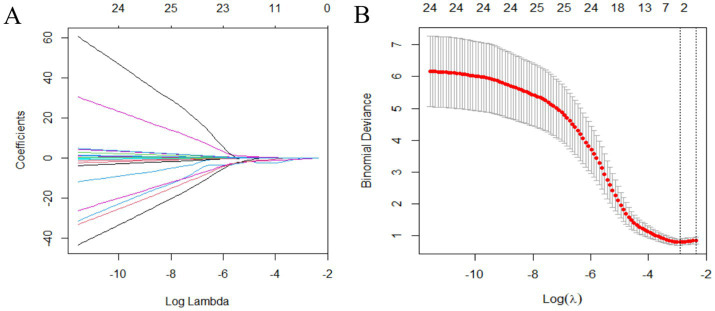
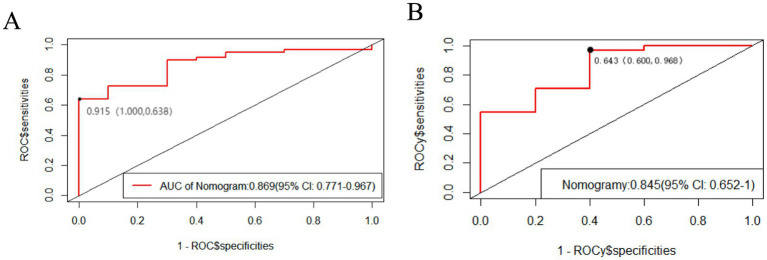
We collected data from 104 PD participants with FOG who underwent STN-DBS at Xuanwu Hospital between September 2017 and June 2022. The patients were divided into a training set (70%; = 68) and a validation set (30%; = 36). The selected characteristics in the LASSO regression were used in multivariate logistic regression to build the prediction model. The receiver operating characteristic (ROC) curves were constructed for the training and validation sets to verify the model's efficiency.
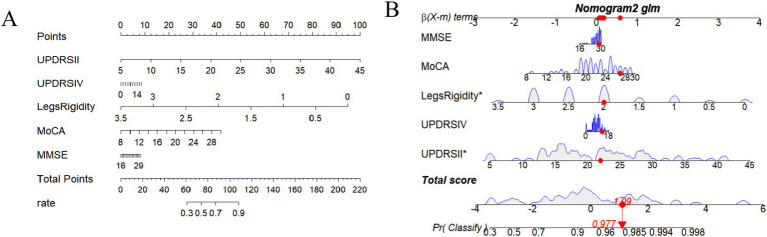
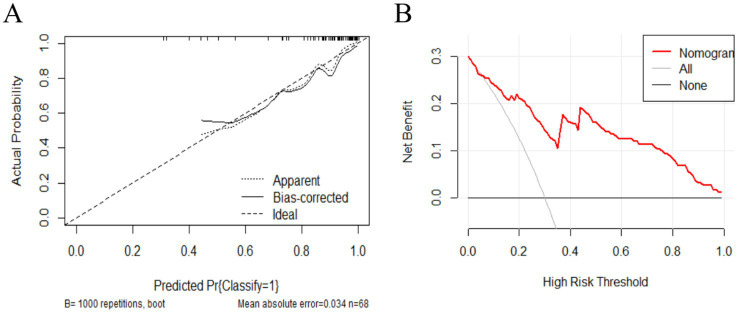
Independent variables in the prediction model included Unified Parkinson's Disease Rating Scale II (UPDRS II), UPDRS IV, leg rigidity, Montreal Cognitive Assessment (MoCA) score, and Mini-Mental State Examination (MMSE) score. The prediction model formula is as follows: Logit(y) = -1.0043 + 0.159 × UPDRS II + 0.030 × UPDRS IV - 1.726 × leg rigidity + 0.121 × MoCA + 0.036 × MMSE. To validate the model, we analyzed the ROC curves of the training and validation sets. The area under the ROC curve (AUC) of internal validation was 0.869 (95% confidence interval [CI]: 0.771-0.967) and the AUC of external validation was 0.845 (95% CI: 0.6526-1). The calibration plots showed good calibration.
The model we developed can effectively assist clinicians in assessing the efficacy of deep brain stimulation of the bilateral subthalamic nucleus for freezing of gait in Parkinson's disease patients. This approach can support the formulation of personalized treatment plans and has the potential to improve patient outcomes.
冻结步态(FOG)是一种严重的致残症状,会影响帕金森病(PD)患者的生活质量。迄今为止,关于丘脑底核深部脑刺激(STN-DBS)对冻结步态影响的观点仍存在争议。因此,我们基于双侧丘脑底核(STN)深部脑刺激(DBS)对PD患者冻结步态的影响,开发了一种预测模型。
我们收集了2017年9月至2022年6月期间在宣武医院接受STN-DBS治疗的104例有冻结步态的PD患者的数据。将患者分为训练集(70%;n = 68)和验证集(30%;n = 36)。在多因素逻辑回归中使用LASSO回归中选定的特征来构建预测模型。为训练集和验证集构建受试者工作特征(ROC)曲线,以验证模型的有效性。
预测模型中的自变量包括统一帕金森病评定量表II(UPDRS II)、UPDRS IV、腿部僵硬程度、蒙特利尔认知评估(MoCA)评分和简易精神状态检查表(MMSE)评分。预测模型公式如下:Logit(y) = -1.0043 + 0.159 × UPDRS II + 0.030 × UPDRS IV - 1.726 × 腿部僵硬程度 + 0.121 × MoCA + 0.036 × MMSE。为验证该模型,我们分析了训练集和验证集的ROC曲线。内部验证的ROC曲线下面积(AUC)为0.869(95%置信区间[CI]:0.771 - 0.967),外部验证的AUC为0.845(95% CI:0.6526 - 1)。校准图显示校准良好。
我们开发的模型可以有效地帮助临床医生评估双侧丘脑底核深部脑刺激对PD患者冻结步态的疗效。这种方法可以支持制定个性化治疗方案,并有可能改善患者的治疗效果。