Wang Yixin, Ho William, Huszar Istvan N, DiGiacomo Phillip, Taghavi Hossein Moein, Tao Lee, Choi Matthew, Nguyen Nhu, Leventis Samantha, Camarillo David B, Schlömer Philipp, Axer Markus, Wei Shao, Rusu Mirabela, Cobos Inma, Nirschl Jeff, Georgiadis Marios, Zeineh Michael
Department of Bioengineering, Stanford University, Stanford, CA, USA.
Department of Radiology, Stanford School of Medicine, Stanford, CA, USA.
bioRxiv. 2025 Jun 5:2025.06.02.657335. doi: 10.1101/2025.06.02.657335.
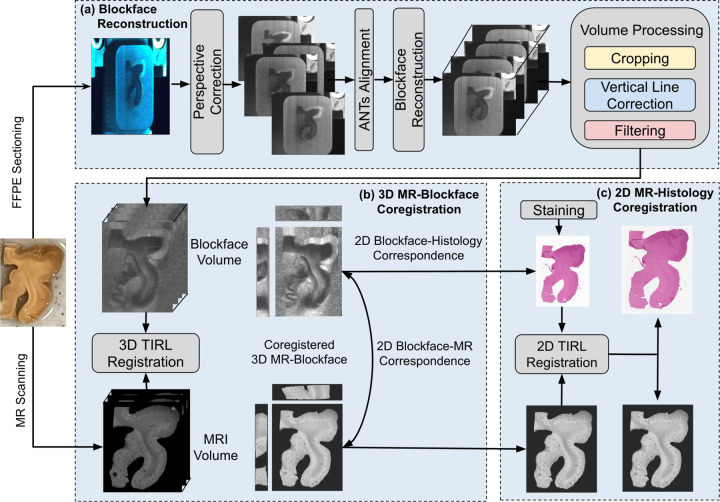
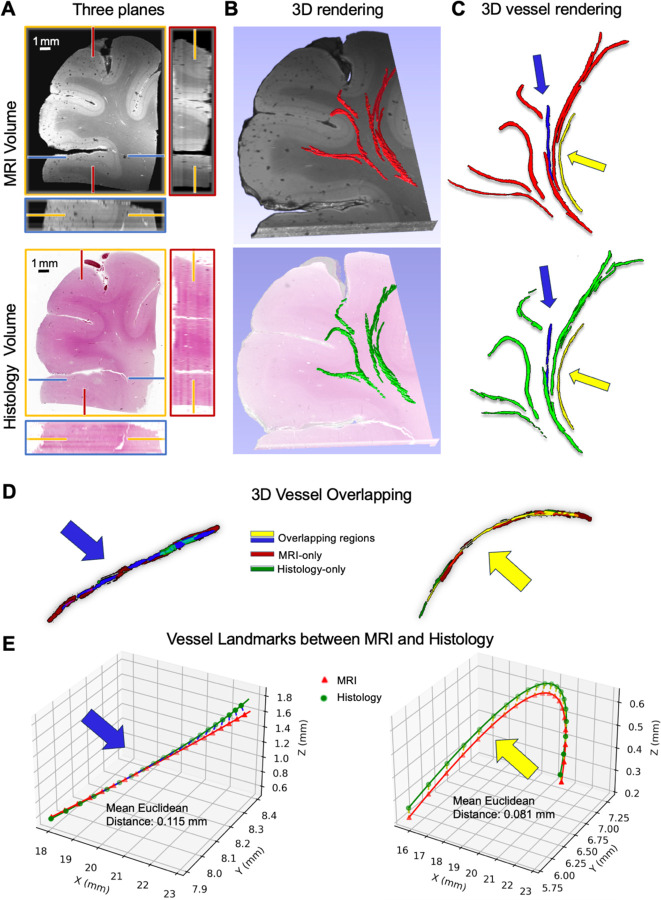
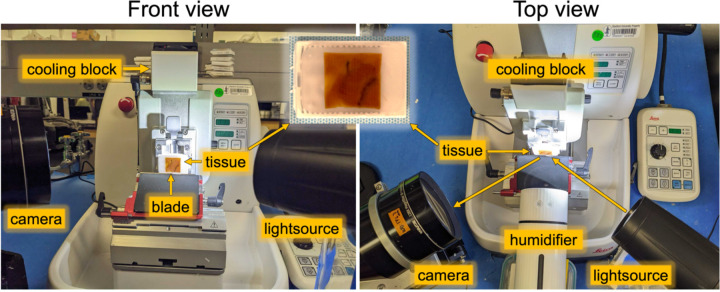
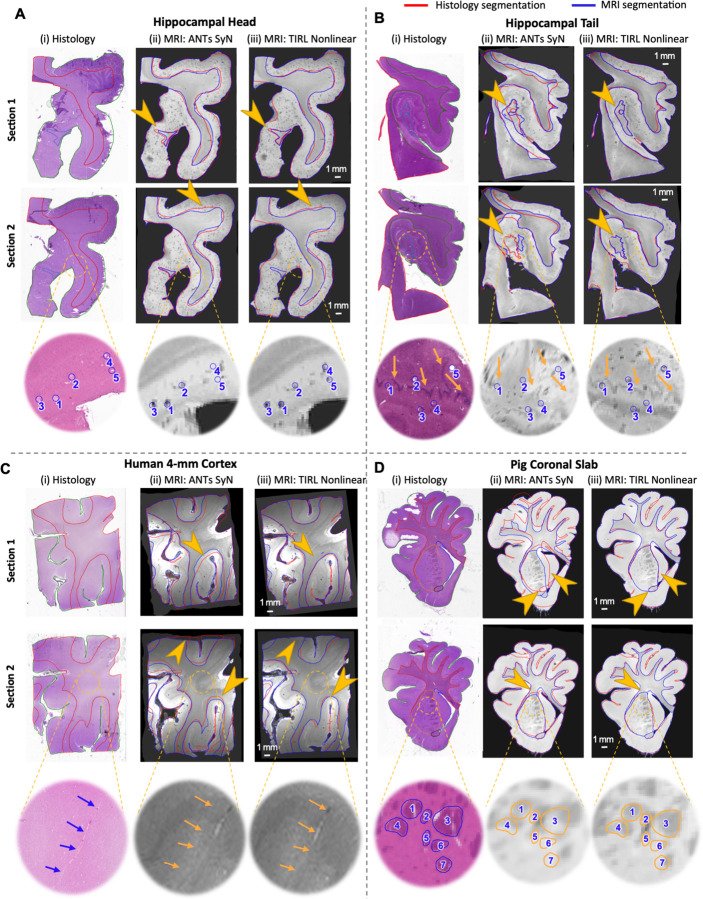
Magnetic resonance imaging (MRI) provides 3D spatial information on tissue, yet it lacks at the molecular level. In contrast, histology provides cellular and molecular information, but it lacks the 3D spatial context and direct translation. Coregistering the two is key for the 3D-embedding of histological details, validating pathological MRI findings, and finding quantitative imaging biomarkers of neurodegenerative diseases. However, coregistration is challenging due to non-linear distortions of the tissue from histological processing and sectioning leading to microscopic and macroscopic nonlinear 3D deformations between specimen MRI and stained histology sections. To address this, we developed a novel pipeline, named Brewster's Blockface Quantification (BBQ), integrating robust optical approaches with innovative 2D and 3D registration algorithms to achieve precise volumetric alignment of specimen MRI data with histological images. On a variety of brain tissue specimens from distinct anatomical regions and across multiple species, our methodology generated blockface volumes with minimal distortion and artifacts. Using these blockface volumes as an intermediary, we achieve a precise alignment between MRI and histology slides, yielding registration results with an overlapping Dice score of ~90% for whole tissue alignment between MRI and blockface volumes, and >95% for 2D MRI-histology registration. This correlative MRI-histology pipeline with robust 2D and 3D coregistration methods promises to enhance our understanding of neurodegenerative diseases and aid the development of MRI-based disease biomarkers.
磁共振成像(MRI)可提供组织的三维空间信息,但在分子层面存在不足。相比之下,组织学能提供细胞和分子信息,却缺乏三维空间背景及直接的转化。将两者进行配准是对组织学细节进行三维嵌入、验证MRI病理结果以及寻找神经退行性疾病定量成像生物标志物的关键。然而,由于组织学处理和切片过程中组织的非线性变形,导致标本MRI与染色组织学切片之间出现微观和宏观的非线性三维变形,配准具有挑战性。为解决这一问题,我们开发了一种名为布鲁斯特块面量化(BBQ)的新型流程,将强大的光学方法与创新的二维和三维配准算法相结合,以实现标本MRI数据与组织学图像的精确体积对齐。在来自不同解剖区域和多个物种的各种脑组织标本上,我们的方法生成的块面体积失真和伪影最小。以这些块面体积作为中介,我们实现了MRI与组织学切片之间的精确对齐,在MRI与块面体积之间的全组织对齐中,重叠Dice分数约为90%,在二维MRI - 组织学配准中大于95%。这种具有强大二维和三维配准方法的相关MRI - 组织学流程有望加深我们对神经退行性疾病的理解,并有助于基于MRI的疾病生物标志物的开发。