Jain Vedant D, Lundquist Erik A
The University of Kansas, Program in Molecular, Cellular, and Developmental Biology, KU Center for Genomics, Lawrence, KS 66045.
bioRxiv. 2025 May 29:2025.05.28.656589. doi: 10.1101/2025.05.28.656589.
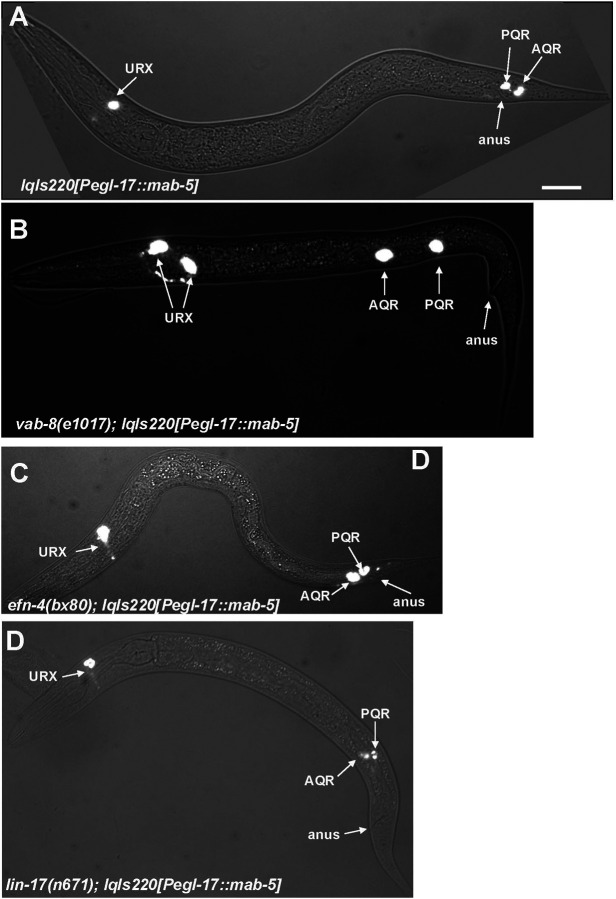
Hox transcription factors are involved in neuronal and neural crest development and differentiation, including migration, but the genetic programs employed by Hox genes to regulate terminal differentiation remain to be defined. In , the Antennapedia-like Hox factor MAB-5 is both necessary and sufficient to induce posterior migration of the Q lineage neuroblasts and neurons downstream of canonical Wnt signaling. Q lineage fluorescence-activated cell sorting and RNA seq in loss-of-function and gain-of-function backgrounds revealed genes with expression in the Q lineage dependent upon MAB-5. Here, the roles of three target genes in QL lineage posterior migration are delineated, and . First, live, time-lapse imaging of QL.a and QL.ap posterior migration revealed that this migration occurs in three distinct stages: QL.a migration posterior to QL.p; after QL.a division, posterior migration of QL.ap to a region immediately anterior to the anus; and final migration of QL.ap posterior to the anus to the final position where it differentiates into the PQR neuron. affected each of the three stages, affected stages two and three, and was required for the third stage of posterior QL.ap migration. Thus, different MAB-5 target genes control distinct stages of posterior migration. a known interaction partner with also affected only the third stage similar to . Suppression of gof posterior migration confirmed that these genes act downstream of in posterior migration. Possibly, VAB-8/KIF26 trafficks distinct molecules to the plasma membrane that mediate distinct stages of migration, including LIN-17/Fz and EFN-4. Surpisingly, failure of stages two and three led to the premature extension of a posterior dendritic protrusion, which normally forms after QL.ap had migrated to its final position and PQR differentiation begins. This suggests a link between migration and differentiation, where differentiation is delayed while migration proceeds. In sum, this works delineates a transcriptional program downstream of that controls posterior neuroblast migration, in response to Wnt signaling.
Hox转录因子参与神经元和神经嵴的发育与分化,包括迁移,但Hox基因用于调控终末分化的遗传程序仍有待确定。在秀丽隐杆线虫中,触角足样Hox因子MAB-5对于诱导Q系神经母细胞和神经元在经典Wnt信号下游的向后迁移既是必需的也是充分的。在功能丧失和功能获得背景下进行的Q系荧光激活细胞分选和RNA测序揭示了在Q系中依赖于MAB-5表达的基因。在此,描绘了三个MAB-5靶基因在QL系向后迁移中的作用,即mig-1、mig-2和mig-17。首先,对QL.a和QL.ap向后迁移的实时延时成像显示,这种迁移发生在三个不同阶段:QL.a向QL.p后方迁移;QL.a分裂后,QL.ap向后迁移到肛门前方紧邻的区域;以及QL.ap最终迁移到肛门后方至其分化为PQR神经元的最终位置。mig-1影响这三个阶段中的每一个,mig-2影响第二和第三阶段,而mig-17是QL.ap向后迁移第三阶段所必需的。因此,不同的MAB-5靶基因控制向后迁移的不同阶段。与mig-17已知的相互作用伙伴VAB-8/KIF26也仅影响第三阶段,类似于mig-17。对mig-17功能获得性向后迁移的抑制证实了这些基因在向后迁移中作用于MAB-5的下游。可能,VAB-8/KIF26将不同的分子运输到质膜,介导迁移的不同阶段,包括LIN-17/Fz和EFN-4。令人惊讶的是,第二和第三阶段的失败导致了后树突突起的过早延伸,后树突突起通常在QL.ap迁移到其最终位置且PQR分化开始后形成。这表明迁移与分化之间存在联系,即迁移进行时分化被延迟。总之,这项工作描绘了MAB-5下游的一个转录程序,该程序响应Wnt信号控制神经母细胞向后迁移。