Sall Izabella, Foxall Randi, Felth Lindsey, Gaur Anirudh, Whistler Jennifer L, Whistler Cheryl A
Department of Molecular, Cellular, & Biomedical Sciences, University of New Hampshire, Durham, NH, USA.
Graduate program in Molecular and Evolutionary Systems Biology, University of New Hampshire, Durham, NH, USA.
bioRxiv. 2025 Jun 1:2025.06.01.657215. doi: 10.1101/2025.06.01.657215.
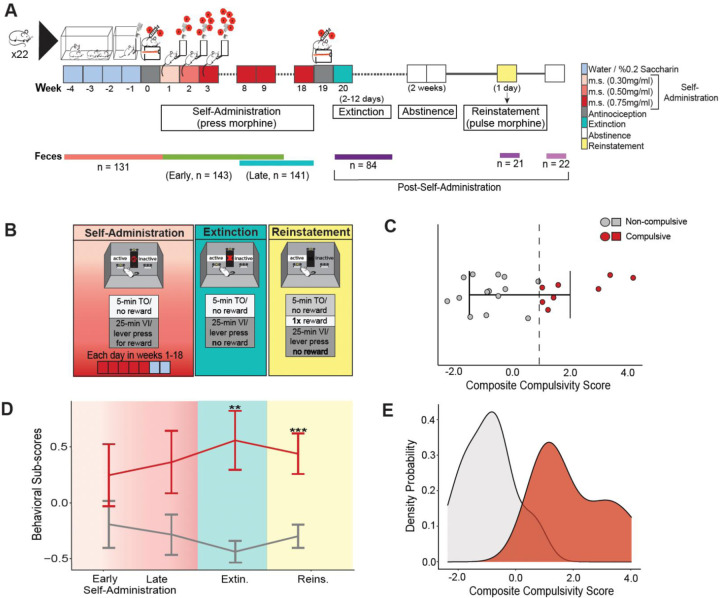
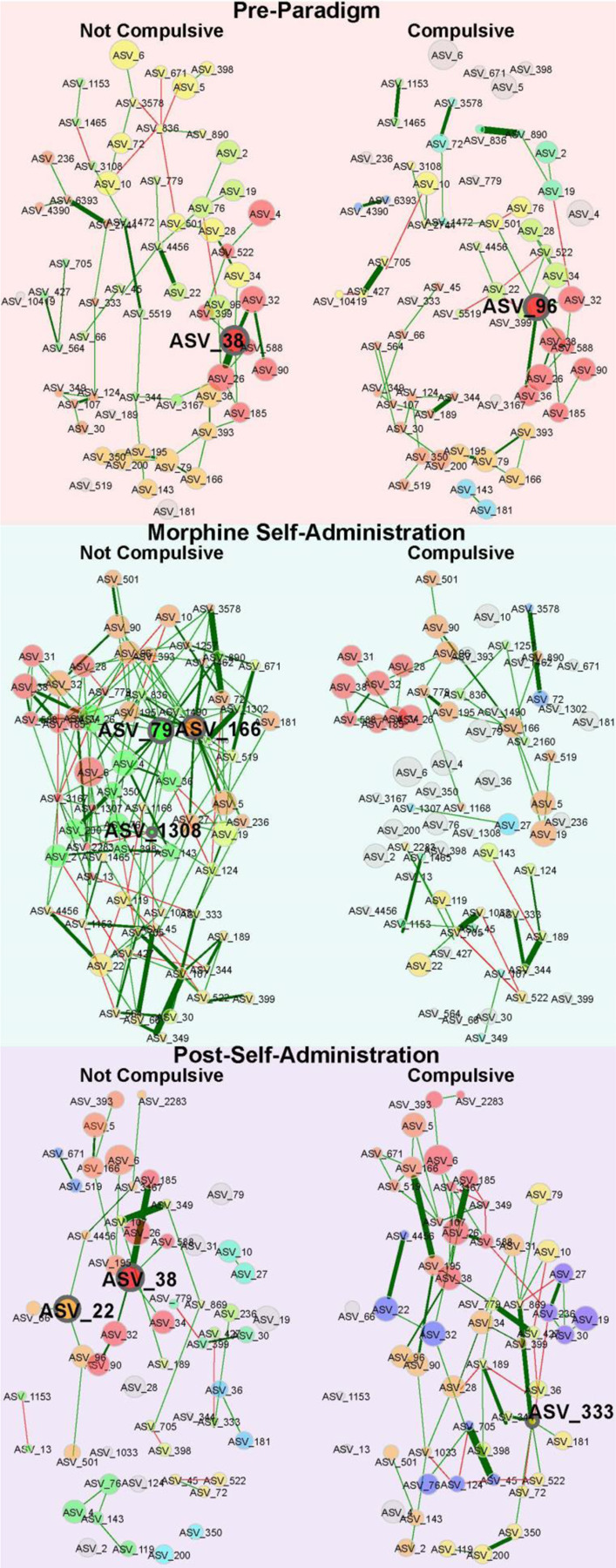
Although opioids are effective analgesics, they can lead to problematic drug use behaviors that underlie opioid use disorder (OUD). Opioids also drive gut microbiota dysbiosis which is linked to altered opioid responses tied to OUD. To interrogate the role of the gut microbiota in a mouse model of OUD, we used a longitudinal paradigm of voluntary oral morphine self-administration to capture multiple facets of drug seeking and preserve both individual behavioral response and gut microbiota variation to examine associations between these two variables. After prolonged morphine consumption, only a subset of mice transitioned to a state we define statistically as compulsive. In compulsive mice, morphine fragmented the microbiota networks which subsequently reorganized to form robust novel connections. In contrast, the communities of non-compulsive mice also changed but were highly interconnected during morphine disturbance and maintained more continuity post morphine suggesting dynamic flexibility. Compulsive mice displayed a greater loss of functional diversity and a shift towards a new stable state dominated by potential pathobionts, whereas non-compulsive mice better preserved genera associated with gut health and broader functional diversity. These findings highlight how persistent and stable gut microbiota dysbiosis aligns with long-term behavioral changes underlying OUD, potentially contributing to relapse.
尽管阿片类药物是有效的镇痛药,但它们会导致引发阿片类药物使用障碍(OUD)的药物使用问题行为。阿片类药物还会导致肠道微生物群失调,这与OUD相关的阿片类药物反应改变有关。为了探究肠道微生物群在OUD小鼠模型中的作用,我们采用了自愿口服吗啡自我给药的纵向范式,以捕捉药物寻求的多个方面,并保留个体行为反应和肠道微生物群变异,以检查这两个变量之间的关联。在长期服用吗啡后,只有一部分小鼠转变为我们在统计学上定义为强迫性的状态。在强迫性小鼠中,吗啡破坏了微生物群网络,随后这些网络重新组织形成了强大的新连接。相比之下,非强迫性小鼠的群落也发生了变化,但在吗啡干扰期间高度互联,在停用吗啡后保持了更多的连续性,表明具有动态灵活性。强迫性小鼠表现出更大的功能多样性丧失,并向以潜在致病共生菌为主导的新稳定状态转变,而非强迫性小鼠更好地保留了与肠道健康相关的属和更广泛的功能多样性。这些发现突出了持续且稳定的肠道微生物群失调如何与OUD潜在的长期行为变化相关联,可能导致复发。