Dang Linh V P, Martin Alexis, Carosi Julian M, Gore Jemima, Singh Sanjna, Sargeant Timothy J
Lysosomal Health in Ageing, Lifelong Health, South Australian Health and Medical Research Institute (SAHMRI), Adelaide, South Australia, Australia.
Adelaide Medical School, The University of Adelaide, Adelaide, South Australia, Australia.
FASEB J. 2025 Jun 30;39(12):e70708. doi: 10.1096/fj.202402377R.
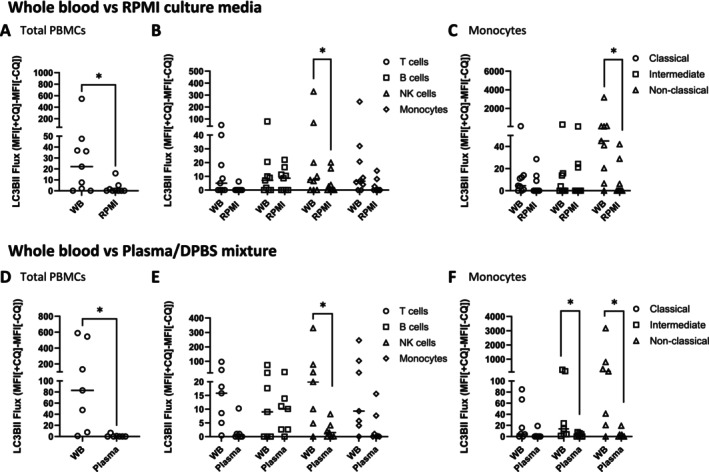
Autophagy is a naturally conserved mechanism crucial for degrading and recycling damaged organelles and proteins to support cell survival. This process slows biological aging and age-related disease in preclinical models. However, there has been little translation of autophagy to the clinic, and we have identified a lack of measurement tools for physiological human autophagy as a barrier. To address this, we have previously developed a direct measurement tool for autophagy in pooled human peripheral blood mononuclear cells (PBMCs) in the context of whole blood. In order to better understand how autophagy behaves and changes in humans, we measured human autophagic flux using flow cytometry in 19 cell subpopulations in whole blood to retain physiological flux. Autophagic flux was different between different cell types, being different within different monocyte, B lymphocyte, natural killer cell, and T lymphocyte subtypes. Autophagic flux also varied with sex, being higher in monocytes in females compared with males. In keeping with previous observations in humans, autophagy also increased with aging at subpopulation levels. Importantly, we found that only monocytes-specifically, nonclassical monocytes-displayed robust increased autophagic flux following amino acid withdrawal, underscoring the importance of population selection for measurement of autophagic flux during nutrient restriction studies in humans. Collectively, these data show PBMC population-level analysis improves sensitivity of human autophagic flux measurement.
自噬是一种自然保守的机制,对于降解和回收受损的细胞器及蛋白质以维持细胞存活至关重要。在临床前模型中,这一过程可减缓生物衰老及与年龄相关的疾病。然而,自噬在临床上的转化应用极少,我们发现缺乏用于测量人体生理自噬的工具是一个障碍。为解决这一问题,我们之前开发了一种在全血环境下对人外周血单个核细胞(PBMC)中的自噬进行直接测量的工具。为了更好地了解自噬在人体中的表现及变化,我们使用流式细胞术在全血中的19种细胞亚群中测量人体自噬通量以保留生理通量。不同细胞类型之间的自噬通量不同,在不同的单核细胞、B淋巴细胞、自然杀伤细胞和T淋巴细胞亚型中也存在差异。自噬通量也因性别而异,女性单核细胞中的自噬通量高于男性。与之前在人体中的观察结果一致,在亚群水平上自噬也随年龄增长而增加。重要的是,我们发现只有单核细胞——具体而言是非经典单核细胞——在氨基酸撤出后显示出自噬通量显著增加,这突出了在人体营养限制研究中选择细胞群体来测量自噬通量的重要性。总体而言,这些数据表明PBMC群体水平分析提高了人体自噬通量测量的灵敏度。