Kumar Aravinda, Konduru Rajesh Kumar, Rajaram Saranya, Mani Manikandan, Natarajan Anusha, Cherian Jerin Jose, Bagepally Bhavani Shankara, Purty Anil Jacob, Iqbal Nayyar, Sekar Dineshbabu, Sundaramurthi Sudharsanan, Topno Isabella, Chalawadi Hanumappa Manjunatha
Department of Pharmacology, Pondicherry Institute of Medical Sciences, Puducherry, India.
Department of Community Medicine, Pondicherry Institute of Medical Sciences, Puducherry, India.
JMIR Res Protoc. 2025 Jul 31;14:e69626. doi: 10.2196/69626.
The inappropriate use of multiple medications known as polypharmacy is a growing concern for older populations with comorbid conditions in India. Polypharmacy can lead to serious adverse health outcomes, increased health care costs, and reduced quality of life. Screening tools such as the Medication Appropriateness Index (MAI) and Screening Tool for Older Persons' Prescriptions (STOPP) or Screening Tool to Alert to Right Treatment (START) criteria can help identify potentially inappropriate medications, and interventions such as medication review clinics and prescribing audits can help improve the appropriateness. A collaborative medication review (CMR) involving a team approach is important to ensure that patients receive the best possible care.
The primary objective is to assess the feasibility of implementation of interdepartmental CMR to reduce potentially inappropriate medications in hospitalized older adults. The secondary objectives are to (1) explore the facilitators and barriers in this implementation from the health care providers' perspective, (2) determine the costs involved in the implementation from a health system perspective, and (3) analyze the efficacy of interdepartmental CMR by using MAI, postdischarge adverse events, and number of medication-related admissions.
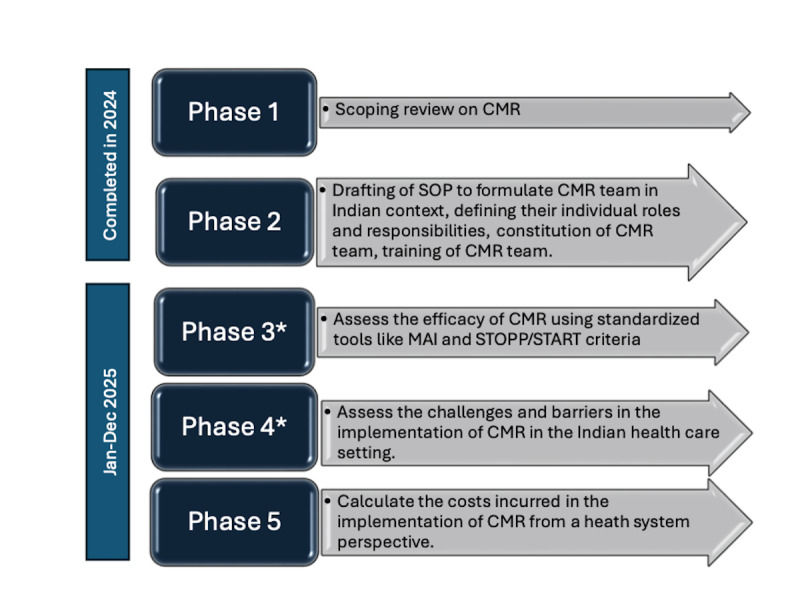
This study consists of 5 phases aimed at improving CMR practices in India. Phase 1 focused on conducting a scoping review of CMR practices. Phase 2 involved creating standard operating procedures to establish a CMR team, delineating roles and responsibilities, and providing training. Phase 3 will evaluate the efficacy of CMR by using standardized tools such as MAI and STOPP/START criteria. Phase 4 assesses the challenges faced in implementing CMR. Finally, phase 5 analyzes the costs related to CMR implementation. This study employs a multicentered mixed methods approach, combining qualitative methods (in-depth interviews and focus group discussions) to explore implementation challenges and quantitative analysis through a quasi-experimental study involving 280 hospitalized older adults. It aims to measure costs and the reduction of potentially inappropriate medications post discharge.
This study received a grant from the Indian Council of Medical Research-Safe and Rational Use of Medicine Task Force in December 2023. All study preparatory approvals were obtained. Phase 1 and phase 2 were completed by December 2024. Phase 3 is scheduled to finish by June 2025. Phases 4 and 5 are planned for completion by August 2025. Final data analysis and manuscript submission are expected by December 2025.
This study can provide insights into the implementation and effectiveness of CMR and help to understand the facilitators and barriers to implementing interdepartmental CMR and the cost incurred in its implementation. Interprofessional teams will collaboratively review and optimize medications for older patients with multimorbidity in India-a strategy expected to enhance care coordination, improve clinical outcomes, and reduce health care costs.
Clinical Trials Registry - India CTRI/2024/06/069220; https://ctri.nic.in/Clinicaltrials/pmaindet2.php?EncHid=OTgyNDg=&Enc=&userName=.
在印度,多种药物的不当使用(即多重用药)日益引起患有合并症的老年人群的关注。多重用药可能导致严重的不良健康后果、医疗保健成本增加以及生活质量下降。诸如药物适宜性指数(MAI)、老年人处方筛查工具(STOPP)或正确治疗警示筛查工具(START)标准等筛查工具可帮助识别潜在不适当的药物,而诸如药物审查诊所和处方审核等干预措施有助于提高用药的适宜性。涉及团队协作的联合药物审查(CMR)对于确保患者获得最佳护理至关重要。
主要目的是评估实施跨部门联合药物审查以减少住院老年人潜在不适当用药的可行性。次要目的包括:(1)从医疗保健提供者的角度探索实施过程中的促进因素和障碍;(2)从卫生系统的角度确定实施过程中涉及成本;(3)通过使用MAI、出院后不良事件以及与药物相关的住院次数分析跨部门联合药物审查的效果。
本研究包括五个阶段,旨在改善印度的联合药物审查实践。第一阶段专注于对联合药物审查实践进行范围审查。第二阶段涉及创建标准操作程序,以建立联合药物审查团队、明确角色和职责并提供培训。第三阶段将通过使用MAI和STOPP/START标准等标准化工具评估联合药物审查的效果。第四阶段评估实施联合药物审查时面临的挑战。最后,第五阶段分析与联合药物审查实施相关的成本。本研究采用多中心混合方法,结合定性方法(深入访谈和焦点小组讨论)来探索实施挑战,并通过涉及280名住院老年人的准实验研究进行定量分析。其旨在衡量成本以及出院后潜在不适当用药的减少情况。
本研究于2023年12月获得了印度医学研究理事会 - 安全合理用药特别工作组的资助。已获得所有研究筹备批准。第一阶段和第二阶段已于2024年12月完成。第三阶段计划于2025年6月完成。第四阶段和第五阶段计划于2025年8月完成。预计最终数据分析和稿件提交将于2025年12月完成。
本研究可为联合药物审查的实施和有效性提供见解,并有助于了解实施跨部门联合药物审查的促进因素和障碍以及实施过程中产生的成本。跨专业团队将协作审查并优化印度患有多种疾病的老年患者的用药——这一策略有望加强护理协调、改善临床结果并降低医疗保健成本。
印度临床试验注册中心CTRI/2024/06/069220;https://ctri.nic.in/Clinicaltrials/pmaindet2.php?EncHid=OTgyNDg=&Enc=&userName=.