Zhu Xiangjia, Liu Xin, He Wenwen, Cheng Kaiwen, Meng Jiaqi, Qi Jiao, Zhao Jing, Lu Yi, Zhou Xingtao
Eye Institute and Department of Ophthalmology, Eye & ENT Hospital Fudan University, Shanghai, China.
NHC Key laboratory of Myopia and Related Eye Diseases, Key Laboratory of Myopia and Related Eye Diseases, Chinese Academy of Medical Sciences, Shanghai, China.
Transl Vis Sci Technol. 2025 Jun 2;14(6):26. doi: 10.1167/tvst.14.6.26.
The purpose of this study was to classify eyes with presbyopia using lens functional and structural features to aid in surgical decision making.
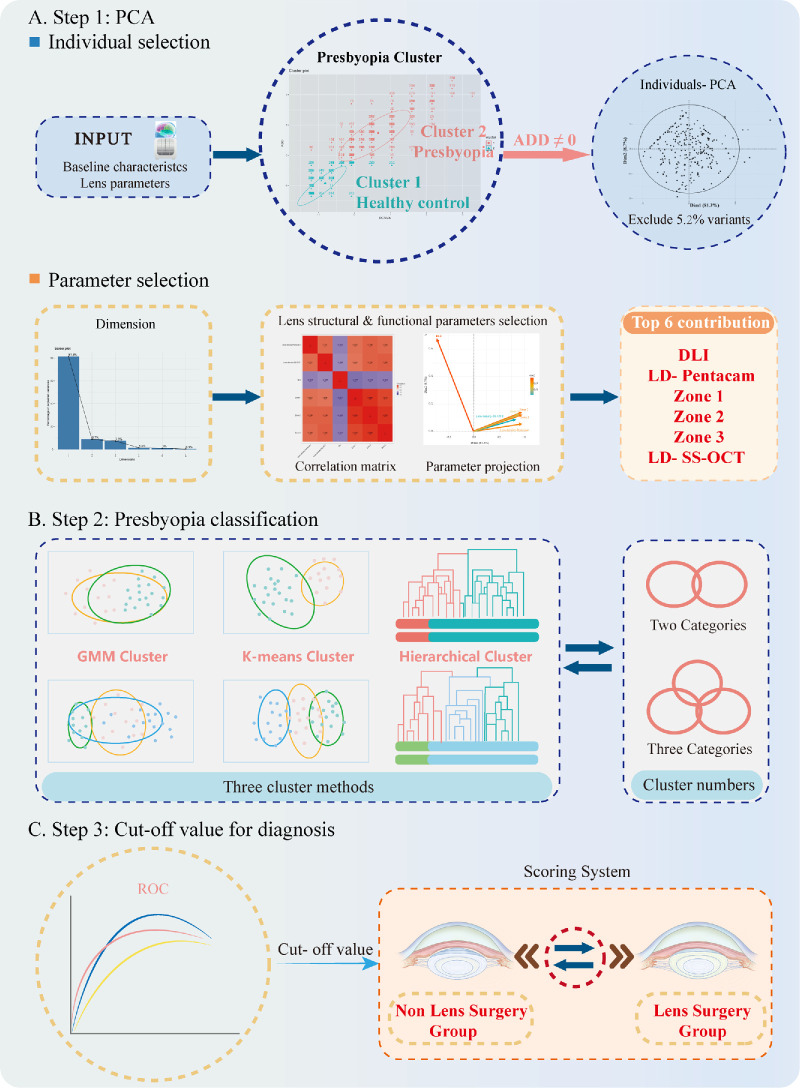
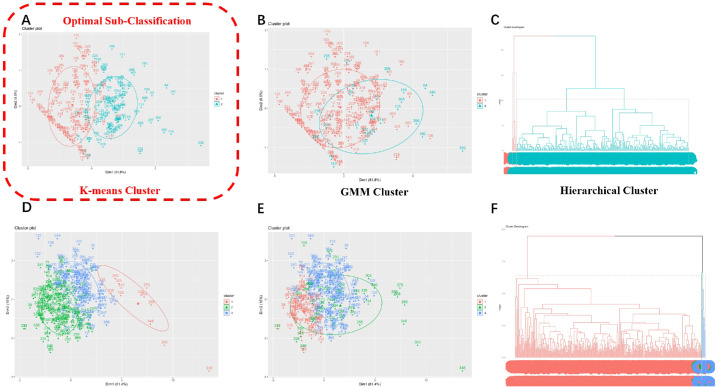
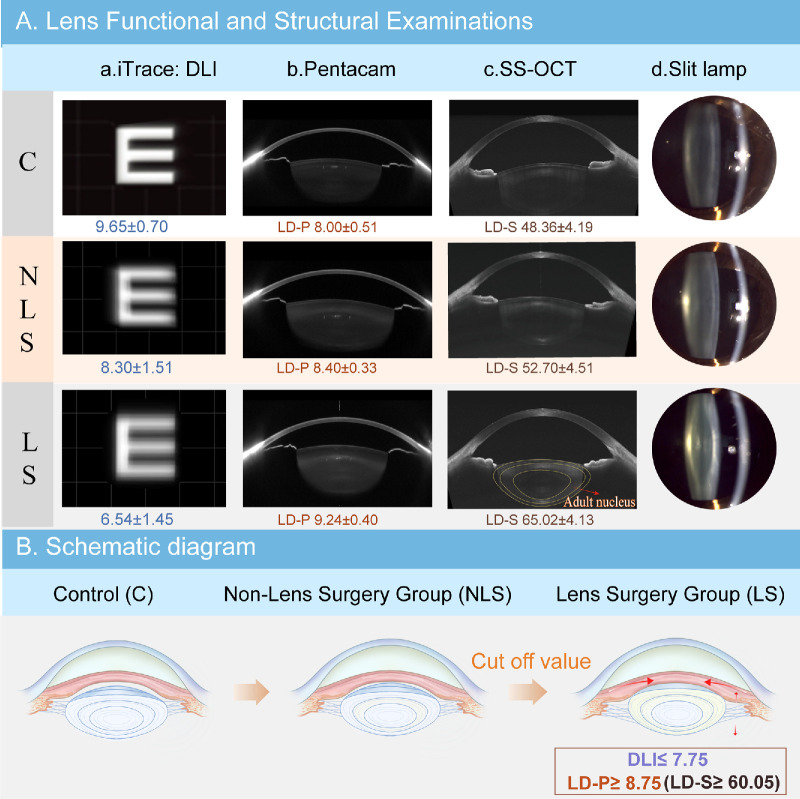
This cross-sectional observational study included healthy volunteers or those solely affected by presbyopia. Lens function was assessed using dysfunction lens index (DLI), whereas lens density was evaluated with Pentacam (LD-P) and swept-source optical coherence tomography (LD-S). Principal component analysis (PCA) and k-means clustering classified participants into non-lens surgery (NLS) and lens surgery (LS) groups. A scoring system was developed from the optimal cutoff values for simplified diagnosis, with a website created for automatic classification.
Totally, 352 eyes of 176 patients were studied, with a mean age of 46.1 ± 6.2 years and a mean axial length of 24.42 ± 1.62 mm. Among them, 268 (76.1%) eyes were diagnosed with presbyopia. The top 5.2% (14/268) of presbyopia cases with the highest variability were excluded by PCA. Subsequently, 138 eyes (51.5%) were clustered into the NLS group, and 116 eyes (43.3%) into the LS group. The LS group presented lower DLI and higher lens density compared to the NLS group (all P < 0.001). Optimal cutoff values were determined as follows: DLI = 7.75, LD-P = 8.75, and LD-S = 60.05 pixel units. The scoring system demonstrated that combining DLI with LD-P achieved the highest diagnostic efficacy. A website (www.zhu-zhou-lf.com) was developed for automatic classification.
We proposed a novel classification of presbyopia using lens functional and structural features.
This classification, integrating DLI and lens density values, offers a diagnostic tool to guide surgical decisions in presbyopia.
本研究旨在利用晶状体功能和结构特征对老花眼进行分类,以辅助手术决策。
这项横断面观察性研究纳入了健康志愿者或仅患有老花眼的患者。使用功能障碍晶状体指数(DLI)评估晶状体功能,而使用Pentacam(LD-P)和扫频光学相干断层扫描(LD-S)评估晶状体密度。主成分分析(PCA)和k均值聚类将参与者分为非晶状体手术(NLS)组和晶状体手术(LS)组。根据简化诊断的最佳临界值建立了一个评分系统,并创建了一个网站用于自动分类。
共研究了176例患者的352只眼,平均年龄为46.1±6.2岁,平均眼轴长度为24.42±1.62mm。其中,268只眼(76.1%)被诊断为老花眼。PCA排除了变异性最高的5.2%(14/268)的老花眼病例。随后,138只眼(51.5%)被聚类到NLS组,116只眼(43.3%)被聚类到LS组。与NLS组相比,LS组的DLI较低,晶状体密度较高(所有P<0.001)。确定的最佳临界值如下:DLI = 7.75,LD-P = 8.75,LD-S = 60.05像素单位。评分系统表明,将DLI与LD-P相结合可实现最高的诊断效能。开发了一个网站(www.zhu-zhou-lf.com)用于自动分类。
我们提出了一种利用晶状体功能和结构特征对老花眼进行的新分类。
这种整合DLI和晶状体密度值的分类方法提供了一种诊断工具,可指导老花眼的手术决策。