Rizzo Stefania, Bellesi Luca, Khalifa Ebticem Ben, Presilla Stefano, D'Ermo Andrea, Magoga Francesco, Merli Matteo, Rezzonico Ermidio, D'Ecclesiis Oriana, Del Grande Filippo
Clinic of Radiology, Imaging Institute of Southern Switzerland (IIMSI), Ente Ospedaliero Cantonale (EOC), 6900 Lugano, Switzerland.
Faculty of Biomedical Sciences, Università Della Svizzera Italiana (USI), Via G. Buffi 13, 6904 Lugano, Switzerland.
Cancers (Basel). 2025 May 29;17(11):1815. doi: 10.3390/cancers17111815.
BACKGROUND/OBJECTIVES: The primary aim of this study was to evaluate whether the replacement of roughly one-decade-old computed tomography (CT) scanners with new-model CT scanners were associated with an additional reduction in the radiation dose delivered to oncological patients, in a radiological setting where the optimization of protocols had already reached very low radiation doses. An exploratory secondary objective was to evaluate the potential differences in the objective image quality between the CT scans obtained before and after the installation of the new-generation CT scanners.
Chest and abdominal CT examinations conducted for oncologic purposes were retrospectively selected from two time periods-prior to scanner replacement (2022) and following an upgrade (2024)-after five CT systems in our radiology department were replaced. We extracted and compared the CT dose index (CTDI) and dose length product (DLP) for each CT phase. For the objective image quality evaluation, we calculated the signal-to-noise ratio (SNR) and the contrast-to-noise ratio (CNR) at the center of the liver and the aorta. An appropriate statistical analysis was performed and a -value < 0.05 was considered significant.
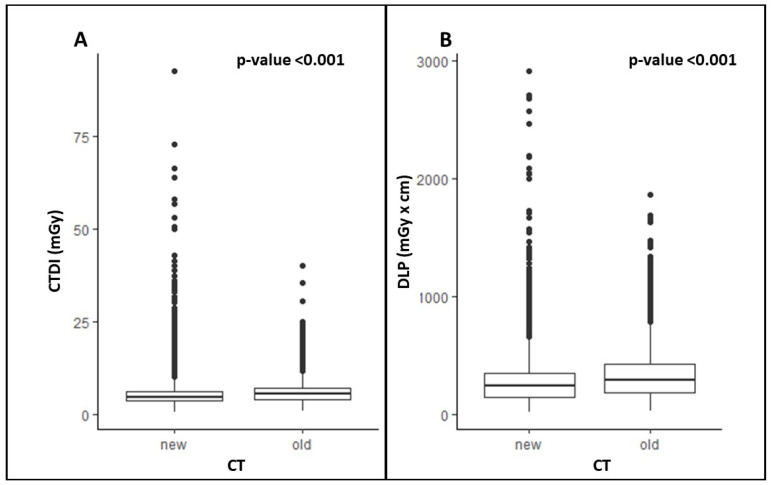
We included 14,601 CT acquisitions, of which 9013 (61.7%) were performed before and 5588 (38.3%) after the replacement of the CT scanners. There were significantly lower values for the CTDI and DLP with the new CT scanners compared to the old ones. The CTDI with the new CT scanners was significantly lower in all phases (-value = 0.002 for unenhanced phase, and < 0.001 for arterial, portal venous, and delayed phases). The DLP using the new CT scanners was significantly lower in the arterial, portal venous, and delayed phases ( < 0.001), and it was not significantly different in the unenhanced phase ( = 0.36). There was no significant difference in the SNR at the liver level ( = 0.72) or at the aorta level ( = 0.51). There was no significant difference in the CNR at the liver level ( = 0.24), whereas the CNR was higher with the new CT scanners at the aorta level ( = 0.03).
The transition to new-model CT scanners resulted in a significant reduction in the radiation dose delivered by chest and abdomen CT scans, without compromising the objective image quality.
背景/目的:本研究的主要目的是评估在一个协议优化已使辐射剂量降至极低水平的放射环境中,用新型计算机断层扫描(CT)扫描仪替换使用了近十年的CT扫描仪是否会使肿瘤患者所接受的辐射剂量进一步降低。一个探索性的次要目的是评估安装新一代CT扫描仪前后所获得的CT扫描图像在客观图像质量上的潜在差异。
我们回顾性选取了两个时间段内出于肿瘤学目的进行的胸部和腹部CT检查,这两个时间段分别为:我们放射科的五台CT系统更换前(2022年)和更换后(2024年)。我们提取并比较了每个CT阶段的CT剂量指数(CTDI)和剂量长度乘积(DLP)。对于客观图像质量评估,我们计算了肝脏和主动脉中心处的信噪比(SNR)和对比噪声比(CNR)。进行了适当的统计分析,P值<0.05被认为具有统计学意义。
我们纳入了14601次CT扫描,其中9013次(61.7%)是在CT扫描仪更换前进行的,5588次(38.3%)是在更换后进行的。与旧CT扫描仪相比,新CT扫描仪的CTDI和DLP值显著更低。新CT扫描仪在所有阶段的CTDI均显著更低(平扫期P值=0.002,动脉期、门静脉期和延迟期P<0.001)。新CT扫描仪在动脉期、门静脉期和延迟期的DLP显著更低(P<0.001),在平扫期无显著差异(P=0.36)。肝脏层面的SNR(P=0.72)或主动脉层面的SNR(P=0.51)无显著差异。肝脏层面的CNR无显著差异(P=0.24),而主动脉层面新CT扫描仪的CNR更高(P=0.03)。
向新型CT扫描仪的转变显著降低了胸部和腹部CT扫描的辐射剂量,且未影响客观图像质量。