Boschloo Lynn, Wijnands Jasmijn, Garnefski Nadia, Kraaij Vivian, Hurks Petra, Remmerswaal Danielle, Wiers Reinout W, Struijs Sascha, Salemink Elske
Department of Clinical Psychology, Utrecht University, Utrecht, the Netherlands.
Division of Clinical Psychology, Leiden University, Leiden, the Netherlands.
Internet Interv. 2025 May 16;41:100834. doi: 10.1016/j.invent.2025.100834. eCollection 2025 Sep.
Students often report depression and stress symptomatology but may differ in their symptoms and their symptom-specific changes during interventions. This study adopted a symptom-specific approach and examined 1) individual symptoms in students experiencing mild to severe depression symptomatology and 2) changes in individual symptoms during a guided, internet-based intervention. We zoomed in on how these (changes in) symptoms were related to each other and to (changes in) overall quality of life.
This study included 1816 students with mild to severe baseline depression symptomatology, of which 412 activated their account for an eight-week, guided, internet-based Cognitive Behavioural Therapy intervention () and completed the post-treatment assessment. Depression symptomatology was assessed with the Patient Health Questionnaire, stress symptomatology with the Perceived Stress Scale and overall quality of life with a single item from the Mental Health Quality of Life questionnaire. Network estimations were conducted to examine the interrelations of (changes in) symptoms.
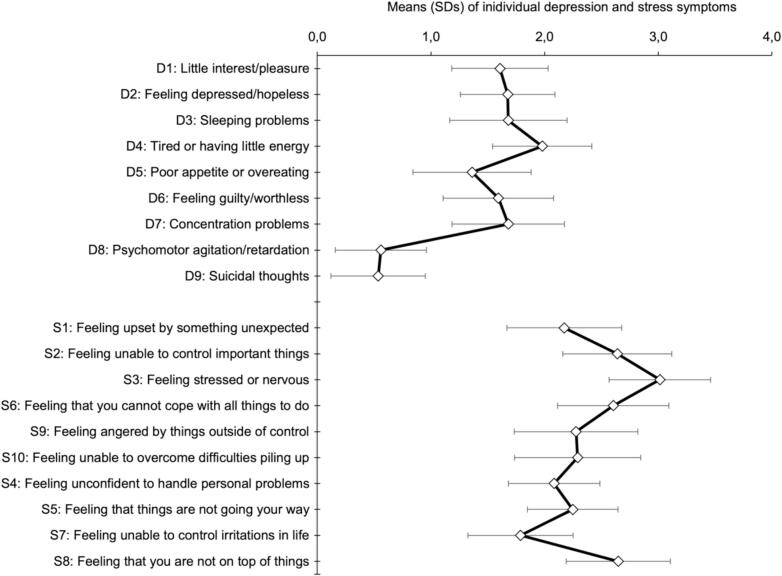
Mean scores of baseline symptoms differed substantially, and network estimations showed multiple positive connections across symptoms and negative connections of symptoms with overall quality of life. During the intervention, all symptoms reduced significantly, although with differential magnitude, and network estimations showed that changes in symptoms were differentially related to other changes in symptoms and changes in overall quality of life.
Our findings highlight the importance of considering individual symptoms and their interrelations as a more complete and nuanced measure for 1) the heterogeneity of baseline symptomatology and 2) the heterogeneity of changes in symptomatology during an intervention.
学生经常报告有抑郁和压力症状,但在干预期间他们的症状及其特定症状变化可能存在差异。本研究采用特定症状方法,研究了1)有轻度至重度抑郁症状的学生的个体症状,以及2)在基于互联网的引导式干预期间个体症状的变化。我们深入研究了这些(症状的)变化如何相互关联以及与总体生活质量(的变化)相关。
本研究纳入了1816名有轻度至重度基线抑郁症状的学生,其中412人激活了他们的账户,接受为期八周的基于互联网的引导式认知行为疗法干预,并完成了治疗后评估。使用患者健康问卷评估抑郁症状,使用感知压力量表评估压力症状,使用心理健康生活质量问卷中的一个单项评估总体生活质量。进行网络估计以研究(症状的)变化之间的相互关系。
基线症状的平均得分差异很大,网络估计显示症状之间存在多个正向联系,以及症状与总体生活质量之间存在负向联系。在干预期间,所有症状均显著减轻,尽管减轻幅度不同,并且网络估计显示症状变化与其他症状变化以及总体生活质量变化存在不同程度的关联。
我们的研究结果强调了将个体症状及其相互关系作为一种更完整、更细致的衡量标准的重要性,以用于1)基线症状的异质性和2)干预期间症状变化的异质性。