Munoz-Chereau Bernardita, Ang Lynn, Dockrell Julie, Outhwaite Laura, Heffernan Claire
UCL Institute of Education, UK.
London International Development Centre (LIDC) London School of Hygiene and Tropical Medicine, UCL Institute of Education, UK.
J Early Child Res. 2021 Dec;19(4):443-470. doi: 10.1177/1476718X211020031. Epub 2021 Jun 14.
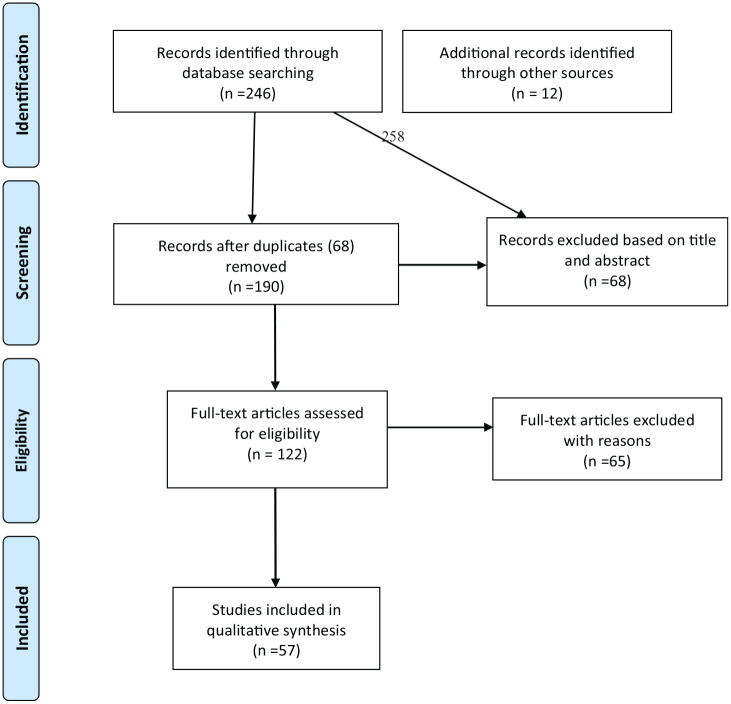
The Sustainable Development Goals mandate that by 2030, all children should have access to quality early child development opportunities, healthcare and pre-primary education. Yet validated measures of ECD in low and middle income countries (LMICs) are rare. To address this gap, a Systematic Review (SR) of measures available to profile the development of children between the ages of 0-5 years in LMICs was undertaken. Drawing on education, psychology and health databases, we identified reliable, valid or measures adapted for use in LMICs for either assessments of children's development or their learning environments. The inclusion criteria were (1) peer reviewed papers published between January 2009 and May 2019; (2) assessment tools used to measure cognitive/language development or the early years or home environment in at least one LMIC; (3) report of the psychometric properties (validity and reliability) of the tool, and/or description of the cultural adaptability/translation process undertaken before applying it to a LMIC. Two hundred and forty-nine available records published in the last decade in peer-review journals and nine relevant systematic literature reviews were identified. Fifty-seven records were qualitatively synthesised based on their psychometric properties and cultural adaptation. Forty-three tools were reviewed utilising 12 criteria. Five elements of analysis present in Tables 2 and 3 (study, population tested, validity, reliability and cultural adaptability/translation) focused on the tools' psychometric properties and previous application in LMICs. A further seven dimensions outlined in Tables 4 and 5 identified specific characteristics of the tools from target age, administration method, domains, battery, accessibility, language and country/institution. We suggest these 12 key considerations for the selection of measurement tools that are applicable to effectively assess ECD in LMICs.
可持续发展目标要求,到2030年,所有儿童都应能获得优质的早期儿童发展机会、医疗保健和学前教育。然而,在低收入和中等收入国家(LMICs),经过验证的早期儿童发展测量方法却很少见。为了填补这一空白,我们对LMICs中用于描述0至5岁儿童发展情况的现有测量方法进行了系统综述(SR)。我们利用教育、心理学和健康数据库,确定了可靠、有效或适用于LMICs的测量方法,用于评估儿童的发展或其学习环境。纳入标准为:(1)2009年1月至2019年5月期间发表的同行评审论文;(2)至少在一个LMIC中用于测量认知/语言发展或早年或家庭环境的评估工具;(3)该工具的心理测量特性(有效性和可靠性)报告,和/或在将其应用于LMIC之前进行的文化适应性/翻译过程的描述。我们确定了过去十年在同行评审期刊上发表的249条可用记录以及9篇相关的系统文献综述。根据其心理测量特性和文化适应性,对57条记录进行了定性综合。利用12条标准对43种工具进行了审查。表2和表3中呈现的五个分析要素(研究、测试人群、有效性、可靠性和文化适应性/翻译)侧重于工具的心理测量特性以及此前在LMICs中的应用情况。表4和表5中概述的另外七个维度确定了工具在目标年龄、施测方法、领域、成套工具、可及性、语言以及国家/机构方面的具体特征。我们提出了这12项关键考量因素,以选择适用于有效评估LMICs中早期儿童发展情况的测量工具。