Iida Kenji, Kikkawa Taishi, Murakami Takashi
Department of Rehabilitation, Makita Rehabilitation Hospital: 4-22-1 Nishikamata, Ota-ku, Tokyo 144-0051, Japan.
Department of Rehabilitation, Ushioda General Hospital, Japan.
J Phys Ther Sci. 2025 Jun;37(6):316-319. doi: 10.1589/jpts.37.316. Epub 2025 Jun 1.
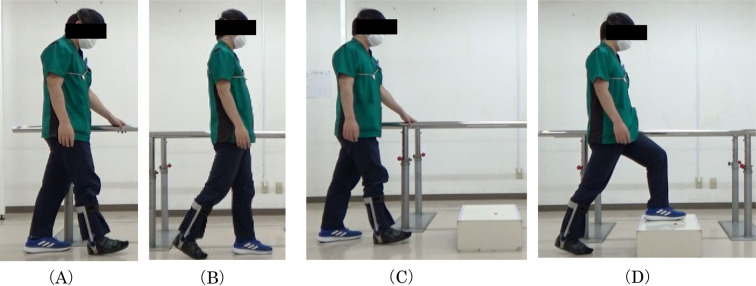
[Purpose] We report a case of stroke hemiplegia in which two types of step training affected gait parameters. [Participant and Methods] A 50-year-old man presented with right-sided hemiplegia caused by a left putaminal hemorrhage. Four months after the onset of asymmetric gait, he practiced stepping in the anterior-posterior directions on a 20-cm platform. Step training was conducted over three 5-day periods. Gait parameters were evaluated on the day following the completion of each training period. Data on the maximum walking speed, single- and double-leg support phases, and step length were collected. Furthermore, the symmetry ratio and trailing limb angle were calculated. [Results] Post-training improvements were noted in gait symmetry, and the trailing limb angle on the affected side improved after anterior-posterior step training. [Conclusion] Anterior-posterior step training may improve gait parameters following a hemiplegic stroke.
[目的] 我们报告一例中风偏瘫病例,其中两种类型的阶梯训练影响了步态参数。[参与者与方法] 一名50岁男性因左侧壳核出血导致右侧偏瘫。在不对称步态发作四个月后,他在一个20厘米高的平台上练习前后方向的踏步。阶梯训练分三个为期5天的阶段进行。在每个训练阶段结束后的第二天评估步态参数。收集最大步行速度、单腿和双腿支撑阶段以及步长的数据。此外,计算对称率和患侧拖曳肢体角度。[结果] 训练后步态对称性有所改善,前后阶梯训练后患侧拖曳肢体角度得到改善。[结论] 前后阶梯训练可能改善偏瘫性中风后的步态参数。