Hegedűs Zsombor I, Jakab Márk E, Gergely Tamás G, Sayour Nabil V, Kovács Andrea, Antal Sára, Kovács Tamás, Ferdinandy Péter, Varga Zoltán V, Tóth Viktória E
Department of Pharmacology and Pharmacotherapy, Semmelweis University, Budapest, Hungary.
Center for Pharmacology and Drug Research and Development, Semmelweis University, Budapest, Hungary.
Cardiovasc Diabetol. 2025 Jun 14;24(1):253. doi: 10.1186/s12933-025-02806-5.
Incretin analogues, used for the treatment of type 2 diabetes mellitus and obesity, such as GLP1-receptor agonist liraglutide (Lira) have been shown to reduce major adverse cardiac events in recent clinical trials of heart failure. Tirzepatide (TZP), a dual GIP/GLP1-receptor agonist has shown promising results in the SUMMIT trial as improved cardiovascular outcomes in patients with heart failure with preserved ejection fraction (HFpEF). However, data regarding their use in heart failure with reduced ejection fraction (HFrEF) is lacking. We performed a head-to-head comparative study in a mouse model of non-ischaemic cardiac injury induced by continuous angiotensin II (AngII) infusion, as AngII is a key driver of both heart failure forms.
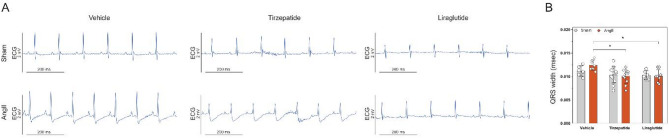
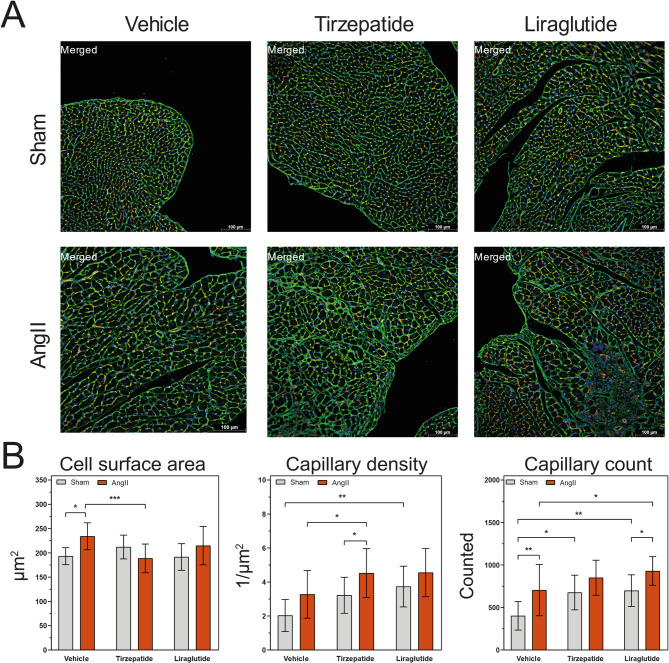
Osmotic minipumps were inserted for subcutaneous (s.c.) administration of AngII (1.5 mg/kg/day) in 5-month-old male Balb/c mice or sham surgery was performed. Animals were treated with vehicle (Veh), Lira (300 µg/day i.p.) or TZP (48 µg/day s.c.) for 14 days in the following groups: Sham/Veh (n = 7), AngII/Veh (n = 15), Sham/Lira (n = 7), AngII/Lira (n = 15), Sham/TZP (n = 8), AngII/TZP (n = 15). Cardiac structural, functional and molecular characteristics were assessed by echocardiography, ECG, immunohistochemistry, flow cytometry and qRT-PCR.
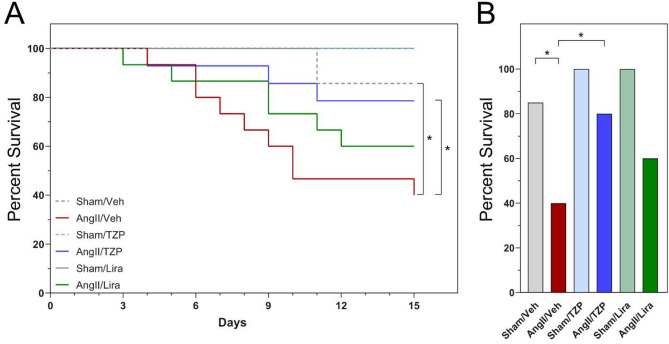
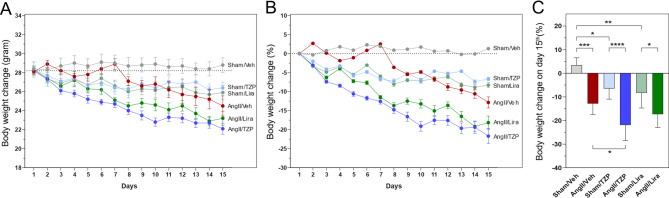
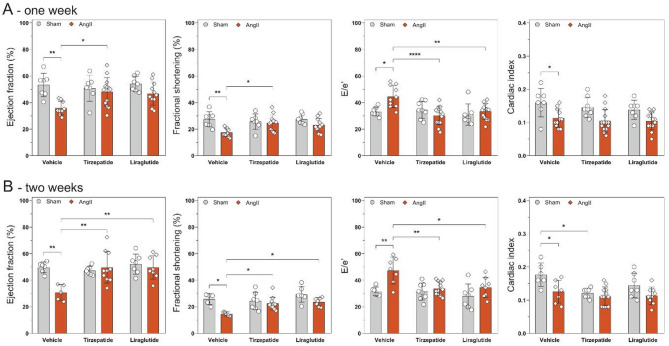
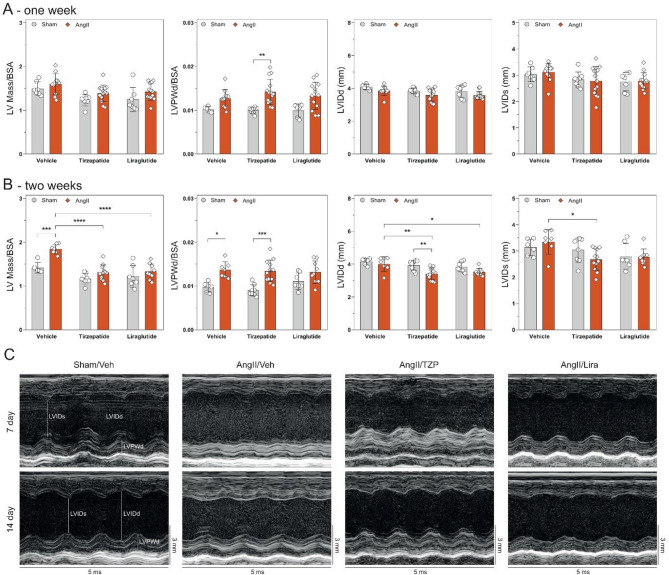
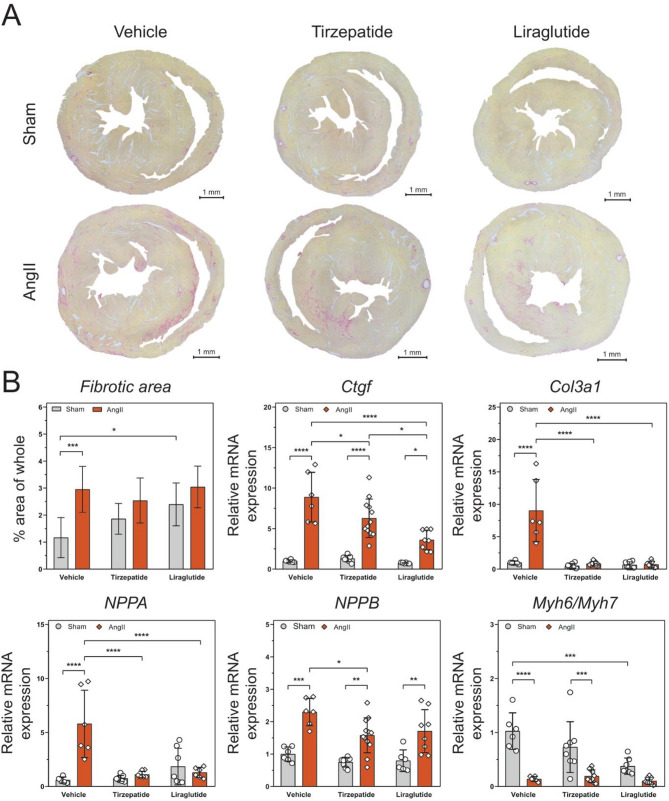
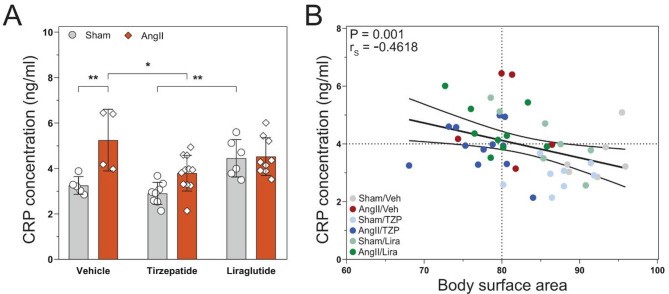
Mortality was significantly higher in AngII/Veh animals compared to controls, while AngII/TZP mice showed significantly reduced mortality after 14 days of treatment. Both Lira and TZP caused significant weight reduction compared to controls. AngII given alone also reduced body mass, and this reduction was further enhanced by TZP. Treatment with both compounds preserved cardiac systolic and diastolic function compared with AngII/Veh animals, as shown by normal ejection fraction and E/e', respectively. Both Lira and TZP decreased the AngII-induced elevation of cardiac fibrosis and hypertrophy markers, including Ctgf, Col1a1, Col3a1, and Nppa, while TZP also reduced the elevated Nppb level. TZP also reduced systemic inflammation, as shown by the reduction in serum CRP levels.
Lira and TZP preserved cardiac function and decreased markers of hypertrophy and fibrosis in mice with AngII-induced heart failure, whereas TZP also significantly decreased mortality. In addition to HFpEF, the use of incretin analogues may also be of clinical relevance in the treatment of HFrEF. However, as patients with heart failure, AngII level is elevated and can cause weight loss/cachexia, the usage of incretin analogues to treat non-obese heart failure patients should be considered.
用于治疗2型糖尿病和肥胖症的肠促胰岛素类似物,如胰高血糖素样肽1(GLP1)受体激动剂利拉鲁肽(Lira),在近期心力衰竭临床试验中已显示可减少主要不良心脏事件。替尔泊肽(TZP)是一种双重葡萄糖依赖性促胰岛素多肽(GIP)/GLP1受体激动剂,在SUMMIT试验中已显示出有前景的结果,即改善射血分数保留的心力衰竭(HFpEF)患者的心血管结局。然而,关于它们在射血分数降低的心力衰竭(HFrEF)中的应用数据尚缺乏。我们在持续输注血管紧张素II(AngII)诱导的非缺血性心脏损伤小鼠模型中进行了一项直接比较研究,因为AngII是两种心力衰竭形式的关键驱动因素。
将渗透微型泵插入5月龄雄性Balb/c小鼠皮下以给予AngII(1.5mg/kg/天),或进行假手术。在以下组中,动物用溶媒(Veh)、Lira(300μg/天,腹腔注射)或TZP(48μg/天,皮下注射)治疗14天:假手术/Veh组(n = 7)、AngII/Veh组(n = 15)、假手术/Lira组(n = 7)、AngII/Lira组(n = 15)、假手术/TZP组(n = 8)、AngII/TZP组(n = 15)。通过超声心动图、心电图、免疫组织化学、流式细胞术和定量逆转录聚合酶链反应(qRT-PCR)评估心脏结构、功能和分子特征。
与对照组相比,AngII/Veh组动物的死亡率显著更高,而AngII/TZP组小鼠在治疗14天后死亡率显著降低。与对照组相比,Lira和TZP均导致显著体重减轻。单独给予AngII也降低了体重,并且TZP进一步增强了这种降低。与AngII/Veh组动物相比,两种化合物治疗均保留了心脏收缩和舒张功能,分别通过正常射血分数和E/e'得以体现。Lira和TZP均降低了AngII诱导的心脏纤维化和肥大标志物的升高,包括结缔组织生长因子(Ctgf)、I型胶原α1(Col1a1)、III型胶原α1(Col3a1)和心房钠尿肽(Nppa),而TZP还降低了升高的脑钠肽(Nppb)水平。TZP还降低了全身炎症,如血清C反应蛋白(CRP)水平的降低所示。
Lira和TZP在AngII诱导的心力衰竭小鼠中保留了心脏功能并降低了肥大和纤维化标志物,而TZP还显著降低了死亡率。除HFpEF外,肠促胰岛素类似物的应用在HFrEF治疗中可能也具有临床相关性。然而,由于心力衰竭患者的AngII水平升高且可导致体重减轻/恶病质,应考虑使用肠促胰岛素类似物治疗非肥胖心力衰竭患者。