Alshehri Mohammed Ali, Alahdal Hadil, Aloqbi Akram Ahmed, Shakoori Afnan Mohammed, Sindi Ghadir, Bagadood Rehab M, Alsaffar Nida, Alobaidy Mohammad Ahmad, Alrabiah Noof Abdulrahman, Khursheed Md, Tuwaijri Abeer Al
Department of Clinical Laboratory Sciences, Faculty of Applied Medical Sciences, Najran University, Najran, Saudi Arabia.
Department of Biology, College of Science, Princess Nourah bint Abdulrahman University, Riyadh, Saudi Arabia.
Front Oncol. 2025 May 30;15:1598883. doi: 10.3389/fonc.2025.1598883. eCollection 2025.
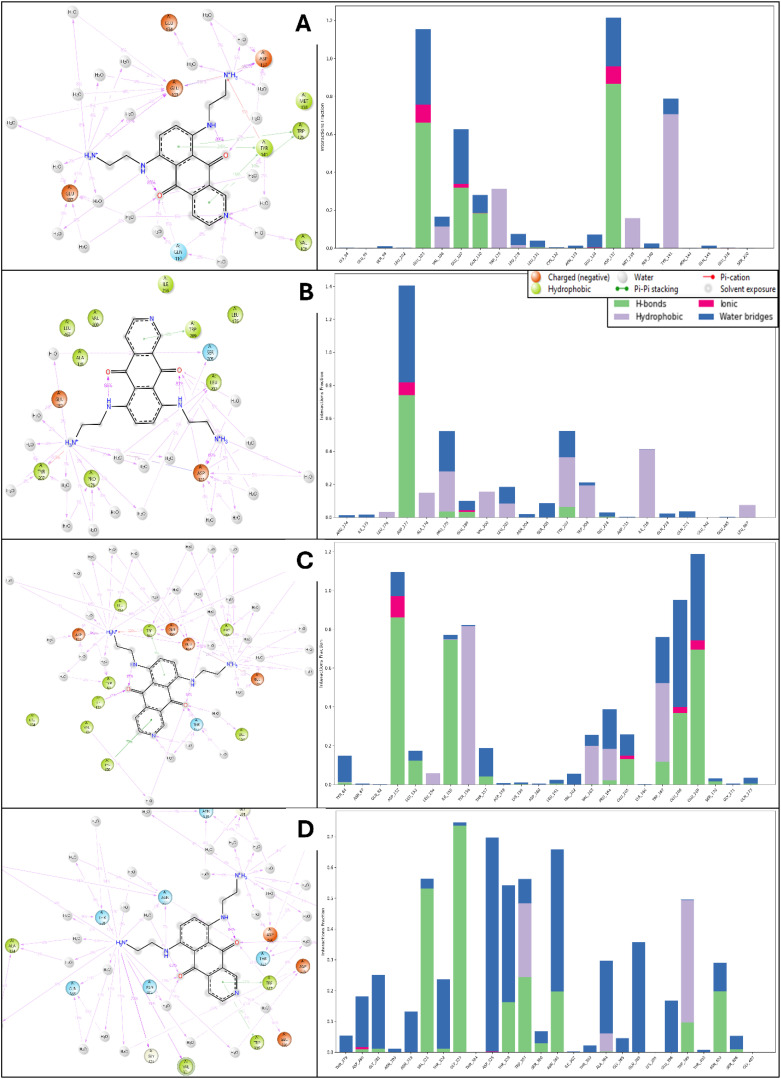
Cervical cancer, primarily caused by persistent infection with high-risk human papillomavirus strains, leads to abnormal cell growth in the cervix. Globally, it accounts for over 600,000 new cases and 340,000 deaths annually, with the highest burden in low- and middle-income countries due to limited screening and vaccination. Early detection is challenging as initial stages are asymptomatic, while advanced cases are challenging to treat. Current options, including surgery, radiotherapy, and chemotherapy, face issues like toxicity, limited efficacy, recurrence, and drug resistance caused by tumor heterogeneity and adaptive mechanisms. Multitargeted drug design offers a solution by modulating multiple cancer pathways, enhancing efficacy, minimizing resistance, and reducing side effects. In this study, we screened Selleckchem approved library against cervical cancer proteins that regulate the cell cycle, particularly during mitosis and cell division (PDBIDs: 2VFX, 2WVI, 3KND, 4N14) using HTVS, SP, and XP docking followed by MMGBSA post-processing. Pixuvri (Pixantrone Maleate) emerged as the top candidate with docking scores of -5.234 to -9.218 kcal/mol and MMGBSA scores of -39.22 to -53.87 kcal/mol. Pixuvri is approved for non-Hodgkin lymphoma and exhibits minimal cardiotoxicity compared to anthracyclines. Interaction fingerprints highlighted key residues (4GLN, 4GLU, 3TRP), while pharmacokinetics, DFT computations, and WaterMap hydration site analysis supported its potential. Molecular dynamics (100 ns, NVT ensemble at 300K) validated stability by deviation and fluctuation studies and found many interactions to stabilize the complex, with binding free energy computations confirming its affinity. While the results support Pixuvri's repurposing for cervical cancer, experimental validation is essential for clinical application.
宫颈癌主要由高危型人乳头瘤病毒持续感染引起,会导致子宫颈细胞异常生长。在全球范围内,宫颈癌每年新增病例超过60万例,死亡34万例,由于筛查和疫苗接种受限,低收入和中等收入国家的负担最重。早期检测具有挑战性,因为初始阶段无症状,而晚期病例治疗也很困难。目前的治疗选择,包括手术、放疗和化疗,面临着毒性、疗效有限、复发以及由肿瘤异质性和适应性机制导致的耐药性等问题。多靶点药物设计通过调节多种癌症途径、提高疗效、最小化耐药性和减少副作用提供了一种解决方案。在本研究中,我们使用高通量虚拟筛选(HTVS)、标准精度(SP)和高精度(XP)对接,随后进行MMGBSA后处理,针对调节细胞周期(特别是在有丝分裂和细胞分裂期间)的宫颈癌蛋白(PDB编号:2VFX、2WVI、3KND、4N14)对赛莱默公司批准的文库进行了筛选。匹杉琼(马来酸匹杉琼)成为顶级候选药物,对接分数为-5.234至-9.218千卡/摩尔,MMGBSA分数为-39.22至-53.87千卡/摩尔。匹杉琼已被批准用于非霍奇金淋巴瘤,与蒽环类药物相比,其心脏毒性最小。相互作用指纹突出了关键残基(4GLN、4GLU、3TRP),而药代动力学、密度泛函理论(DFT)计算和水合位点分析支持了其潜力。分子动力学(100纳秒,300K下的NVT系综)通过偏差和波动研究验证了稳定性,发现许多相互作用稳定了复合物,结合自由能计算证实了其亲和力。虽然结果支持匹杉琼用于宫颈癌的重新利用,但实验验证对于临床应用至关重要。