Burgess Mark, Silsby Laura, Madden Susanna, Letra Joana Da Silva, Thomson Stephanie, Tate Janine, Mitchinson Sharon, Hurley Katherine, Hurley Rebecca, Bon Marco, Pritchard Rachel, Duncalf Sue, Gardiner Dale
Department of Intensive Care and Anaesthetics, Faculty of Intensive Care Medicine, St. Richard's Hospital, Royal College of Anaesthetists, University Hospitals Sussex, Chichester, United Kingdom.
Statistics and Clinical Research, NHS Blood and Transplant, Bristol, United Kingdom.
Transplant Direct. 2025 Jun 12;11(7):e1804. doi: 10.1097/TXD.0000000000001804. eCollection 2025 Jul.
Eligible donation after brain death (DBD) donors may rarely proceed via the donation after circulatory death (DCD) pathway. The incidence, reasons for pathway divergence, and graft and recipient outcomes in the United Kingdom of this cohort are unknown. We aimed to establish the incidence of eligible DBD to DCD donors in the United Kingdom, the reasons for pathway divergence, organ donation and utilization rates, and the renal graft and recipient outcomes for this cohort.
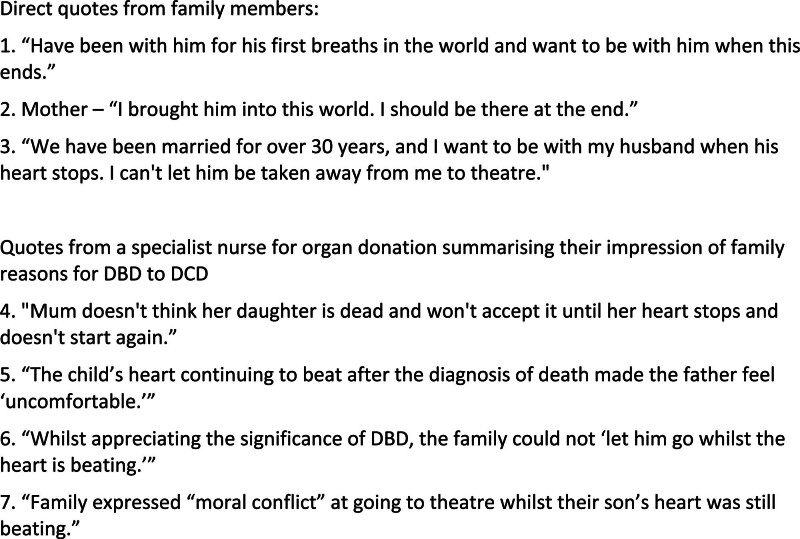
UK electronic and article records were reviewed for all eligible DBD donors proceeding via the DCD pathway from 2012 to 2022. Incidence and stated reasons for pathway divergence, including direct family quotations and time to mechanical asystole, were recorded. These data, in addition to organ donation and utilization rates and those pertaining to renal graft and recipient survival rates, were compared with "standard DCD" and "standard DBD" control groups.
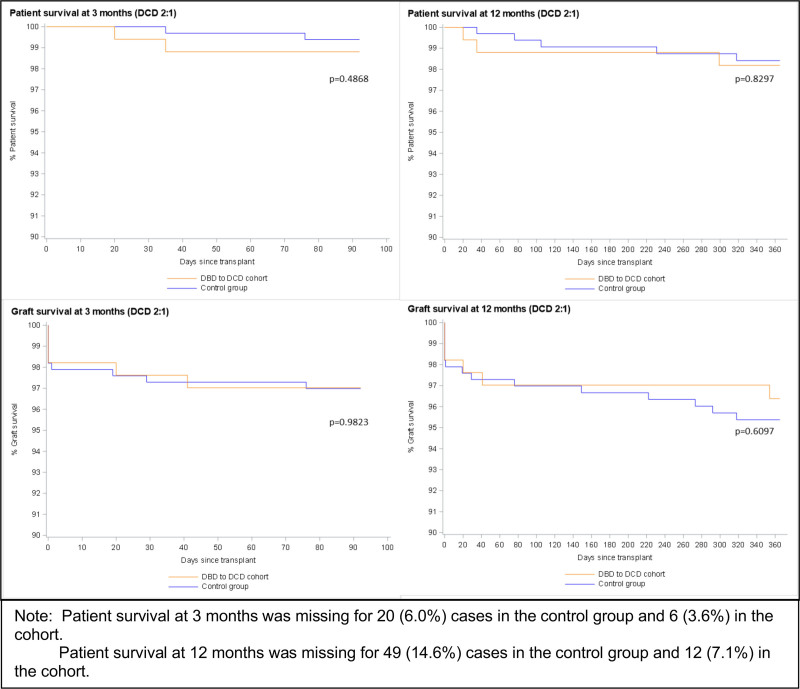
One hundred twenty-three eligible DBD donors proceeded via the DCD pathway, overwhelmingly due to a familial desire to be present at mechanical asystole. Median time to asystole was comparable between the cohort and DCD control groups, but the range of times was considerably shorter in the cohort group. Donation and utilization rates were similar between all groups except for the notably lower rates in liver donation for DCD control. Graft and recipient survival rates were similar for all groups, but there was a nonsignificant reduction in delayed graft function (DGF) for the cohort versus DCD control and a significant reduction in DGF for the DBD versus DCD control groups.
Eligible DBD donors proceeding via the DCD pathway is a rare event in the United Kingdom and overwhelmingly occurs due to a familial desire to witness asystole. This cohort proceeded to asystole more reliably within acceptable time periods for donation, have higher donation and utilization rates for liver grafts, and may show reduced rates of DGF for renal grafts versus "standard DCD" groups.
符合条件的脑死亡后捐赠(DBD)供体很少会通过循环死亡后捐赠(DCD)途径进行捐赠。在英国,这一队列的发生率、途径差异的原因以及移植物和受者的结局尚不清楚。我们旨在确定英国符合条件的DBD转DCD供体的发生率、途径差异的原因、器官捐赠和利用率,以及该队列的肾移植和受者结局。
回顾了2012年至2022年期间通过DCD途径进行捐赠的所有符合条件的DBD供体的英国电子和文章记录。记录发生率和途径差异的陈述原因,包括直系亲属的引述和达到心脏停搏的时间。除了器官捐赠和利用率以及与肾移植和受者存活率相关的数据外,还将这些数据与“标准DCD”和“标准DBD”对照组进行了比较。
123名符合条件的DBD供体通过DCD途径进行捐赠,绝大多数是因为家属希望在心脏停搏时在场。该队列与DCD对照组达到心脏停搏的中位时间相当,但该队列组的时间范围明显更短。除了DCD对照组肝脏捐赠率明显较低外,所有组之间的捐赠和利用率相似。所有组的移植物和受者存活率相似,但该队列与DCD对照组相比,移植肾功能延迟(DGF)有非显著性降低,而DBD与DCD对照组相比,DGF有显著性降低。
在英国,符合条件的DBD供体通过DCD途径进行捐赠是一种罕见事件,绝大多数是由于家属希望见证心脏停搏。该队列在可接受的捐赠时间段内更可靠地进入心脏停搏状态,肝脏移植的捐赠和利用率更高,并且与“标准DCD”组相比,肾移植的DGF发生率可能更低。