Wang Min, Ma Liang, Luo Chengjuan, Luo Changying, Qin Xia, Huang Xiaohang, Miao Yan, Cao Qing, Fleurie Aurore, Berthier Franck, Liang Ji, Chen Jing
Department of Hematology and Oncology, Shanghai Children's Medical Center, School of Medicine, Shanghai Jiao Tong University, Shanghai, China.
Shanghai Children's Medical Center-bioMérieux Laboratory, Shanghai Children's Medical Center, School of Medicine, Shanghai Jiao Tong University, Shanghai, China.
Transl Pediatr. 2025 May 30;14(5):834-843. doi: 10.21037/tp-2025-80. Epub 2025 May 26.
Adequate T-cell immune reconstitution (IR) following allogeneic hematopoietic stem cell transplantation (allo-HSCT) is pivotal for the recovery and optimal outcomes of pediatric HSCT recipients. A thorough assessment of global T-cell functionality is a crucial component in monitoring T-cell IR during the post-transplant period. The purpose of this study is to provide a novel tool and strategy for assessing and monitoring T-cell IR after pediatric allo-HSCT.
This study enrolled 126 pediatric patients receiving allo-HSCT at a single institution. A standardized whole blood interferon-gamma release assay (WB-IGRA) was introduced to evaluate global T-cell functionality in different periods after HSCT.
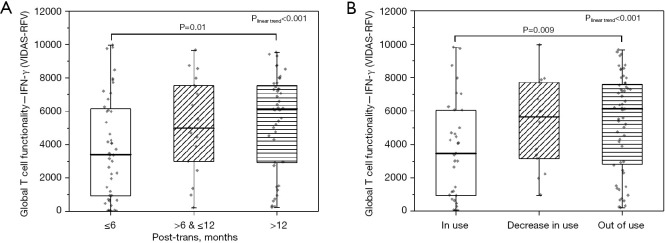
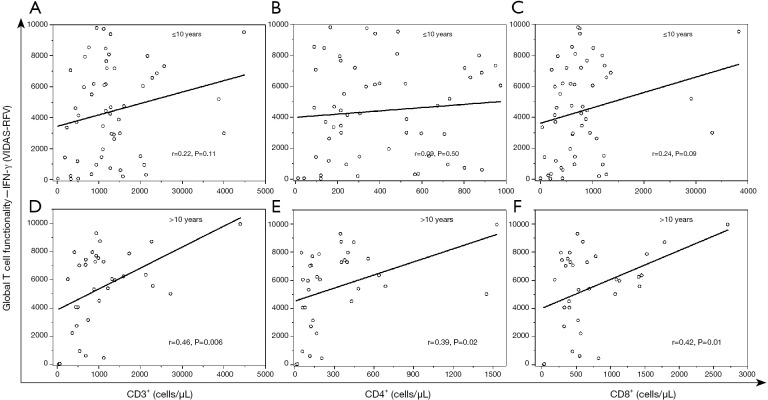
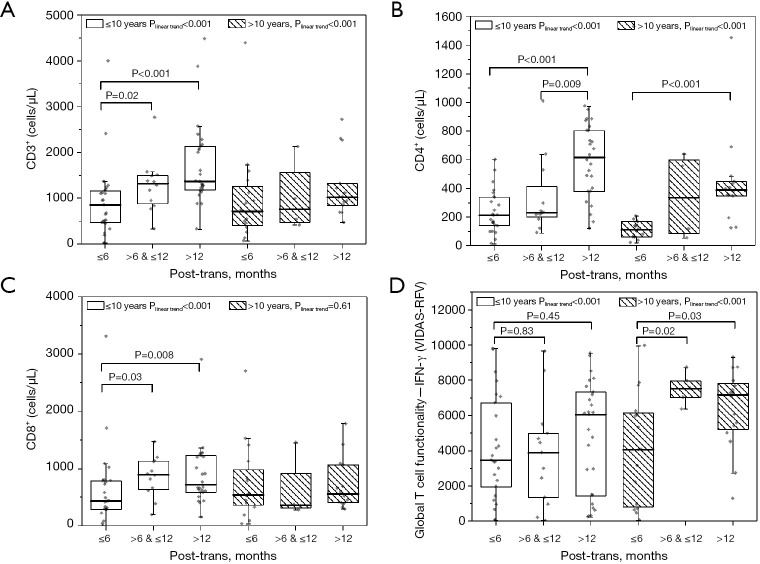
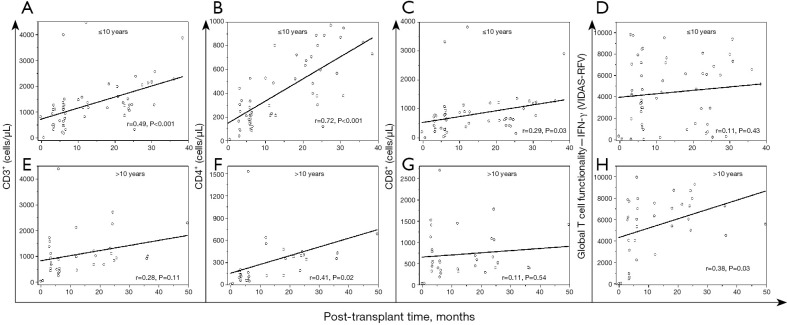
The study revealed that T-cell functionality, assessed via the WB-IGRA assay, progressively enhanced over the post-transplant period, effectively distinguishing between patients with and without immunosuppression, thereby highlighting the assay's viability in assessment of T-cell IR in children after allo-HSCT. Further analysis stratified by age revealed a more significant enhancement in T-cell functionality among children >10 years old compared to those ≤10. Conversely, when evaluating immune cell subsets, increases in CD3, CD4, and CD8 subsets well reflected immune reconstructive progress in children ≤10 years old, whereas only increases in CD4 cell subsets exhibited statistical significance in older children. Additionally, all three T cell subset counts were significantly correlated with T-cell functionality in older children, whereas no such correlation was observed in younger ones.
This study demonstrated the potential application of the WB-IGRA approach in evaluating and monitoring T-cell IR in pediatric allo-HSCT recipients. Combining the assessment of T-cell immune functionality with cellular phenotypes could enhance the understanding of T-cell IR in HSCT children of different ages.
异基因造血干细胞移植(allo-HSCT)后充分的T细胞免疫重建(IR)对于儿科HSCT受者的恢复和最佳预后至关重要。全面评估整体T细胞功能是移植后阶段监测T细胞IR的关键组成部分。本研究的目的是提供一种用于评估和监测儿科allo-HSCT后T细胞IR的新工具和策略。
本研究纳入了在单一机构接受allo-HSCT的126例儿科患者。引入标准化全血干扰素-γ释放试验(WB-IGRA)来评估HSCT后不同时期的整体T细胞功能。
研究表明,通过WB-IGRA试验评估的T细胞功能在移植后阶段逐渐增强,能有效区分免疫抑制患者和非免疫抑制患者,从而突出了该试验在评估allo-HSCT后儿童T细胞IR方面的可行性。按年龄分层的进一步分析显示,10岁以上儿童的T细胞功能增强比10岁及以下儿童更显著。相反地,在评估免疫细胞亚群时,CD3、CD4和CD8亚群的增加很好地反映了10岁及以下儿童的免疫重建进程,而在年龄较大儿童中只有CD4细胞亚群的增加具有统计学意义。此外,在年龄较大儿童中,所有三个T细胞亚群计数均与T细胞功能显著相关,而在年龄较小儿童中未观察到这种相关性。
本研究证明了WB-IGRA方法在评估和监测儿科allo-HSCT受者T细胞IR方面的潜在应用。将T细胞免疫功能评估与细胞表型相结合,可以增强对不同年龄HSCT儿童T细胞IR的理解。