Osmola Małgorzata, Hémont Caroline, Romańczyk Marcin, Druet Amaury, Chapelle Nicolas, Matysiak-Budnik Tamara, Lenti Marco Vincenzo, Martin Jérôme C
Maria Sklodowska-Curie Medical Academy in Warsaw, Warsaw, Poland.
Mazovian Oncological Hospital, Oncology Department, Warsaw, Poland.
J Transl Autoimmun. 2025 May 24;10:100294. doi: 10.1016/j.jtauto.2025.100294. eCollection 2025 Jun.
Autoimmune gastritis (AIG) is an important health problem and a risk factor for gastric neoplasms. This study assessed the diagnostic performance of different assays for anti-parietal cell antibodies (APCA) and anti-intrinsic factor antibodies (AIFA) in patients with histologically confirmed AIG.
This prospective, multicenter study included 50 AIG patients and 93 controls. The diagnostic performance of fluorescent enzyme immunoassay (FEIA) and immunoblot was evaluated for the detection of both APCA and AIFA, while indirect immunofluorescence (IIF) was assessed for APCA only.
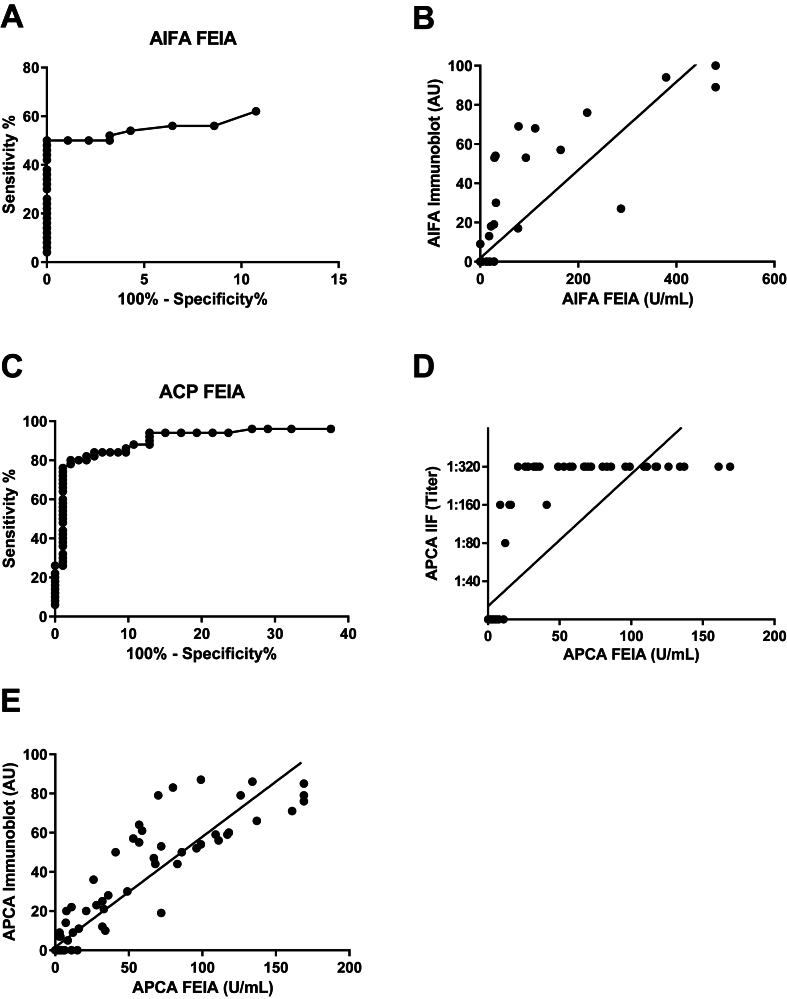
Overall, AIFA detection using FEIA demonstrated slightly better performance (specificity [Sp] 100 %, positive predictive value [PPV] 100 %, negative predictive value [NPV] 75 %) compared to immunoblot (Sp 98.9 %, PPV 94.1 %, NPV 73 %). However, both methods showed low sensitivity (Se): 38 % for FEIA and 32 % for immunoblot. When the FEIA cut-off was adjusted using ROC curve analysis, Se increased to 50 %, while maintaining high Sp (98.9 %). For APCA detection, Se was similar across all methods (∼80 %), but Sp varied: immunoblot showed lower Sp (89.3 %) compared to IIF (98.8 %) and FEIA (95.7 %). PPV was highest for IIF (97.5 %), followed by FEIA (89.9 %) and immunoblot (89.3 %). NPV was lowest for immunoblot (80 %), while IIF and FEIA showed comparable values (89.5 % and 90.9 %, respectively). Adjusting the FEIA cut-off for APCA increased Sp to 98.9 % without reducing Se (76 %). Combining AIFA and APCA testing improved diagnostic performance, yielding a sensitivity of 90 % and specificity of 95.7 %.
FEIA offers superior diagnostic accuracy for APCA and AIFA testing in AIG. The highest diagnostic yield for AIG is observed when both APCA and AIFA are assessed. This approach could be clinically applicable in the screening for AIG and diagnostic process of AIG.
自身免疫性胃炎(AIG)是一个重要的健康问题,也是胃肿瘤的一个危险因素。本研究评估了不同检测方法对组织学确诊的AIG患者抗壁细胞抗体(APCA)和抗内因子抗体(AIFA)的诊断性能。
这项前瞻性、多中心研究纳入了50例AIG患者和93例对照。评估了荧光酶免疫分析(FEIA)和免疫印迹法检测APCA和AIFA的诊断性能,同时仅评估了间接免疫荧光法(IIF)检测APCA的性能。
总体而言,与免疫印迹法(特异性[Sp]98.9%,阳性预测值[PPV]94.1%,阴性预测值[NPV]73%)相比,使用FEIA检测AIFA表现略优(Sp 100%,PPV 100%,NPV 75%)。然而,两种方法的敏感性(Se)均较低:FEIA为38%,免疫印迹法为32%。当使用ROC曲线分析调整FEIA临界值时,Se提高到了50%,同时保持了较高的Sp(98.9%)。对于APCA检测,所有方法的Se相似(约80%),但Sp有所不同:免疫印迹法的Sp(89.3%)低于IIF(98.8%)和FEIA(95.7%)。IIF的PPV最高(97.5%),其次是FEIA(89.9%)和免疫印迹法(89.3%)。免疫印迹法的NPV最低(80%),而IIF和FEIA的值相当(分别为89.5%和90.9%)。调整APCA的FEIA临界值可将Sp提高到98.9%,而不降低Se(76%)。联合检测AIFA和APCA可提高诊断性能,敏感性为90%,特异性为95.7%。
FEIA在AIG患者的APCA和AIFA检测中具有更高的诊断准确性。同时评估APCA和AIFA时,AIG的诊断率最高。这种方法在AIG的筛查和诊断过程中具有临床应用价值。