Rosenkilde Mette Marie, George Jyothis Thomas, Véniant Murielle M, Holst Jens Juul
Molecular and Translational Pharmacology, Department of Biomedical Sciences, University of Copenhagen, Copenhagen, Denmark.
Amgen Office of the Chief Medical Officer, Amgen, Thousand Oaks, CA.
Diabetes. 2025 Aug 1;74(8):1334-1338. doi: 10.2337/dbi24-0027.
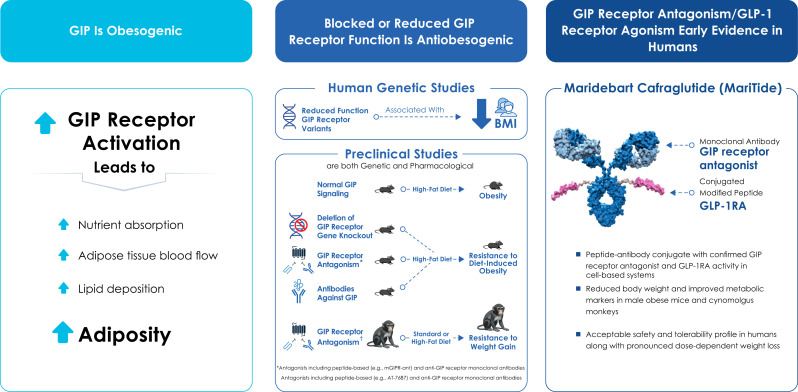
Obesity is a prevalent disease that also contributes to the incidence and severity of many other chronic diseases and health conditions. Treatment approaches include lifestyle intervention, bariatric surgery, and pharmacological approaches, with glucagon-like peptide 1 (GLP-1) receptor agonists approved specifically for weight loss having changed the treatment landscape significantly in the last 5 years. Targeting the glucose-dependent insulinotropic polypeptide (GIP) receptor may enhance the metabolic benefits of GLP-1 receptor agonism. These beneficial effects are seen with both GIP receptor antagonism and GIP receptor agonism, although the mechanisms underlying this apparent paradox remain unknown. Here, we summarize the physiologic, genetic, and clinical evidence for pursuing GIP receptor antagonism to achieve metabolic and weight benefits. Both global and central nervous system knockout of GIP receptors protects mice fed a high-fat diet from obesity and insulin resistance. Genome-wide association studies in humans support this notion, correlating lower BMI with GIP receptor genetic variants with reduced function. Pharmacologic approaches in mice and monkeys confirm that GIP receptor antagonism enhances GLP-1-induced weight reduction and other metabolic benefits, and a phase 1 study provides proof of principle that beneficial effects extend to humans. GIP receptor antagonism may represent an important new mechanism to expand the treatment options available to individuals living with obesity.
肥胖是一种普遍存在的疾病,它还会导致许多其他慢性疾病和健康状况的发生及严重程度增加。治疗方法包括生活方式干预、减肥手术和药物治疗方法,在过去5年中,专门批准用于减肥的胰高血糖素样肽1(GLP-1)受体激动剂显著改变了治疗格局。靶向葡萄糖依赖性促胰岛素多肽(GIP)受体可能会增强GLP-1受体激动作用的代谢益处。GIP受体拮抗和GIP受体激动均可见到这些有益效果,尽管这种明显矛盾背后的机制仍不清楚。在此,我们总结了通过GIP受体拮抗来实现代谢和体重益处的生理学、遗传学和临床证据。GIP受体的全身敲除和中枢神经系统敲除均可保护高脂饮食喂养的小鼠免于肥胖和胰岛素抵抗。人类全基因组关联研究支持这一观点,即较低的体重指数与功能降低的GIP受体基因变异相关。在小鼠和猴子身上的药物治疗方法证实,GIP受体拮抗可增强GLP-1诱导的体重减轻和其他代谢益处,一项1期研究提供了原理证明,即有益效果可扩展至人类。GIP受体拮抗可能代表了一种重要的新机制,可扩大肥胖患者可用的治疗选择。