Meenakumari Balaiah, K Chandramouleeswari, Dhanasekar Sariga
Institute of Child health and hospital for children, Rina mandal road, Egmore, Chennai, Tamil Nadu, India.
Institute of Child health and hospital for children, Rina mandal road, Egmore, Chennai, Tamil Nadu, India.
Hematol Transfus Cell Ther. 2025 Jun 14;47(3):103860. doi: 10.1016/j.htct.2025.103860.
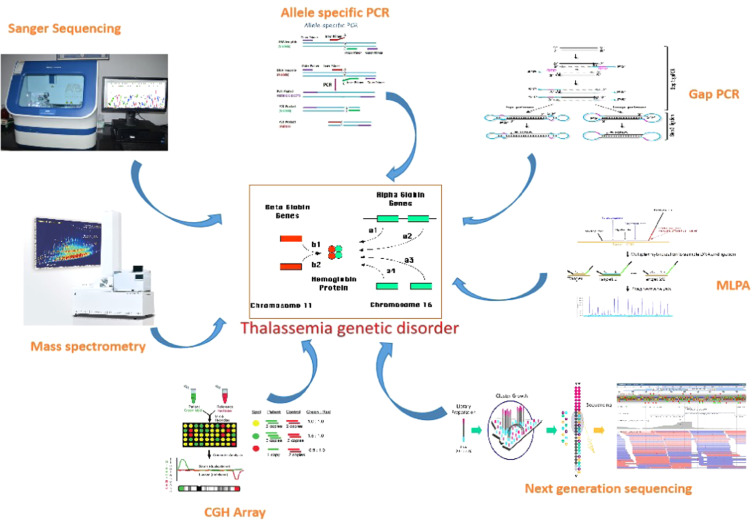
Beta-thalassemia is a genetic disorder that significantly burdens healthcare systems globally. This inherited blood disorder, categorized into beta-thalassemia and alpha-thalassemia, results in insufficient globin production, leading to anemia and iron overload from frequent transfusions. Severe cases, known as thalassemia major, require regular blood transfusions. Beyond clinical suspicion and biochemical tests, molecular techniques are essential for confirming the diagnosis and guiding treatment. Advanced molecular profiling methods such as Polymerase Chain Reaction (PCR), Multiplex Ligation-dependent Probe Amplification (MLPA), Next-Generation Sequencing (NGS), Third-Generation Sequencing (TGS), and Clustered Regularly Interspaced Short Palindromic Repeats (CRISPR) are effective in detecting mutations. Epigenetic factors also play a crucial role, driving the development of epidrugs for targeted therapy. This review covers various molecular techniques, established gene-editing methods, epigenetic mechanisms, and the impact of artificial intelligence on thalassemia management. It highlights the importance of selecting precise and sensitive molecular tools for detecting thalassemia gene mutations and stresses the need to make these testing methods accessible in resource-limited clinical settings.
β地中海贫血是一种遗传性疾病,给全球医疗系统带来了沉重负担。这种遗传性血液疾病分为β地中海贫血和α地中海贫血,会导致珠蛋白生成不足,进而引发贫血以及因频繁输血导致的铁过载。严重的病例,即重型地中海贫血,需要定期输血。除了临床怀疑和生化检测外,分子技术对于确诊和指导治疗至关重要。先进的分子分析方法,如聚合酶链反应(PCR)、多重连接依赖探针扩增(MLPA)、下一代测序(NGS)、第三代测序(TGS)和成簇规律间隔短回文重复序列(CRISPR),在检测突变方面很有效。表观遗传因素也起着关键作用,推动了用于靶向治疗的表观遗传药物的开发。这篇综述涵盖了各种分子技术、既定的基因编辑方法、表观遗传机制以及人工智能对地中海贫血管理的影响。它强调了选择精确且灵敏的分子工具来检测地中海贫血基因突变的重要性,并强调了在资源有限的临床环境中使这些检测方法可及的必要性。