Costa Daniela O, Protty Majd B, Tyrrell Victoria J, Hajeyah Ali A, Morgan Bethan H, Mead Ben, Giera Martin, Collins Peter W, Jenkins P Vince, Choy Ernest, Jones Simon A, O'Donnell Valerie B
Division of Infection and Immunity, Systems Immunity Research Institute, School of Medicine, Cardiff University, Cardiff, UK.
Division of Infection and Immunity, Systems Immunity Research Institute, School of Medicine, Cardiff University, Cardiff, UK.
J Lipid Res. 2025 Jul;66(7):100842. doi: 10.1016/j.jlr.2025.100842. Epub 2025 Jun 14.
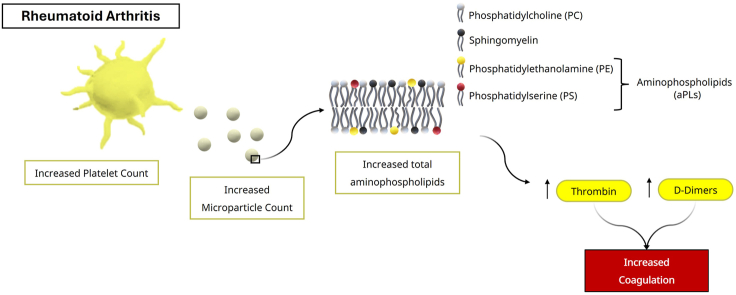
Patients with rheumatoid arthritis (RA) are at elevated risk of thrombotic events, yet the underlying mechanisms remain unknown. The contribution of the procoagulant membrane surface provided by aminophospholipids (aPLs) in driving thrombotic risk in RA has not been investigated. Specifically, neither the type of aPL exposed on circulating blood cell membranes in patients is characterized nor is their ability to support thrombin generation is known. Here, lipidomics was used to characterize the external-facing and total levels of aPL molecular species in RA, specifically phosphatidylserine and phosphatidylethanolamine on extracellular vesicles (EVs), platelets, and white blood cells (WBCs). The ability of the cells and EVs to support thrombin generation from patients and healthy controls was compared using an in vitro prothrombinase assay. RA patient plasma had significantly higher levels of thrombin-antithrombin and d-dimers, indicating increased thrombotic activity in vivo. Higher EV and platelet counts were seen in RA, but WBC counts were not elevated. EVs from RA patients supported higher levels of thrombin generation compared with healthy controls, whereas for platelets and WBC, thrombin generation was similar for both groups. EVs from RA patients also showed elevated external-facing phosphatidylserine molecular species, with total aPL also increased. For platelets and WBC, total and external-facing aPL levels were similar. Thrombin-antithrombin (TAT) complexes significantly correlated with EV particle counts, indicating that their circulating numbers are directly related to coagulation in vivo. Overall, our data suggest that elevated plasma EV levels in RA are a major source of procoagulant membranes, contributing to thrombotic risk in RA.
类风湿关节炎(RA)患者发生血栓事件的风险升高,但其潜在机制仍不清楚。氨基磷脂(aPLs)提供的促凝膜表面在RA引发血栓形成风险中的作用尚未得到研究。具体而言,既未对患者循环细胞膜上暴露的aPL类型进行表征,也不清楚其支持凝血酶生成的能力。在此,脂质组学被用于表征RA中aPL分子种类的外向水平和总水平,特别是细胞外囊泡(EVs)、血小板和白细胞(WBCs)上的磷脂酰丝氨酸和磷脂酰乙醇胺。使用体外凝血酶原酶测定法比较了患者和健康对照的细胞及EVs支持凝血酶生成的能力。RA患者血浆中凝血酶 - 抗凝血酶和D - 二聚体水平显著更高,表明体内血栓形成活性增加。在RA中观察到EVs和血小板计数较高,但白细胞计数未升高。与健康对照相比,RA患者的EVs支持更高水平的凝血酶生成,而对于血小板和白细胞,两组的凝血酶生成相似。RA患者的EVs还显示外向磷脂酰丝氨酸分子种类升高,并伴有总aPL增加。对于血小板和白细胞,总aPL水平和外向aPL水平相似。凝血酶 - 抗凝血酶(TAT)复合物与EV颗粒计数显著相关,表明它们的循环数量与体内凝血直接相关。总体而言,我们的数据表明,RA中血浆EVs水平升高是促凝膜的主要来源,导致RA中的血栓形成风险。