Zhang Meng, Liang Chengbo, Li Bin, Jiang Feng, Song Pengfei, Gu Haifeng, Gao Hongmei, Cai Zhenyuan, Zhang Tongzuo
Key Laboratory of Adaptation and Evolution of Plateau Biota, Northwest Institute of Plateau Biology, Chinese Academy of Sciences, Xining, China.
College of Life Sciences, University of Chinese Academy of Sciences, Beijing, China.
Commun Biol. 2025 Jun 16;8(1):930. doi: 10.1038/s42003-025-08185-7.
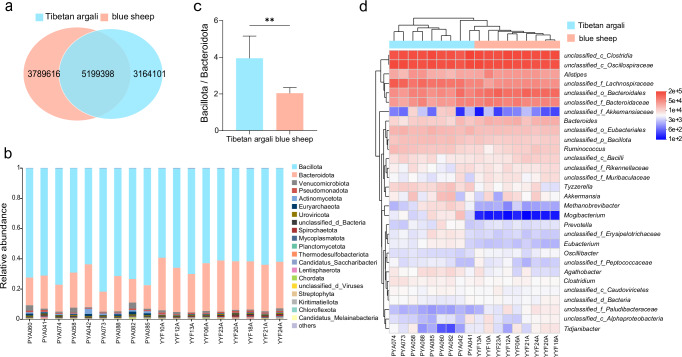
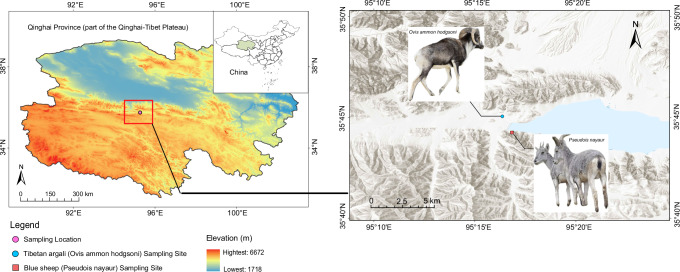
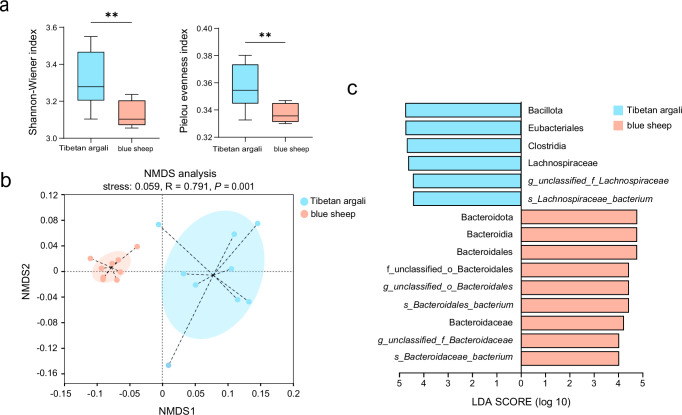
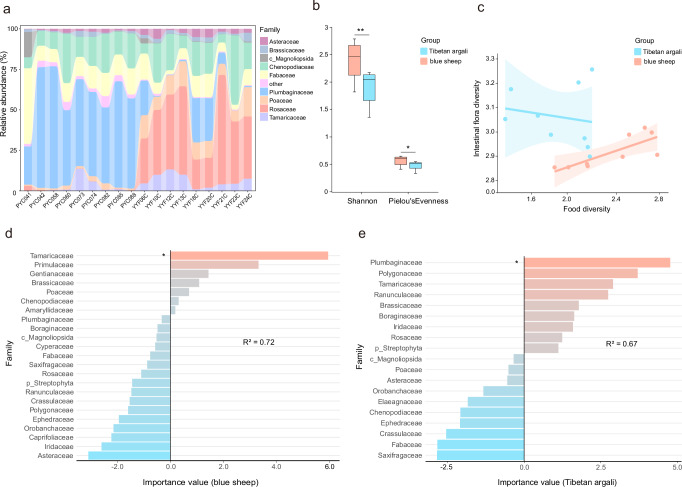
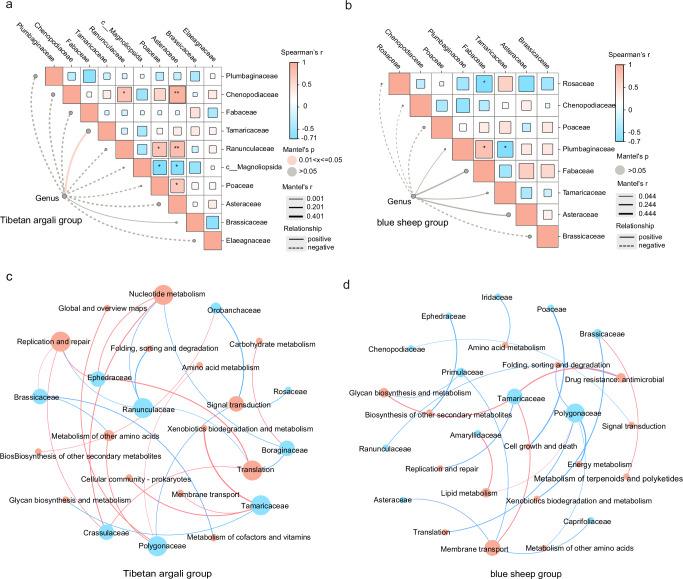
The gut microbiota plays a critical role in plant digestion, nutrient absorption, and ecological adaptation in herbivores. However, how gut microbiota and diet jointly influence ecological niche differentiation in sympatric species remains unclear. Here, we use metagenomic sequencing and plant trnL (UAA) fragment sequencing to examine the gut microbiota and dietary composition of sympatric Tibetan argali (Ovis ammon hodgsoni) and blue sheep (Pseudois nayaur) in the Kunlun Mountains of the Qinghai-Tibet Plateau. Despite inhabiting similar environments, the two species harbor distinct microbial compositions and functional profiles. Interestingly, higher dietary diversity does not correspond to higher microbial diversity. Tibetan argali, despite having a simpler diet, possesses a more diverse and flexible gut microbiome. In contrast, blue sheep show broader dietary preferences and stronger microbial metabolic adaptation to glycan biosynthesis and metabolism. These findings reveal significant associations between gut microbiota composition, function, and diet, supporting a microbial contribution to trophic niche differentiation. Our results highlight distinct microbial-dietary strategies in sympatric herbivores and underscore the role of the gut microbiome in ecological adaptation and species coexistence.
肠道微生物群在食草动物的植物消化、营养吸收和生态适应中起着关键作用。然而,肠道微生物群和饮食如何共同影响同域物种的生态位分化仍不清楚。在这里,我们使用宏基因组测序和植物trnL(UAA)片段测序来研究青藏高原昆仑山脉同域分布的藏羚(Ovis ammon hodgsoni)和岩羊(Pseudois nayaur)的肠道微生物群和饮食组成。尽管栖息在相似的环境中,但这两个物种拥有不同的微生物组成和功能概况。有趣的是,更高的饮食多样性并不对应更高的微生物多样性。藏羚尽管饮食较为简单,但其肠道微生物群更加多样且灵活。相比之下,岩羊表现出更广泛的饮食偏好,并且在聚糖生物合成和代谢方面具有更强的微生物代谢适应性。这些发现揭示了肠道微生物群组成、功能与饮食之间的显著关联,支持了微生物对营养生态位分化的贡献。我们的结果突出了同域食草动物不同的微生物-饮食策略,并强调了肠道微生物群在生态适应和物种共存中的作用。