Liwin Lilipramawanty K, Shen Tianyu, Payne Collin F
Alfred Deakin Institute for Citizenship and Globalisation, Deakin University, Geelong, VIC, Australia.
School of Demography, Research School of Social Sciences, The Australian National University, Canberra, ACT, Australia.
Popul Health Metr. 2025 Jun 16;23(1):26. doi: 10.1186/s12963-025-00372-2.
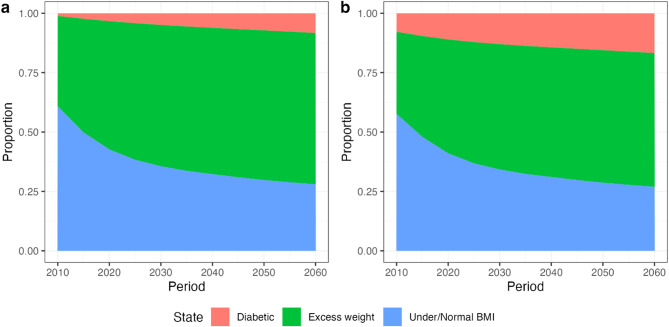
Diabetes prevalence is increasing worldwide, particularly in developing countries and disadvantaged groups. Alongside this phenomenon, the expansion of educational attainment has led to changes in population educational composition, which can significantly influence social disparities in diabetes and its risk factors, including obesity. This paper explores the role of changing educational composition in shaping the future burden of excess body weight and diabetes in Indonesia, a country with a rapidly growing prevalence of both diabetes and obesity.
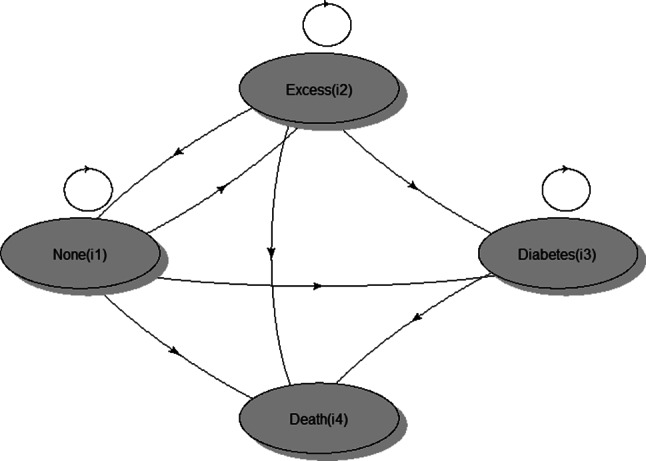
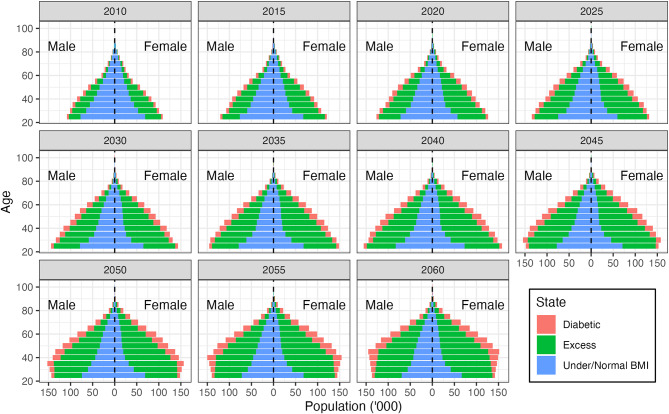
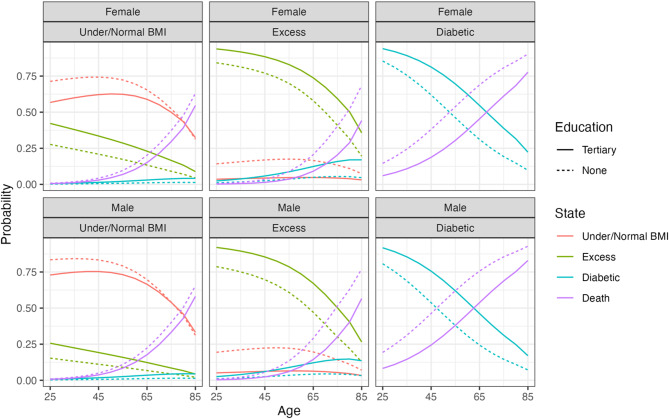
We utilise three data sources as the inputs for our projection model. Panel data from the Indonesia Family Life Survey (IFLS) for 2007 and 2014 were used to compute health transition probabilities by age, sex, and education status using a multinomial logit model. Results from a dried blood test were used to adjust for undiagnosed diabetes in the projection model. The Indonesian National Health Surveys (Riskesdas) in 2007, 2013, and 2018 were used to estimate the prevalence of excess body weight and diabetes by age, sex, and education. Finally, we used projections of Indonesia's population size and composition by age, sex and education level for the period 2010 to 2060 from the Wittgenstein Centre Human Capital Data Explorer version WIC2018 v2. We employ a cohort component model with microsimulation to project the population forward.
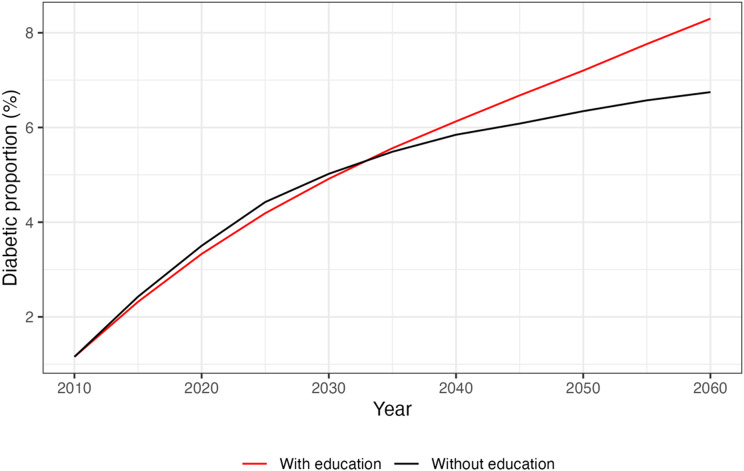
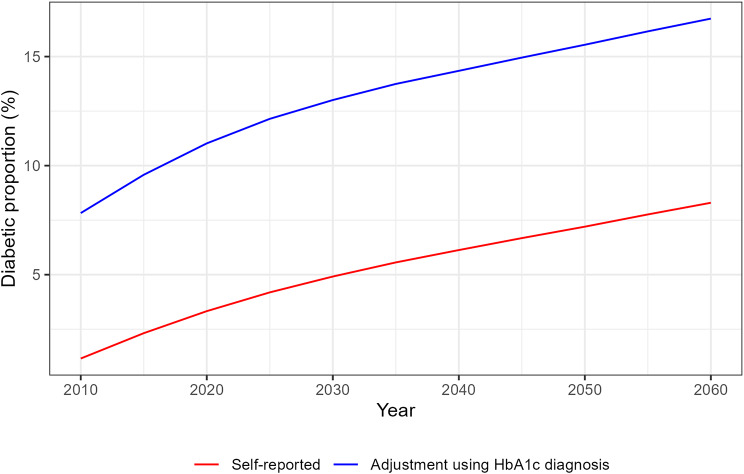
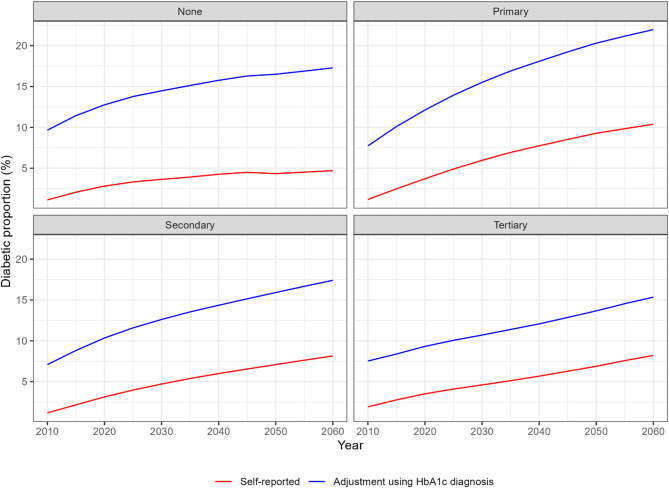
The estimated prevalence of diabetes from our projection model incorporating population education composition is 7.8% in 2010 and is expected to reach 16.7% by 2060. The most rapid increase in prevalence (14% growth in 50 years) is estimated among people with primary education, while other groups show smaller rises.
Incorporating population educational composition into projections of the burden of excess body weight and diabetes provides valuable insights into social disparities in diabetes over time. This can inform policy decisions by helping to prioritise healthcare budgets, targeted disease prevention programs, and diabetes treatment for high-risk groups based on educational status.
糖尿病在全球范围内的患病率正在上升,尤其是在发展中国家和弱势群体中。与此同时,受教育程度的提高导致了人口教育构成的变化,这可能会显著影响糖尿病及其危险因素(包括肥胖症)的社会差异。本文探讨了教育构成变化在塑造印度尼西亚未来超重和糖尿病负担方面的作用,该国糖尿病和肥胖症的患病率都在迅速上升。
我们使用三个数据源作为预测模型的输入。2007年和2014年印度尼西亚家庭生活调查(IFLS)的面板数据用于通过多项logit模型按年龄、性别和教育状况计算健康转变概率。预测模型中使用干血检测结果对未诊断出的糖尿病进行调整。2007年、2013年和2018年的印度尼西亚国家健康调查(Riskesdas)用于按年龄、性别和教育程度估计超重和糖尿病的患病率。最后,我们使用了维特根斯坦中心人力资本数据浏览器WIC2018 v2版本提供的2010年至2060年印度尼西亚按年龄、性别和教育水平划分的人口规模和构成预测。我们采用带有微观模拟的队列成分模型对人口进行预测。
我们纳入人口教育构成的预测模型估计,2010年糖尿病患病率为7.8%,预计到2060年将达到16.7%。小学教育程度人群的患病率预计增长最为迅速(50年内增长14%),而其他群体的增长幅度较小。
将人口教育构成纳入超重和糖尿病负担的预测中,有助于深入了解糖尿病随时间推移的社会差异。这可以为政策决策提供依据,通过根据教育状况帮助确定医疗保健预算、有针对性的疾病预防计划以及高危群体的糖尿病治疗的优先次序。