Prnjak Katarina, Conti Janet, McCormack Madalyn, Heruc Gabriella, McLean Siân A, Barns Rebecca, Hay Phillipa
Graduate School of Health, University of Technology Sydney, Sydney, Australia.
School of Psychology, Western Sydney University, Sydney, Australia.
J Eat Disord. 2025 Jun 16;13(Suppl 1):113. doi: 10.1186/s40337-025-01309-8.
Australia & New Zealand Academy for Eating Disorders (ANZAED) in 2022 established a credentialing system for eating disorder (ED) clinicians that recognises a minimum knowledge, training, and ongoing professional development necessary to provide safe and effective care. The aim of this study was to explore experiences of credentialed clinicians with the new credentialing system, in particular, their view on continuous professional development (CPD) and supervision required for maintaining the credentialed status, as well as how becoming credentialed has affected their clinical work.
Two hundred and twenty-eight credentialed clinicians (92.5% female; 41.7% psychologists; 39.5% dietitians) completed an online survey consisting of multiple choice and open-ended questions regarding their experience with the credentialing system and perceptions of the CPD program.
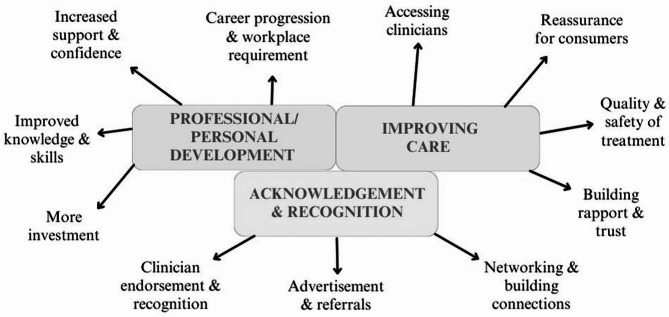
Credentialed clinicians reported that CPD increased their confidence and willingness to deliver ED treatment, and that supervision enhanced their reflective skills and ethical thinking, whilst 75% of clinicians reported that attaining the Credential had not changed the number of ED patients that they were currently treating on a weekly basis. Content analysis of open-ended questions resulted in three broad themes: professional/personal development; improving care; and acknowledgement and recognition. Differences were found between clinicians working in private practice and those working in public health or both settings with regards to impacts on client referrals to their services.
These findings show that credentialed clinicians perceived a positive experience with the Credential and its ongoing CPD program. However, there may be a need to increase the visibility and external awareness of the credentialing system.
澳大利亚和新西兰饮食失调学会(ANZAED)于2022年建立了饮食失调(ED)临床医生认证系统,该系统认可提供安全有效护理所需的最低知识、培训和持续专业发展。本研究的目的是探讨获得认证的临床医生对新认证系统的体验,特别是他们对维持认证状态所需的持续专业发展(CPD)和监督的看法,以及获得认证如何影响他们的临床工作。
228名获得认证的临床医生(92.5%为女性;41.7%为心理学家;39.5%为营养师)完成了一项在线调查,该调查包括关于他们在认证系统方面的经验以及对CPD计划看法的多项选择题和开放式问题。
获得认证的临床医生报告称,CPD增强了他们提供ED治疗的信心和意愿,监督提高了他们的反思技能和道德思维,同时75%的临床医生报告称获得认证并未改变他们目前每周治疗的ED患者数量。对开放式问题的内容分析产生了三个广泛的主题:专业/个人发展;改善护理;以及认可与表彰。在私人执业的临床医生与在公共卫生领域工作或在两种环境中工作的临床医生之间,在对客户转诊至其服务的影响方面存在差异。
这些发现表明,获得认证的临床医生对该认证及其持续的CPD计划有积极的体验。然而,可能需要提高认证系统的知名度和外部认知度。