Heruc Gabriella, Hurst Kim, Casey Anjanette, Fleming Kate, Freeman Jeremy, Fursland Anthea, Hart Susan, Jeffrey Shane, Knight Rachel, Roberton Michelle, Roberts Marion, Shelton Beth, Stiles Garalynne, Sutherland Fiona, Thornton Chris, Wallis Andrew, Wade Tracey
Australia & New Zealand Academy for Eating Disorders, Sydney, Australia.
School of Medicine, Western Sydney University, Campbelltown, Australia.
J Eat Disord. 2020 Nov 10;8(1):63. doi: 10.1186/s40337-020-00341-0.
Eating disorders are complex to manage, and there is limited guidance around the depth and breadth of knowledge, skills and experience required by treatment providers. The Australia & New Zealand Academy for Eating Disorders (ANZAED) convened an expert group of eating disorder researchers and clinicians to define the clinical practice and training standards recommended for mental health professionals and dietitians providing treatment for individuals with an eating disorder. General principles and clinical practice standards were first developed, after which separate mental health professional and dietitian standards were drafted and collated by the appropriate members of the expert group. The subsequent review process included four stages of consultation and document revision: (1) expert reviewers; (2) a face-to-face consultation workshop attended by approximately 100 health professionals working within the sector; (3) an extensive open access online consultation process; and (4) consultation with key professional and consumer/carer stakeholder organisations.
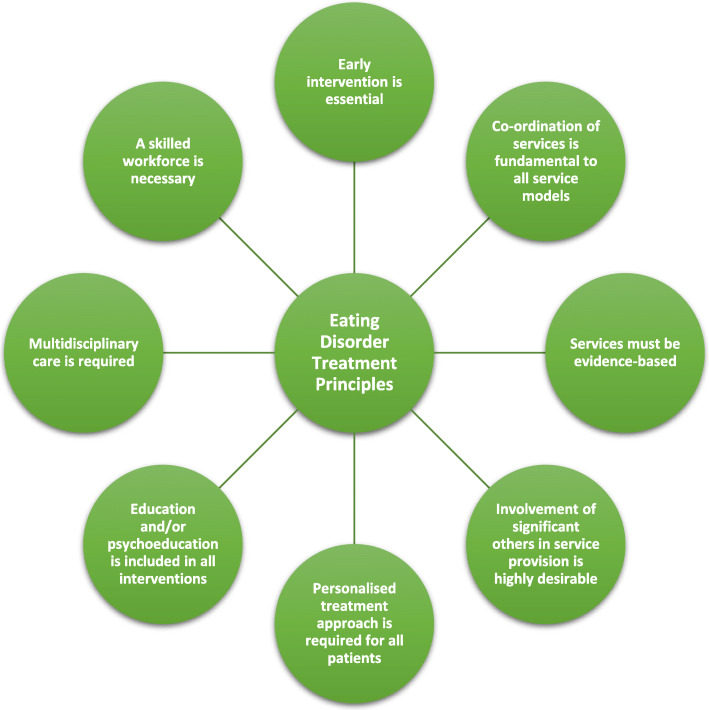
The resulting paper outlines and describes the following eight eating disorder treatment principles: (1) early intervention is essential; (2) co-ordination of services is fundamental to all service models; (3) services must be evidence-based; (4) involvement of significant others in service provision is highly desirable; (5) a personalised treatment approach is required for all patients; (6) education and/or psychoeducation is included in all interventions; (7) multidisciplinary care is required and (8) a skilled workforce is necessary. Seven general clinical practice standards are also discussed, including: (1) diagnosis and assessment; (2) the multidisciplinary care team; (3) a positive therapeutic alliance; (4) knowledge of evidence-based treatment; (5) knowledge of levels of care; (6) relapse prevention; and (7) professional responsibility.
These principles and standards provide guidance to professional training programs and service providers on the development of knowledge required as a foundation on which to build competent practice in the eating disorder field. Implementing these standards aims to bring treatment closer to best practice, and consequently improve treatment outcomes, reduce financial cost to patients and services and improve patient quality of life.
饮食失调症的管理较为复杂,对于治疗提供者所需知识、技能和经验的深度与广度,相关指导有限。澳大利亚和新西兰饮食失调学会(ANZAED)召集了一个由饮食失调症研究人员和临床医生组成的专家小组,以确定为患有饮食失调症的个体提供治疗的心理健康专业人员和营养师所推荐的临床实践和培训标准。首先制定了一般原则和临床实践标准,之后由专家小组的相关成员起草并整理了心理健康专业人员和营养师的单独标准。随后的审查过程包括四个咨询和文件修订阶段:(1)专家评审;(2)由该领域约100名卫生专业人员参加的面对面咨询研讨会;(3)广泛的开放获取在线咨询过程;(4)与关键专业和消费者/护理者利益相关组织进行咨询。
最终形成的文件概述并描述了以下八项饮食失调症治疗原则:(1)早期干预至关重要;(2)服务协调是所有服务模式的基础;(3)服务必须基于证据;(4)非常希望重要他人参与服务提供;(5)所有患者都需要个性化治疗方法;(6)所有干预措施都应包括教育和/或心理教育;(7)需要多学科护理;(8)需要一支技术熟练的员工队伍。还讨论了七项一般临床实践标准,包括:(1)诊断和评估;(2)多学科护理团队;(3)积极的治疗联盟;(4)基于证据的治疗知识;(5)护理水平知识;(6)预防复发;(7)专业责任。
这些原则和标准为专业培训项目和服务提供者提供了指导,有助于他们培养在饮食失调症领域开展胜任实践所需的知识基础。实施这些标准旨在使治疗更接近最佳实践,从而改善治疗效果,降低患者和服务的财务成本,并提高患者的生活质量。