Acworth Jason, Del Castillo Jimena, Tiwari Lokesh Kumar, Atkins Dianne, de Caen Allan, Bansal Arun, Couto Thomaz Bittencourt, Katzenschlager Stephan, Kleinman Monica, Lopez-Herce Jesus, Morgan Ryan W, Myburgh Michelle, Nadkarni Vinay, Tijssen Janice A, Scholefield Barnaby R
Emergency Department, Queensland Children's Hospital, Brisbane, Australia, Faculty of Medicine, University of Queensland, Australia.
Paediatric Intensive Care Department, Hospital General Universitario Gregorio Maranon de Madrid, Spain.
Resusc Plus. 2025 May 26;24:100991. doi: 10.1016/j.resplu.2025.100991. eCollection 2025 Jul.
Early defibrillation is the foundation of treatment of shockable ventricular arrhythmias (VF, pVT) but optimal energy doses for initial and subsequent shocks in paediatric cardiac arrest remain controversial.
To assess the use of different energy doses for initial defibrillation in infants, children and adolescents with ventricular fibrillation (VF) or pulseless ventricular tachycardia (pVT) during cardiac arrest.
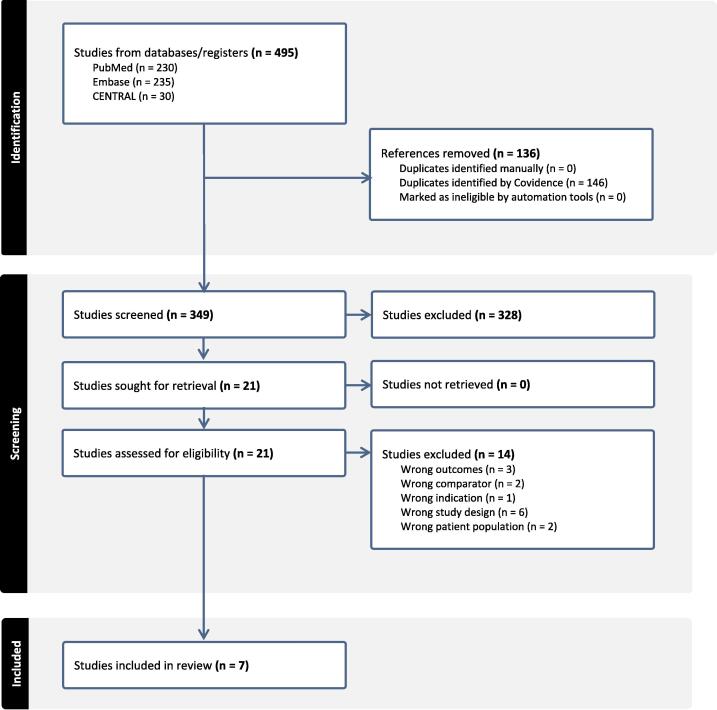
A systematic review was performed by the ILCOR Paediatric Life Support Task force. This systematic review was prospectively registered as PROSPERO CRD42024548898. A search of PubMed, EMBASE, and Cochrane Controlled Register of Trials (CENTRAL) was performed for clinical trials and observational studies, published before 1 January 2025, involving cardiac defibrillation in infants and children (excluding newborn infants) in cardiac arrest. Investigators reviewed studies for relevance, extracted data, and assessed risk of bias using the ROBINS-I framework. Critical outcomes included survival to hospital discharge and return of spontaneous circulation. Results were compiled into a Summary of Findings table using the GRADEpro Guideline Development tool. Statistical calculations and Forest plot generation were performed using RevMan.
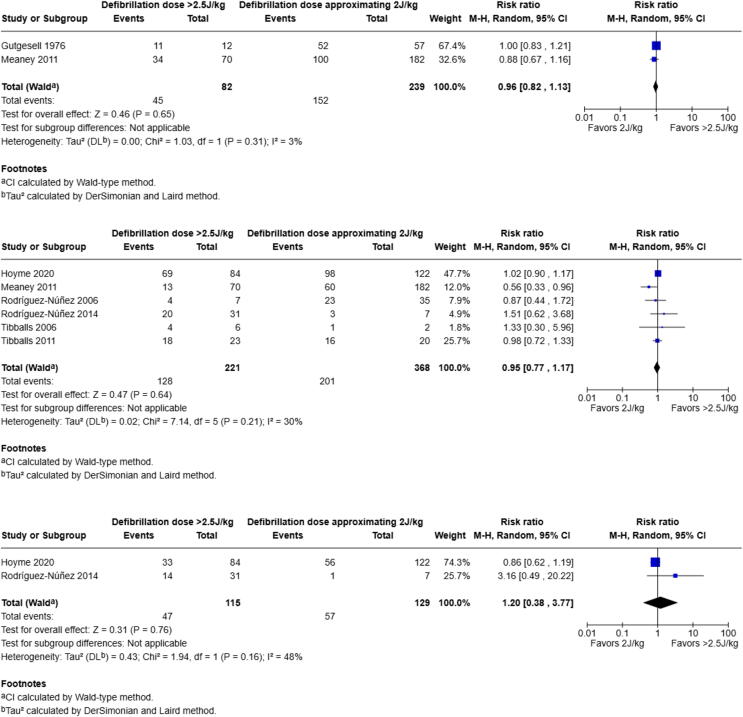
We identified 7 relevant observational studies. The majority of studies involved in-hospital cardiac arrest. The overall certainty of evidence was very low. Critical (survival to hospital discharge, return of spontaneous circulation) and important (termination of VF/pVT) outcomes were not significantly better or worse when initial defibrillation doses of <1.5 J/kg or >2.5 J/kg were used for children in cardiac arrest with a shockable rhythm compared with initial doses approximating 2 J/kg.
The current available data suggest that outcomes are not significantly better or worse when initial defibrillation doses of <1.5 J/kg or >2.5 J/kg are used for children in cardiac arrest with a shockable rhythm (VF or pVT) compared with initial doses approximating 2 J/kg. Well-designed randomised trials are needed to address this important question.
早期除颤是可电击复律的室性心律失常(室颤、无脉性室性心动过速)治疗的基础,但儿科心脏骤停初始及后续电击的最佳能量剂量仍存在争议。
评估在心脏骤停期间,对婴儿、儿童和青少年室颤(VF)或无脉性室性心动过速(pVT)进行初始除颤时不同能量剂量的使用情况。
国际复苏联络委员会儿科生命支持工作组进行了一项系统评价。该系统评价已前瞻性注册于PROSPERO,注册号为CRD42024548898。检索了PubMed、EMBASE和Cochrane对照试验注册中心(CENTRAL),查找2025年1月1日前发表的涉及心脏骤停的婴儿和儿童(不包括新生儿)心脏除颤的临床试验和观察性研究。研究人员审查研究的相关性,提取数据,并使用ROBINS-I框架评估偏倚风险。关键结局包括出院存活和自主循环恢复。使用GRADEpro指南制定工具将结果汇总到结果总结表中。使用RevMan进行统计计算和绘制森林图。
我们确定了7项相关观察性研究。大多数研究涉及院内心脏骤停。证据的总体确定性非常低。对于心脏骤停且心律可电击复律的儿童,与初始剂量约2 J/kg相比,初始除颤剂量<1.5 J/kg或>2.5 J/kg时,关键结局(出院存活、自主循环恢复)和重要结局(室颤/无脉性室性心动过速终止)并无显著更好或更差。
现有数据表明,对于心脏骤停且心律可电击复律(室颤或无脉性室性心动过速)的儿童,与初始剂量约2 J/kg相比,初始除颤剂量<1.5 J/kg或>2.5 J/kg时,结局并无显著更好或更差。需要设计良好的随机试验来解决这个重要问题。