Lopes Nicole Coelho, Meneses Gdayllon Cavalcante, Sales de Souza Santos Ranieri, Machado de Araújo Leticia, Barroso Martins Bruna Viana, Maria Dos Reis Araújo Katarina, Nogueira de Aquino Valéria Holanda, Moreira de Almeida Igor, Brasileiro Mota Sandra Mara, Bezerra da Silva Junior Geraldo, Rodrigues Camila Eleuterio, De Francesco Daher Elizabeth, Moura Moreira Albuquerque Polianna Lemos, Costa Martins Alice Maria
Pharmacology Post-Graduate Program, Federal University of Ceará, Fortaleza, Ceará, Brazil.
Department of Clinical and Toxicological Analysis Federal University of Fortaleza, Fortaleza, Ceará, Brazil.
Toxicon X. 2025 May 20;26:100226. doi: 10.1016/j.toxcx.2025.100226. eCollection 2025 Jun.
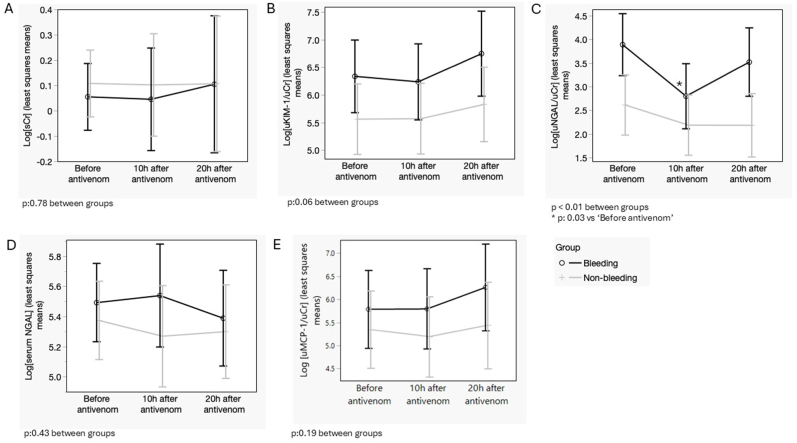
Snakebite antivenom (SAV) is the standard treatment option to neutralize the toxic effects of snake venom, but their consequences on kidney function need to be better understood. This study aims to evaluate the effects of antivenom on kidney and endothelial biomarkers due to venom in two subgroups of patients distinguished by the presence of hemorrhagic syndrome at admission. This prospective study included 34 snakebite patients admitted to a tertiary hospital in Northeast Brazil between August 2019 and November 2020, 50 % of whom experienced spontaneous bleeding. Endothelial and kidney damage biomarkers were analyzed at three time points: before antivenom infusion and after 10 h and 20 h of antivenom infusion. Bleeding patients exhibited higher urine Neutrophil Gelatinase-Associated Lipocalin (uNGAL) and Kidney Injury Molecule-1 (KIM-1) levels, indicating incomplete renal recovery until 20h after antivenom. This group showed higher serum angiopoietin-2 (Ang-2) levels and vascular cell adhesion molecule-1 (VCAM-1). VCAM-1 levels positively correlated with kidney biomarker levels at each time point, especially after SAV. uNGAL was variant across VCAM-1, Ang-1, and Ang-2 levels before antivenom. Elevated levels of uNGAL and KIM-1, observed 10 h after SAV administration, may indicate incomplete renal protection and a potential risk for the development of chronic kidney injury, requiring future follow-up.
蛇咬伤抗蛇毒血清(SAV)是中和蛇毒毒性作用的标准治疗选择,但其对肾功能的影响仍需深入了解。本研究旨在评估抗蛇毒血清对两组患者肾脏和内皮生物标志物的影响,这两组患者根据入院时是否存在出血综合征进行区分。这项前瞻性研究纳入了2019年8月至2020年11月期间入住巴西东北部一家三级医院的34例蛇咬伤患者,其中50%出现自发性出血。在三个时间点分析内皮和肾脏损伤生物标志物:抗蛇毒血清输注前、输注后10小时和20小时。出血患者的尿中性粒细胞明胶酶相关脂质运载蛋白(uNGAL)和肾损伤分子-1(KIM-1)水平较高,表明在抗蛇毒血清治疗后20小时肾功能仍未完全恢复。该组患者的血清血管生成素-2(Ang-2)水平和血管细胞粘附分子-1(VCAM-1)较高。VCAM-1水平在每个时间点都与肾脏生物标志物水平呈正相关,尤其是在使用抗蛇毒血清后。在抗蛇毒血清输注前,uNGAL水平在VCAM-1、Ang-1和Ang-2水平之间存在差异。在抗蛇毒血清给药10小时后观察到uNGAL和KIM-1水平升高,这可能表明肾脏保护不完全,存在慢性肾损伤发展的潜在风险,需要进一步随访。