León-Figueroa Darwin A, Garcia-Vasquez Edwin A, Diaz-Torres Milagros, Aguirre-Milachay Edwin, Villanueva-De La Cruz Jean Pierre, Saldaña-Cumpa Hortencia M, Valladares-Garrido Mario J
Facultad de Medicina Humana, Universidad de San Martín de Porres, Chiclayo, Peru.
Hospital Nacional Sergio E. Bernales, Lima, Perú.
PLoS One. 2025 Jun 17;20(6):e0310163. doi: 10.1371/journal.pone.0310163. eCollection 2025.
Dengue is an acute febrile illness that is a significant public health problem. Peru is an endemic region for vector-borne diseases such as dengue, zika, and chikungunya, which initially manifest with febrile illness and can complicate differential diagnosis. Therefore, the present study aimed to determine the prevalence of positive results for dengue or dengue antibodies in Peruvian patients with febrile illness using diagnostic tools such as RT-PCR and ELISA NS1, IgM, and IgG.
A literature search was conducted in eight databases or search tools (PubMed, Scopus, Embase, Web of Science, ScienceDirect, Google Scholar, Virtual Health Library, and Scielo) until June 9, 2024. Medical Subject Headings (MeSH) terms such as "dengue" and "Peru" were used, together with the free term "febrile illness", combined using the Boolean operators AND and OR. We included observational studies with a control group of patients with fever but no dengue infection and a non-control group of febrile patients who tested positive for dengue. Pooled estimates and 95% confidence intervals (CI) were calculated using random-effects models. Study quality and risk of bias were assessed using the Joanna Briggs Institute Statistical Meta-Analysis Assessment and Review Instrument. Heterogeneity was assessed using the I2 statistic, and statistical analysis was performed with R version 4.2.3.
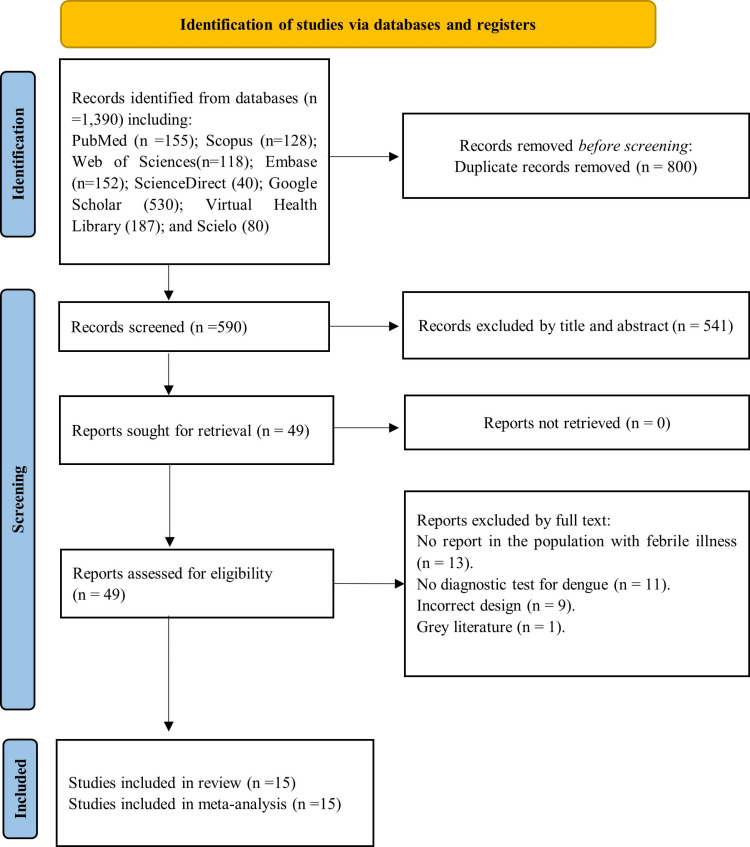
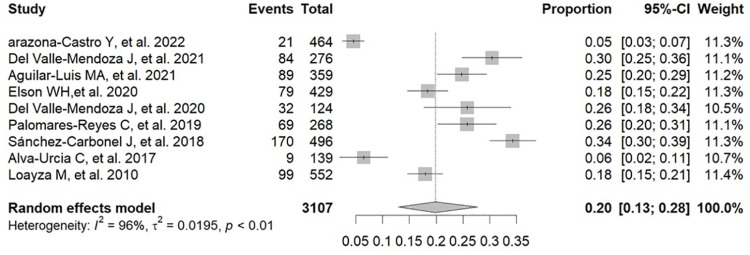
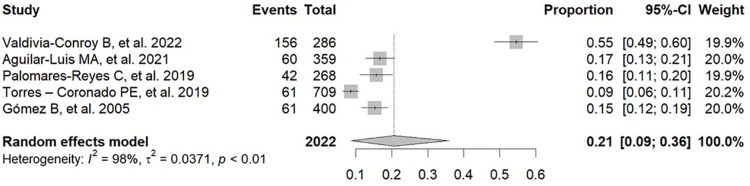
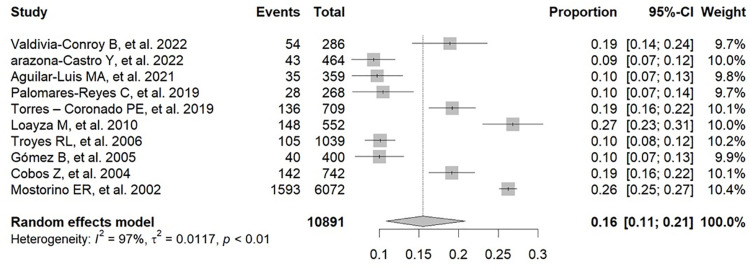
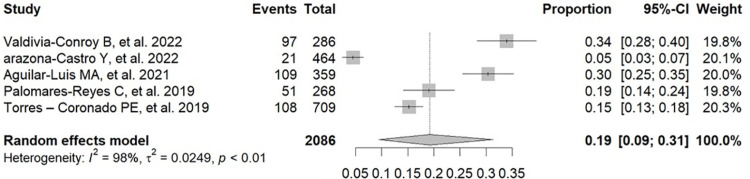
We included 15 observational studies that met the inclusion criteria developed in 10 regions of Peru and published between 2002 and 2022, with a total of 12,355 patients with febrile illness. The pooled prevalence of positive results for dengue or dengue antibodies in these patients was 21% (95% CI: 9%-36%; 2022 participants; 5 studies; I2 = 98%) for IgG ELISA, 16% (95% CI: 11%-21%; 10891 participants; 10 studies; I2 = 97%) for IgM ELISA, 19% (95% CI: 9%-31%; 2086 participants; 5 studies; I2 = 98%) for NS1 ELISA, and 20% (95% CI: 13%-28%; 3107 participants; 9 studies; I2 = 96%) for RNA PCR.
Our results suggest a high prevalence of positive results for dengue or dengue antibodies among febrile patients in Peru, which varies depending on the diagnostic method used. Despite this variability, the use of accurate diagnostic methods is essential for the early detection and prevention of serious complications. The findings underline the need to strengthen dengue control strategies, improve diagnostic capacity in health centers, and optimize epidemiological surveillance in high-incidence regions. It is recommended that public health policies focus on these key areas for better management of the disease.
登革热是一种急性发热性疾病,是一个重大的公共卫生问题。秘鲁是登革热、寨卡病毒病和基孔肯雅热等病媒传播疾病的流行地区,这些疾病最初表现为发热性疾病,可能使鉴别诊断复杂化。因此,本研究旨在使用逆转录聚合酶链反应(RT-PCR)和酶联免疫吸附测定(ELISA)NS1、IgM和IgG等诊断工具,确定秘鲁发热性疾病患者中登革热或登革热抗体阳性结果的患病率。
在8个数据库或检索工具(PubMed、Scopus、Embase、科学引文索引、ScienceDirect、谷歌学术、虚拟健康图书馆和Scielo)中进行文献检索,直至2024年6月9日。使用了“登革热”和“秘鲁”等医学主题词(MeSH),以及自由词“发热性疾病”,并使用布尔运算符AND和OR进行组合。我们纳入了有发热但无登革热感染的对照组患者以及登革热检测呈阳性的无对照组发热患者的观察性研究。使用随机效应模型计算合并估计值和95%置信区间(CI)。使用乔安娜·布里格斯研究所统计元分析评估和审查工具评估研究质量和偏倚风险。使用I2统计量评估异质性,并使用R 4.2.3版本进行统计分析。
我们纳入了15项符合在秘鲁10个地区制定的纳入标准且于2002年至2022年发表的观察性研究,共有12355例发热性疾病患者。这些患者中登革热或登革热抗体阳性结果的合并患病率为:IgG ELISA为21%(95%CI:9%-36%;2022名参与者;5项研究;I2 = 98%),IgM ELISA为16%(95%CI:11%-21%;10891名参与者;10项研究;I2 = 97%),NS1 ELISA为19%(95%CI:9%-31%;2086名参与者;5项研究;I2 = 98%),RNA PCR为20%(95%CI:13%-28%;3107名参与者;9项研究;I2 = 96%)。
我们的结果表明,秘鲁发热患者中登革热或登革热抗体阳性结果的患病率较高,这因所使用的诊断方法而异。尽管存在这种变异性,但使用准确的诊断方法对于早期发现和预防严重并发症至关重要。这些发现强调需要加强登革热控制策略,提高卫生中心的诊断能力,并优化高发病率地区的流行病学监测。建议公共卫生政策关注这些关键领域,以便更好地管理该疾病。