Wolff Justus, Hohenstein Christian, Karagiannidis Christian, Kerkhoff Julius, Lossius Hans Morten, Strobel Johannes, Ule Jakob, Dahmen Janosch
Department of Anesthesia, Intensive Care and Emergency Medicine, Military Hospital Berlin, Scharnhorststrasse 13, 10115, Berlin, Germany.
Prehospital Emergency Medicine Board, German Society for Emergency Medicine, DGINA e.V., Hohenzollerndamm 152, 14199, Berlin, Germany.
Scand J Trauma Resusc Emerg Med. 2025 Jun 17;33(1):107. doi: 10.1186/s13049-025-01418-y.
Healthcare systems are increasingly shifting toward specialization and centralization. As a result, distances are growing between emergency patients and suitable emergency hospitals, as well as in between hospitals for interhospital transfers. Helicopter Emergency Medical Services (HEMS) are essential in maintaining equitable access to emergency care, particularly in rural regions. However, the availability and quality of HEMS landing infrastructure at hospitals remains largely unexamined. This study provides the first nationwide integrated mapping and analysis of emergency care hospital and HEMS landing facility distribution.
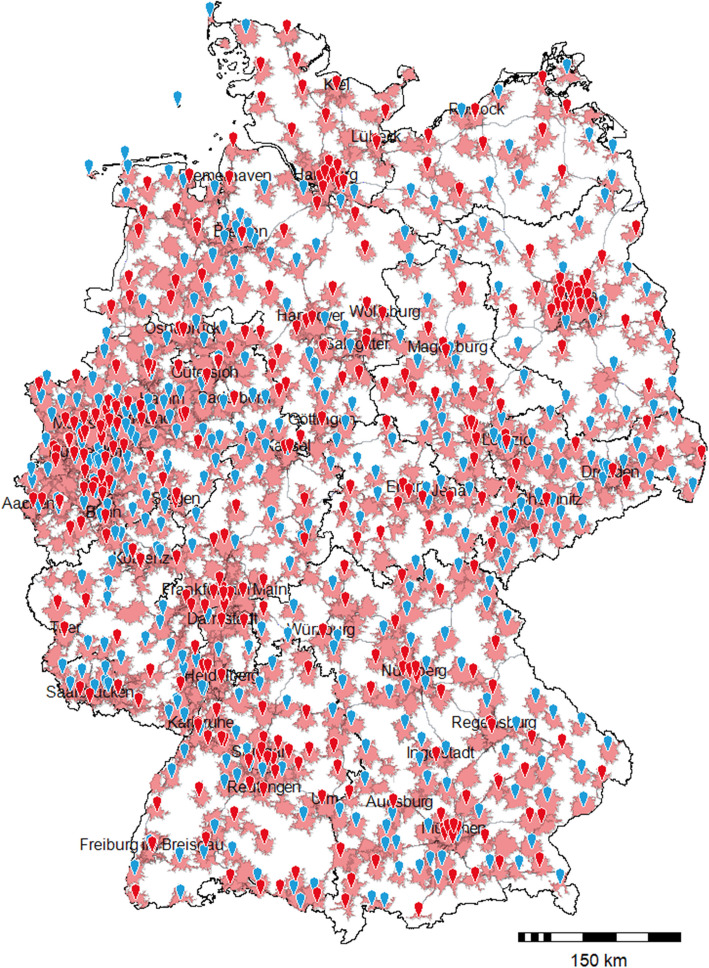
We conducted a nationwide cross-sectional analysis of all German hospitals classified under the Emergency Care Level system (ECL I-III). Using data from hospital quality reports, government registries, and satellite imagery, we assessed the availability and type of HEMS landing facilities, categorized as certified helipads or Public Interest Sites (PIS). The study aimed to map and characterize the emergency care hospital and HEMS infrastructure, identify associated hospital and regional factors, and assess spatial access and data completeness through targeted analyses.
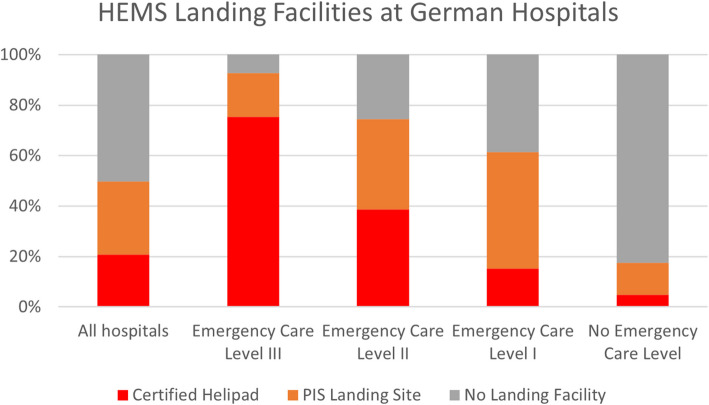
Of 1,037 emergency care hospitals, 69.6% have a designated landing facility, with 44.0% of these featuring a certified helipad and 56.0% relying on PIS. A substantial proportion of hospitals (30.4%) lack any HEMS landing facility, especially in urban areas. Certified helipads are more prevalent at higher-tier emergency hospitals (ECL II and III) but no landing facility is available at 18.3% of these facilities, particularly in metropolitan regions. Hospitals in rural areas are more likely to have a HEMS landing facility.
Despite the crucial role of HEMS in emergency medical care, nearly one-third of Germany's emergency care hospitals lack designated landing facilities, with PIS still outnumbering certified helipads. This reflects structural and regulatory shortcomings that may compromise timely access to specialized care. Enhancing national oversight, modernizing infrastructure, and adopting harmonized European standards are key measures to ensure reliable aeromedical access - and to improve patient outcomes across borders.
医疗保健系统正日益朝着专业化和集中化转变。因此,急诊患者与合适的急诊医院之间的距离在增加,医院之间进行院际转运的距离也在增加。直升机紧急医疗服务(HEMS)对于维持公平的急诊医疗服务可及性至关重要,尤其是在农村地区。然而,医院的直升机紧急医疗服务降落基础设施的可用性和质量在很大程度上仍未得到研究。本研究首次对急诊医院和直升机紧急医疗服务降落设施分布进行了全国范围的综合测绘与分析。
我们对所有按照急诊护理级别系统(ECL I - III)分类的德国医院进行了全国性横断面分析。利用医院质量报告、政府登记处和卫星图像的数据,我们评估了直升机紧急医疗服务降落设施的可用性和类型,分为认证直升机停机坪或公共利益场地(PIS)。该研究旨在绘制急诊医院和直升机紧急医疗服务基础设施的地图并描述其特征,识别相关的医院和区域因素,并通过针对性分析评估空间可及性和数据完整性。
在1037家急诊医院中,69.6%有指定的降落设施,其中44.0%设有认证直升机停机坪,56.0%依赖公共利益场地。相当一部分医院(30.4%)没有任何直升机紧急医疗服务降落设施,尤其是在城市地区。认证直升机停机坪在较高层级的急诊医院(ECL II和III)中更为普遍,但这些设施中有18.3%没有降落设施,特别是在大都市地区。农村地区的医院更有可能拥有直升机紧急医疗服务降落设施。
尽管直升机紧急医疗服务在急诊医疗中起着关键作用,但德国近三分之一的急诊医院缺乏指定的降落设施,公共利益场地的数量仍然超过认证直升机停机坪。这反映了可能会影响及时获得专科护理的结构和监管缺陷。加强国家监管、使基础设施现代化以及采用统一的欧洲标准是确保可靠的空中医疗服务可及性以及改善跨境患者治疗结果的关键措施。