Parenmark Fredric, Walther Sten M
Centre for Research and Development, Uppsala University, Region Gävleborg, Gävle, Sweden.
Department of Anaesthesia and Intensive Care, Gävle Hospital, Gävle, Sweden.
Ann Intensive Care. 2022 Apr 4;12(1):31. doi: 10.1186/s13613-022-01003-x.
Transfers from one intensive care unit (ICU) to another ICU are associated with increased length of intensive care and hospital stay. Inter-hospital ICU transfers are carried out for three main reasons: clinical transfers, capacity transfers and repatriations. The aim of the study was to show that different ICU transfers differ in risk-adjusted mortality rate with repatriations having the least risk.
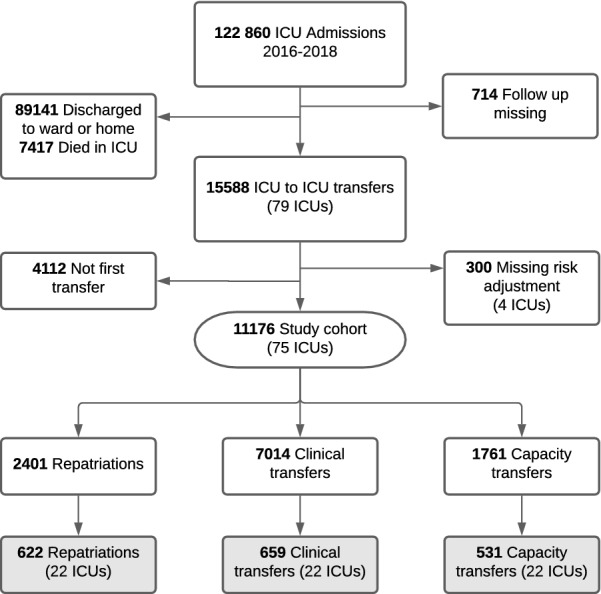
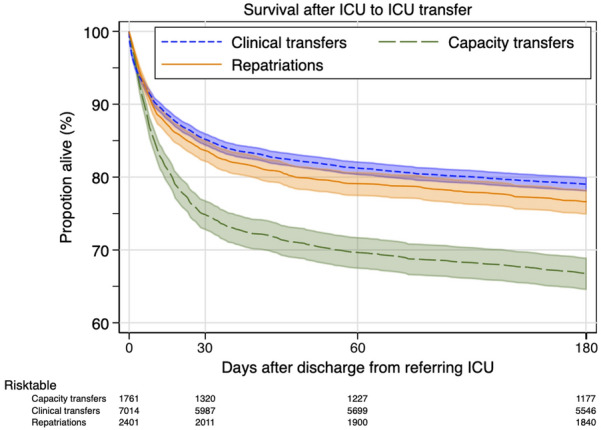
Observational cohort study of adult patients transferred between Swedish ICUs during 3 years (2016-2018) with follow-up ending September 2019. Primary and secondary end-points were survival to 30 days and 180 days after discharge from the first ICU. Data from 75 ICUs in the Swedish Intensive Care Register, a nationwide intensive care register, were used for analysis (89% of all Swedish ICUs), covering local community hospitals, district general hospitals and tertiary care hospitals. We included adult patients (16 years or older) admitted to ICU and subsequently discharged by transfer to another ICU. Only the first admission was used. Exposure was discharge to any other ICU (ICU-to-ICU transfer), whether in the same or in another hospital. Transfers were grouped into three predefined categories: clinical transfer, capacity transfer, and repatriation. We identified 15,588 transfers among 112,860 admissions (14.8%) and analysed 11,176 after excluding 4112 repeat transfer of the same individual and 300 with missing risk adjustment. The majority were clinical transfers (62.7%), followed by repatriations (21.5%) and capacity transfers (15.8%). Unadjusted 30-day mortality was 25.0% among capacity transfers compared to 14.5% and 16.2% for clinical transfers and repatriations, respectively. Adjusted odds ratio (OR) for 30-day mortality were 1.25 (95% CI 1.06-1.49 p = 0.01) for capacity transfers and 1.17 (95% CI 1.02-1.36 p = 0.03) for clinical transfers using repatriation as reference. The differences remained 180 days post-discharge.
There was a large proportion of ICU-to-ICU transfers and an increased odds of dying for those transferred due to other reasons than repatriation.
从一个重症监护病房(ICU)转至另一个ICU与重症监护时长和住院时间的增加相关。医院间ICU转运会出于三个主要原因进行:临床转运、容量转运和遣返。本研究的目的是表明不同类型的ICU转运在风险调整后的死亡率方面存在差异,其中遣返的风险最低。
对2016年至2018年3年间在瑞典各ICU之间转运的成年患者进行观察性队列研究,随访截至2019年9月。主要和次要终点分别是从首个ICU出院后30天和180天的生存率。来自瑞典重症监护登记处(一个全国性的重症监护登记系统)中75家ICU的数据用于分析(占瑞典所有ICU的89%),涵盖当地社区医院、地区综合医院和三级医疗机构。我们纳入了入住ICU并随后通过转至另一个ICU而出院的成年患者(16岁及以上)。仅使用首次入院的数据。暴露因素是转至任何其他ICU(ICU间转运),无论在同一家医院还是另一家医院。转运被分为三个预先定义的类别:临床转运、容量转运和遣返。我们在112,860例入院患者中识别出15,588例转运(14.8%),在排除4112例同一患者的重复转运和300例风险调整缺失的病例后,对11,176例进行了分析。大多数是临床转运(62.7%),其次是遣返(21.5%)和容量转运(15.8%)。容量转运患者未调整的30天死亡率为25.0%,而临床转运和遣返患者分别为14.5%和16.2%。以遣返为参照,容量转运30天死亡率的调整优势比(OR)为1.25(95%置信区间1.06 - 1.49,p = 0.01),临床转运为1.17(95%置信区间1.02 - 1.36,p = 0.03)。出院180天后差异依然存在。
ICU间转运的比例很大,因遣返以外的其他原因转运的患者死亡几率增加。