Vieira-Sousa Elsa, Ávila-Ribeiro Pedro, Fonseca João Eurico
Faculdade de Medicina, Universidade de Lisboa, Centro Académico de Medicina de Lisboa, Lisboa, Portugal.
Rheumatology Department, Hospital de Santa Maria, Unidade Local de Saúde de Santa Maria, Centro Académico de Medicina de Lisboa, Lisboa, Portugal.
Front Med (Lausanne). 2025 Jun 3;12:1576411. doi: 10.3389/fmed.2025.1576411. eCollection 2025.
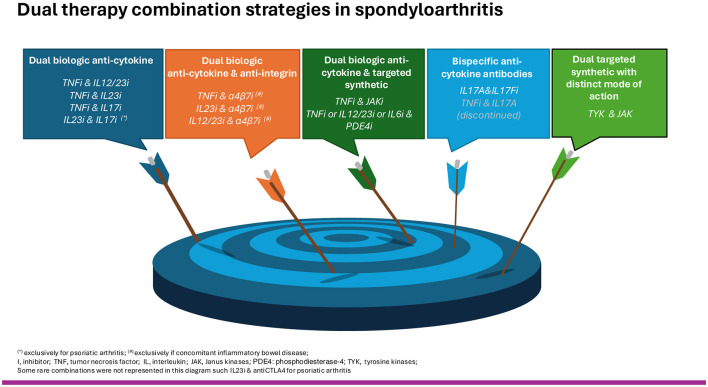
Spondyloarthritis (SpA) is a phenotypically heterogeneous group of diseases that share genetic and immune-mediated inflammatory pathways, affecting various organs/and tissues such as the synovium, enthesis, bone marrow, skin, eye, and bowel. Advances in understanding tissue-specific cytokine imbalance in SpA have unveiled an opportunity to foster higher remission rates through a more tailored cytokine blockade. Furthermore, over the years, the accumulated knowledge of the safety profile of approved anti-cytokine treatments has instilled confidence in considering the combination of two cytokine blockade agents for more severe musculoskeletal (MSK) or extra-MSK manifestations/in refractory patients. The rationale for these dual-targeted therapy combination strategies has largely depended on the predominant SpA manifestations and the known efficacy of these therapeutics in monotherapy. More recently, the addition of a targeted synthetic (ts) to a biologic (b) disease-modifying anti-rheumatic drug (DMARD) has also been considered. Additionally, newer bispecific anti-cytokine antibodies and tsDMARDs with dual mechanisms of action have been developed and assessed. Despite limited evidence from randomized controlled trials, real-world data from retrospective cohorts and case series/reports indicate that b/tsDMARD combinations are being used in clinical practice to overcome efficacy limitations of b/tsDMARD monotherapies in more severe either/or difficult-to-treat SpA patients, particularly in the presence of extra-MSK recalcitrant manifestations such as inflammatory bowel disease or psoriasis.
脊柱关节炎(SpA)是一组表型异质性疾病,具有共同的遗传和免疫介导的炎症途径,可影响各种器官和组织,如滑膜、肌腱附着点、骨髓、皮肤、眼睛和肠道。对SpA中组织特异性细胞因子失衡认识的进展揭示了通过更有针对性的细胞因子阻断提高缓解率的机会。此外,多年来,对已批准的抗细胞因子治疗安全性概况的积累知识,使人们有信心考虑将两种细胞因子阻断剂联合用于更严重的肌肉骨骼(MSK)或MSK外表现/难治性患者。这些双靶点治疗联合策略的基本原理很大程度上取决于主要的SpA表现以及这些疗法在单药治疗中的已知疗效。最近,也有人考虑在生物性(b)疾病改善抗风湿药物(DMARD)中添加靶向合成(ts)药物。此外,还开发并评估了具有双重作用机制的新型双特异性抗细胞因子抗体和tsDMARDs。尽管随机对照试验的证据有限,但回顾性队列研究以及病例系列/报告中的真实世界数据表明,b/tsDMARD联合疗法正在临床实践中用于克服b/tsDMARD单药治疗在更严重或难治性SpA患者中的疗效局限性,特别是在存在炎症性肠病或银屑病等MSK外顽固性表现的情况下。